
Substrate provided with alignment film and liquid crystal display device
a technology alignment film, which is applied in the direction of instruments, transportation and packaging, coatings, etc., can solve the problems of continuous injection of carriers, increase in residual dc voltage, and reduction of voltage holding ratio of liquid crystal display device, so as to achieve easy phase separation, reduce voltage holding ratio (vhr), and increase residual dc voltage (rdc).
- Summary
- Abstract
- Description
- Claims
- Application Information
AI Technical Summary
Benefits of technology
Problems solved by technology
Method used
Image

Examples
embodiment 1
[0096]Another aspect of the present invention relates to a liquid crystal display device including, in the given order: an array substrate including a pixel electrode; an alignment film in contact with the pixel electrode; a liquid crystal layer containing a liquid crystal molecule, and a counter substrate including a counter electrode, the array substrate and the alignment film constituting a stack, the stack being the substrate provided with an alignment film of the present invention.
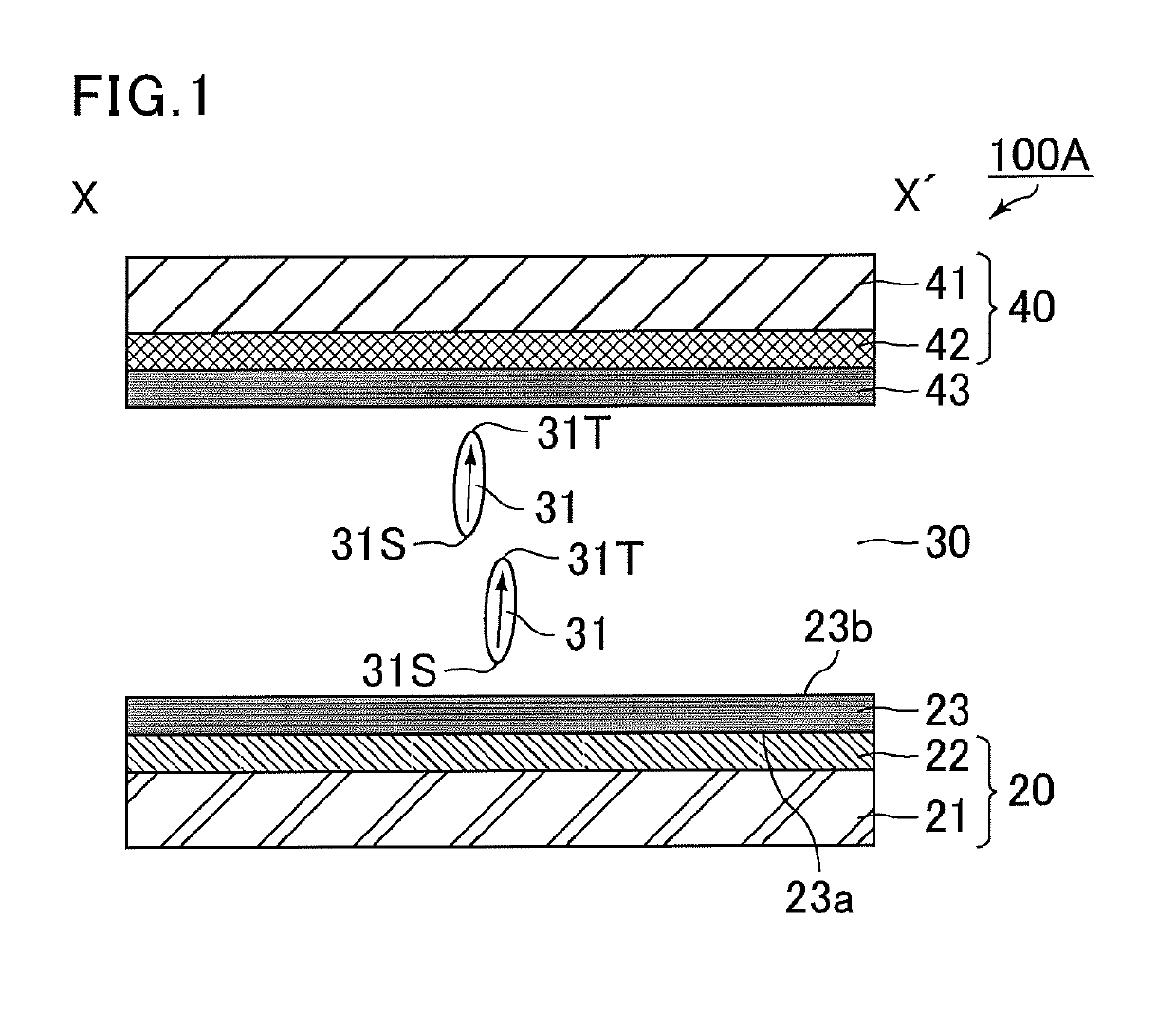
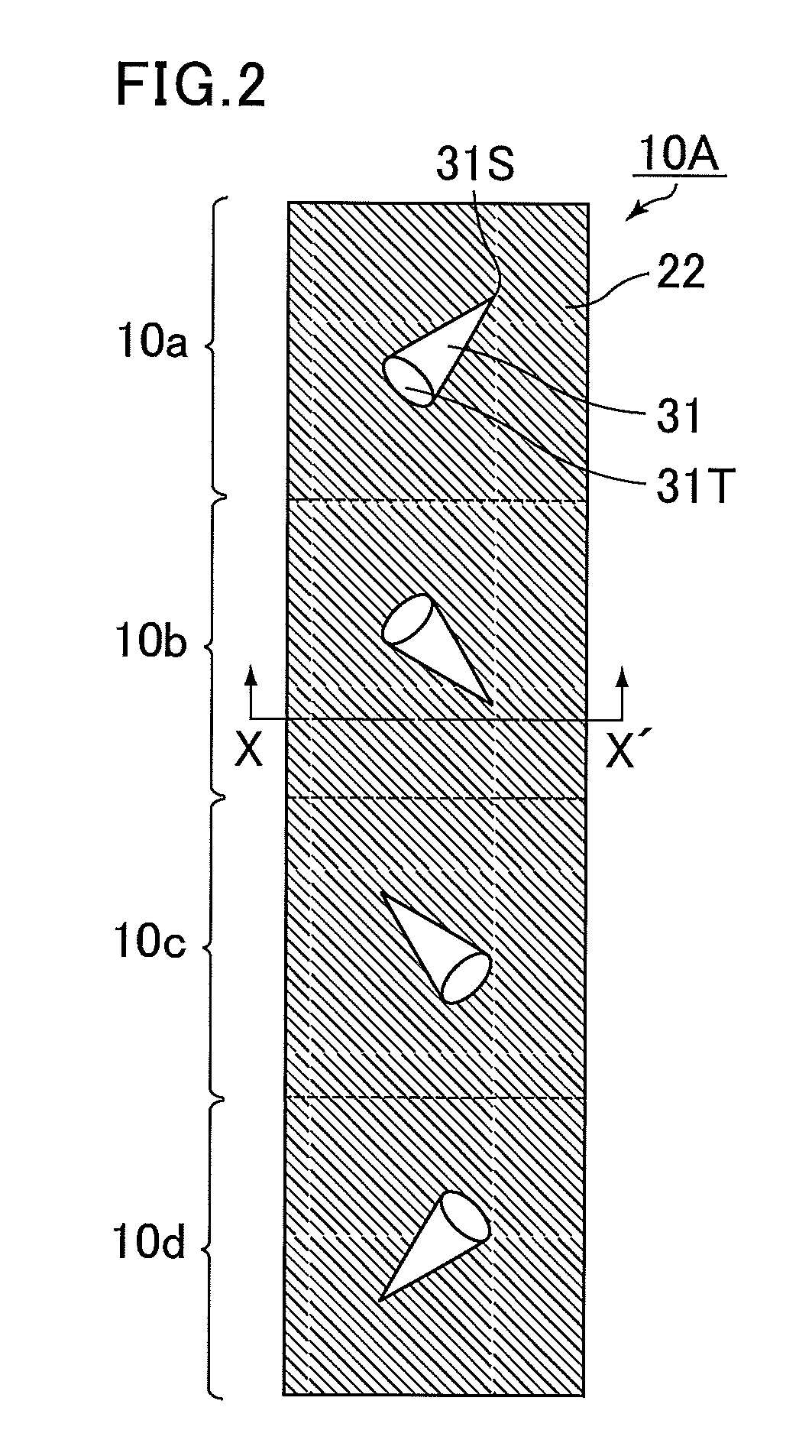
[0097]The following describes a liquid crystal display device 100A of Embodiment 1 referring to FIGS. 1 and 2. The liquid crystal display device 100A is a liquid crystal display device of a display mode in which a vertical electric field is generated between the pixel electrode provided on the array substrate and the counter electrode provided on the counter substrate when voltage is applied. Embodiment 1 relates to this display mode. Still, the display mode of the liquid crystal display device of the...
embodiment 2
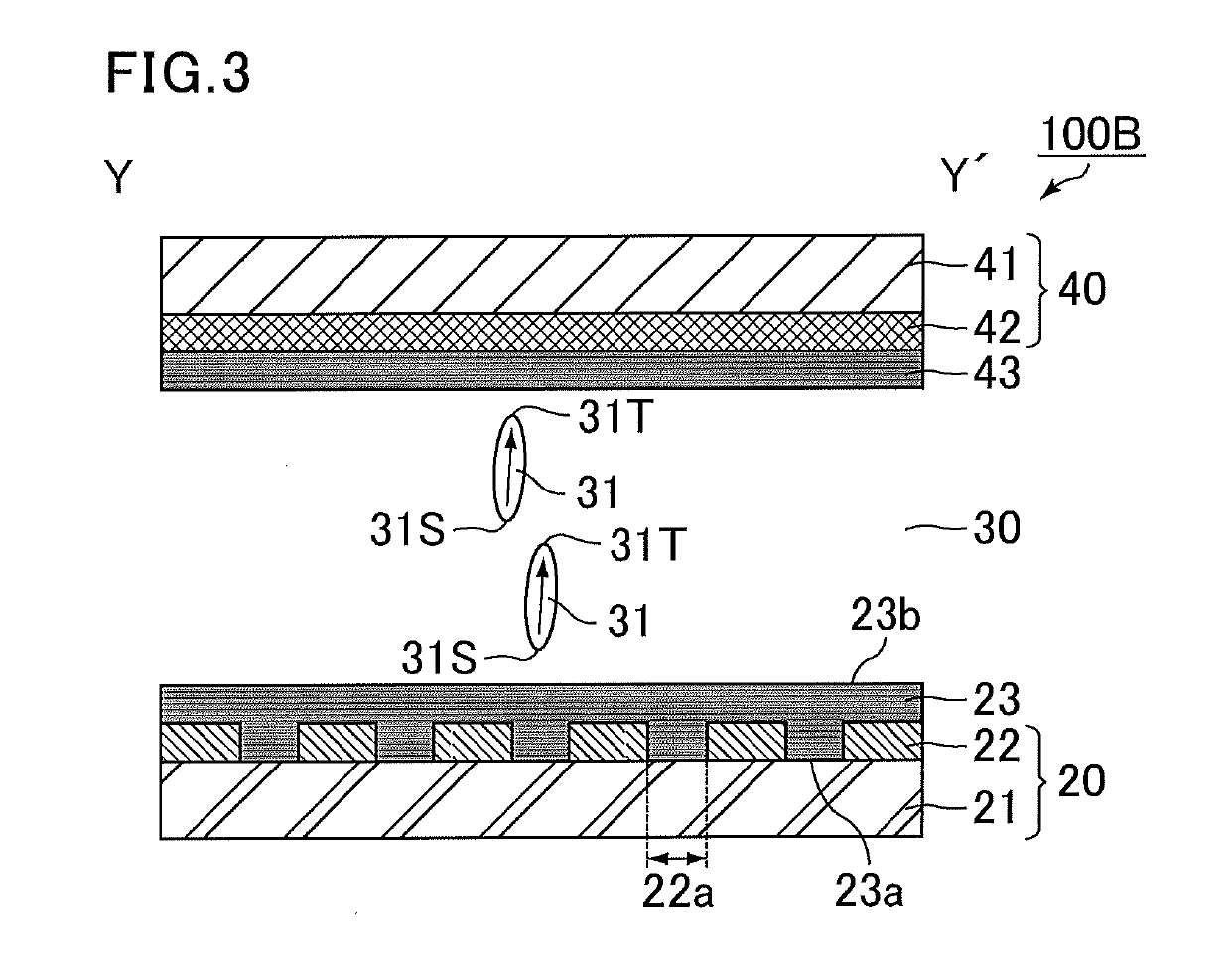
[0122]The following describes a liquid crystal display device 100B of Embodiment 2 referring to FIGS. 3 to 5. FIG. 3 is a schematic cross-sectional view of an example of a liquid crystal display device of Embodiment 2. FIG. 4 is a schematic plan view of an example of the liquid crystal display device of Embodiment 2. As illustrated in FIGS. 3 to 5, in Embodiment 2, the pixel electrode 22 is provided with slits 22a. The liquid crystal display device 100B has the same structure as the liquid crystal display device 100A of Embodiment 1, except that the pixel electrode 22 is provided with the slits 22a. The descriptions of the same features are therefore omitted here.
[0123]As illustrated in FIG. 4, in the liquid crystal display device 100B, one pixel 10B is divided into four alignment regions, i.e., the first domain 10a, the second domain 10b, the third domain 10c, and the fourth domain 10d. The alignment of liquid crystal molecules may be unstable and the transmissivity may be reduced ...
example 1-1
(Synthesis of Silsesquioxane-Containing Diamine)
[0131]The following describes an exemplary synthesis of silsesquioxane-containing diamine. First, as shown in the following reaction scheme (A), 3 g (13.3 mmol) of dinitrophenylacetic acid represented by the following formula (8) was dissolved in 20 mL of benzene. Thionyl chloride (SOCl2) was dropwise added thereto, whereby dinitrophenylacetyl chloride (12.1 mmol, yield: 91%) represented by the following formula (9) was synthesized. In the reaction schemes (A) to (C), the symbol “M.W.” beside each formula number means the weight average molecular weight.
[0132]Next, as shown in the following reaction scheme (B), a benzene solution (10 mL) containing 2.9 g (12 mmol) of dinitrophenylacetyl chloride (formula (9)) obtained in the reaction scheme (A) was dropwise added to a benzene solution (50 mL) containing 13 g (14 mmol) of heptaisobutyl-substituted PSS-[3-(2-aminoethyl)amino]propyl represented by the following formula (10) and 1.5 g (15 ...
PUM
| Property | Measurement | Unit |
|---|---|---|
| pre-tilt angle | aaaaa | aaaaa |
| mol % | aaaaa | aaaaa |
| pre-tilt angle | aaaaa | aaaaa |
Abstract
Description
Claims
Application Information
 Login to View More