Titanium Alloys
- Summary
- Abstract
- Description
- Claims
- Application Information
AI Technical Summary
Benefits of technology
Problems solved by technology
Method used
Image

Examples
example 1
i-1A
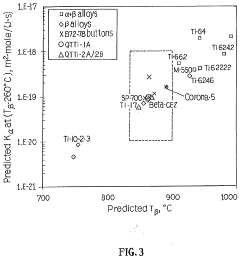
[0060]A melt was prepared with the nominal composition of 4.5 Al, 3.0 V, 2.0 Cr, 1.5 Mo, 1.0 Sn, 0.40 Fe, 0.15 O, and balance Ti, in wt %. As described above, this example alloy includes a variance in the constituents in the range of plus or minus ten percent of the mean (nominal) value. The alloy was cast partially by remelting foundry scrap of Ti 6-4, with appropriate alloying additions. The foundry scrap constituted at least about 75% of the casting. The casting weighed about 13 kg and measured about 15 cm in height, about 15 cm in width, and about 15 cm in depth. The alloy was subjected to a hot isostatic pressing at 900° C. and about 100 MPa in an argon atmosphere for 2 hours, slowly cooled to room temperature, then solutionized at 950° C. for 1 hour, and quenched with pressurized gas to room temperature at an estimate cooling rate of about 1° C. per second to about 2° C. per second. The pressure of the gas was about 2 atm. Kα was calculated as 9.3×10⁻²⁰ m2·mol / J·s. The ten...
example 2
i-1B
[0063]In preparing alloy QTTi-1B as a counter-example, a melt was prepared with the nominal composition of 4.5 Al, 3.0 V, 2.0 Cr, 1.5 Mo, 1.0 Sn, 0.40 Fe, 0.15 O, 0.01 B, and balance Ti, in wt %. The only intended difference from alloy QTTi-1A was an alloying addition of boron. As described above, this alloy includes a variance in the constituents in the range of plus or minus ten percent of the mean (nominal) value. The alloy was cast partially by remelting foundry scrap of Ti 6-4, with appropriate alloying additions. The foundry scrap constituted at least about 75% of the casting. The casting weighed about 13 kg and measured about 15 cm in height, about 15 cm in width, and about 15 cm in depth. The alloy was subjected to a hot isostatic pressing at 900° C. and about 100 MPa in an argon atmosphere for 2 hours, slowly cooled to room temperature, then solutionized at 950° C. for 1 hour, and quenched with pressurized gas to room temperature. The pressure of the gas was about 2 atm...
example 3
i-1C
[0064]In preparing alloy QTTi-1C as a counter-example, a melt was prepared with the nominal composition of 4.5 Al, 3.0 V, 2.0 Cr, 1.5 Mo, 1.0 Sn, 0.40 Fe, 0.15 O, 0.10 Y, and balance Ti, in wt %. The only intended difference from alloy QTTi-1A was an alloying addition of yttrium. The alloy was cast partially by remelting foundry scrap of Ti 6-4, with appropriate alloying additions. The foundry scrap constituted at least about 75% of the casting. The casting weighed about 13 kg and measured about 15 cm in height, about 15 cm in width, and about 15 cm in depth. The alloy was subjected to a hot isostatic pressing at 900° C. and about 100 MPa in an argon atmosphere for 2 hours, slowly cooled to room temperature, then solutionized at 950° C. for 1 hour, and quenched with gas to room temperature. The pressure of the argon gas was about 2 atm. The tensile strength and KQ comparison of the measured properties of alloy QTTi-1C and cast Ti 6-4 is shown in the following Table 3. Ytrrium is...
PUM
| Property | Measurement | Unit |
|---|---|---|
| Temperature | aaaaa | aaaaa |
| Temperature | aaaaa | aaaaa |
| Temperature | aaaaa | aaaaa |
Abstract
Description
Claims
Application Information
 Login to View More