

On-chip monitoring and calibration circuits for frequency modulated continuous wave lidar
a lidar and continuous wave technology, applied in the field of solid-state fmcw lidar systems, can solve the problems of long delay lines, unreliable, expensive, etc., and achieve the effects of reducing reducing the accuracy of lidar, and increasing the cost of fmcw lasers
- Summary
- Abstract
- Description
- Claims
- Application Information
AI Technical Summary
Benefits of technology
Problems solved by technology
Method used
Image



Examples
Embodiment Construction
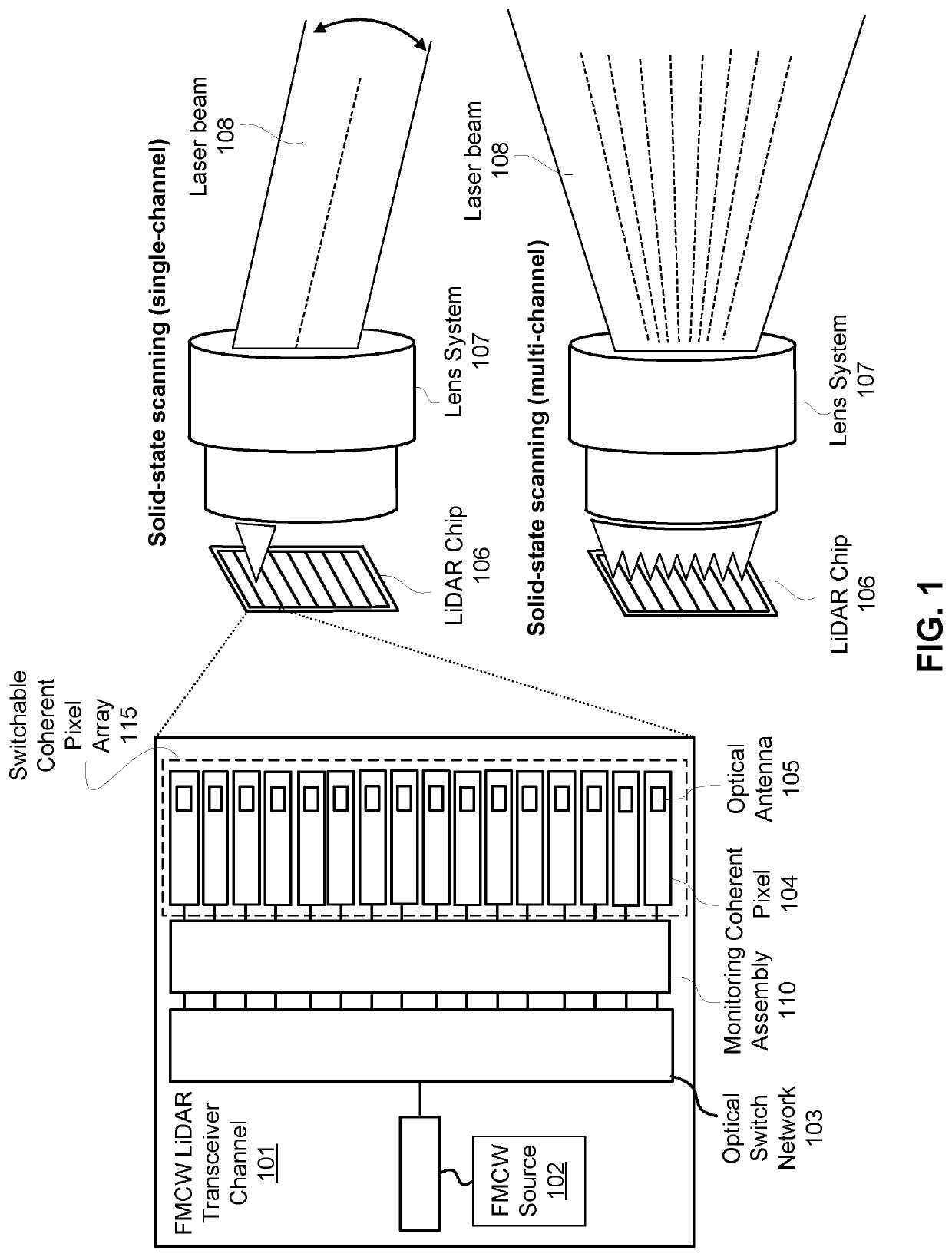
[0018]A solid state FMCW LiDAR system determines depth information (e.g., distance, velocity, acceleration, for one or more objects) for a field of view of the system. The solid state FMCW LiDAR directly measures range and velocity of an object by directing a frequency modulated, collimated light beam into a local area. The light that is reflected from an object within the local area, Signal, is mixed with a tapped version of the beam, referred to as the local oscillator (LO). The frequency of the resulting radiofrequency (RF) beat signal is proportional to the distance of the object from the solid state FMCW LiDAR system once corrected for the doppler shift that requires an additional measurement. The two measurements, which may or may not be performed at the same time, provide range and velocity information of the target.
[0019]The solid state FMCW LiDAR system uses on-chip monitoring and calibration circuits for achieving high-performance solid-state beam steering and laser chirpi...
PUM
 Login to View More
 Abstract
Description
Claims
Application Information
 Login to View More