
Optical system
- Summary
- Abstract
- Description
- Claims
- Application Information
AI Technical Summary
Benefits of technology
Problems solved by technology
Method used
Image

Examples
first embodiment
an optical system in accordance with this invention is described.
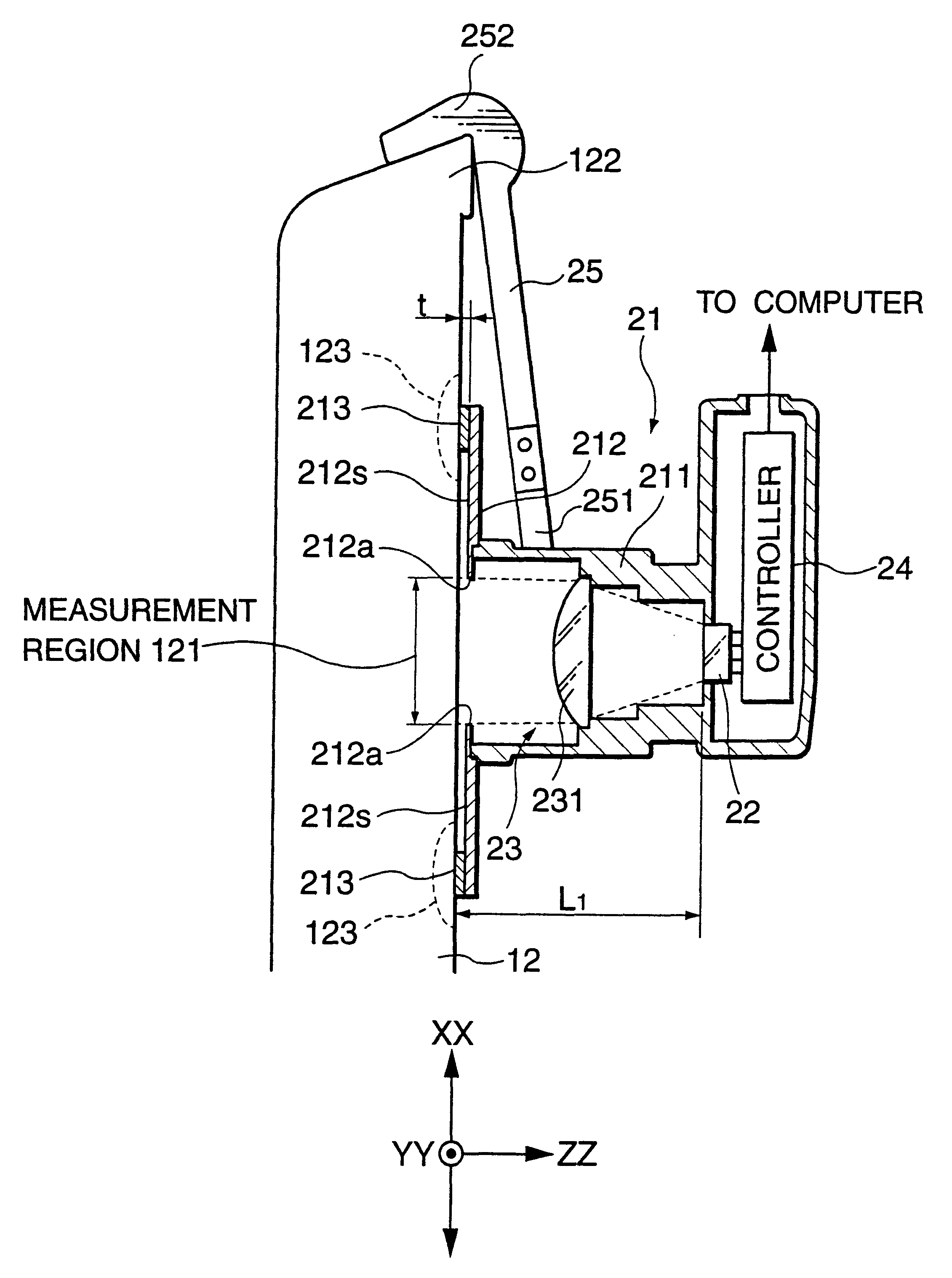
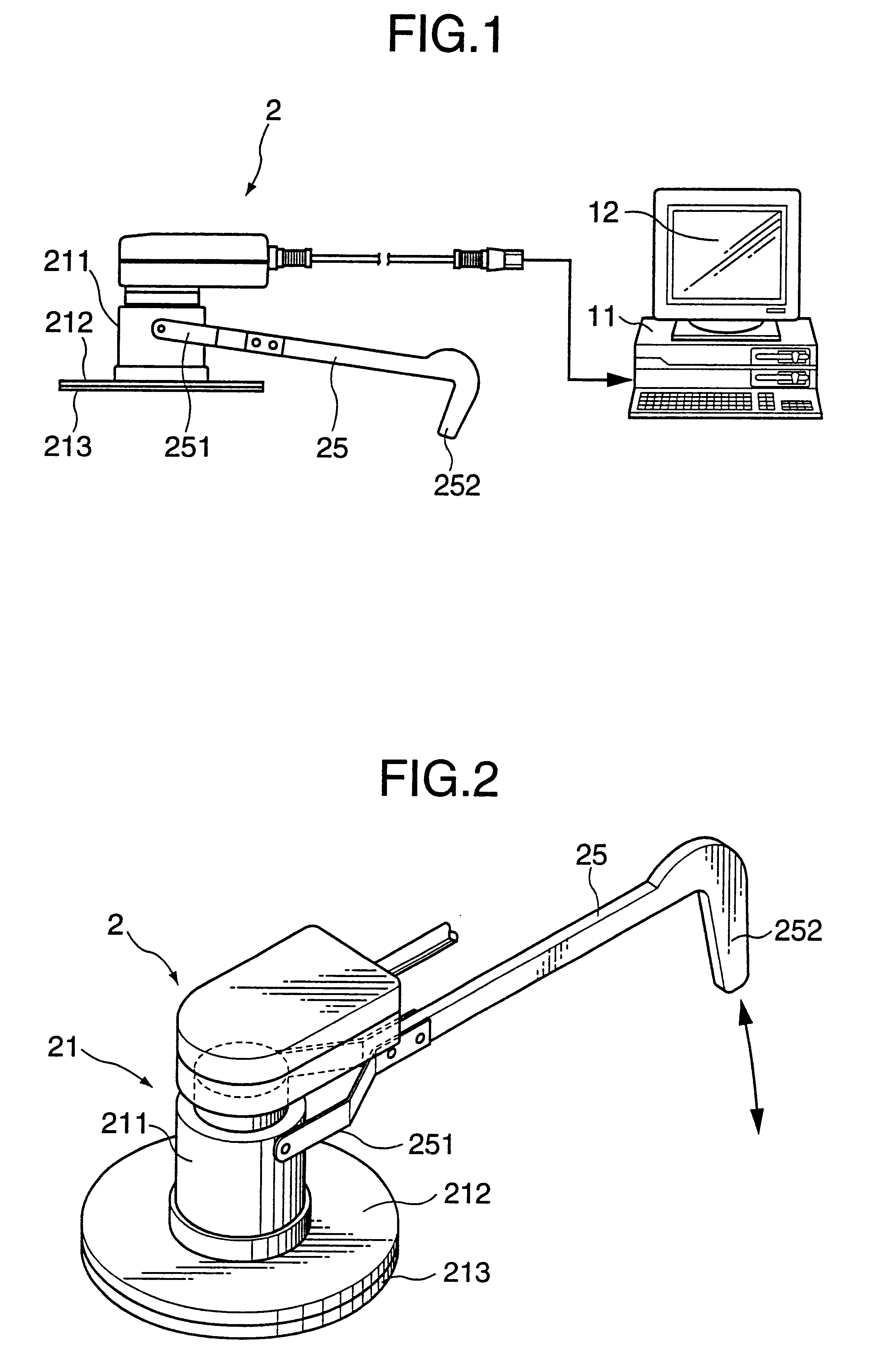
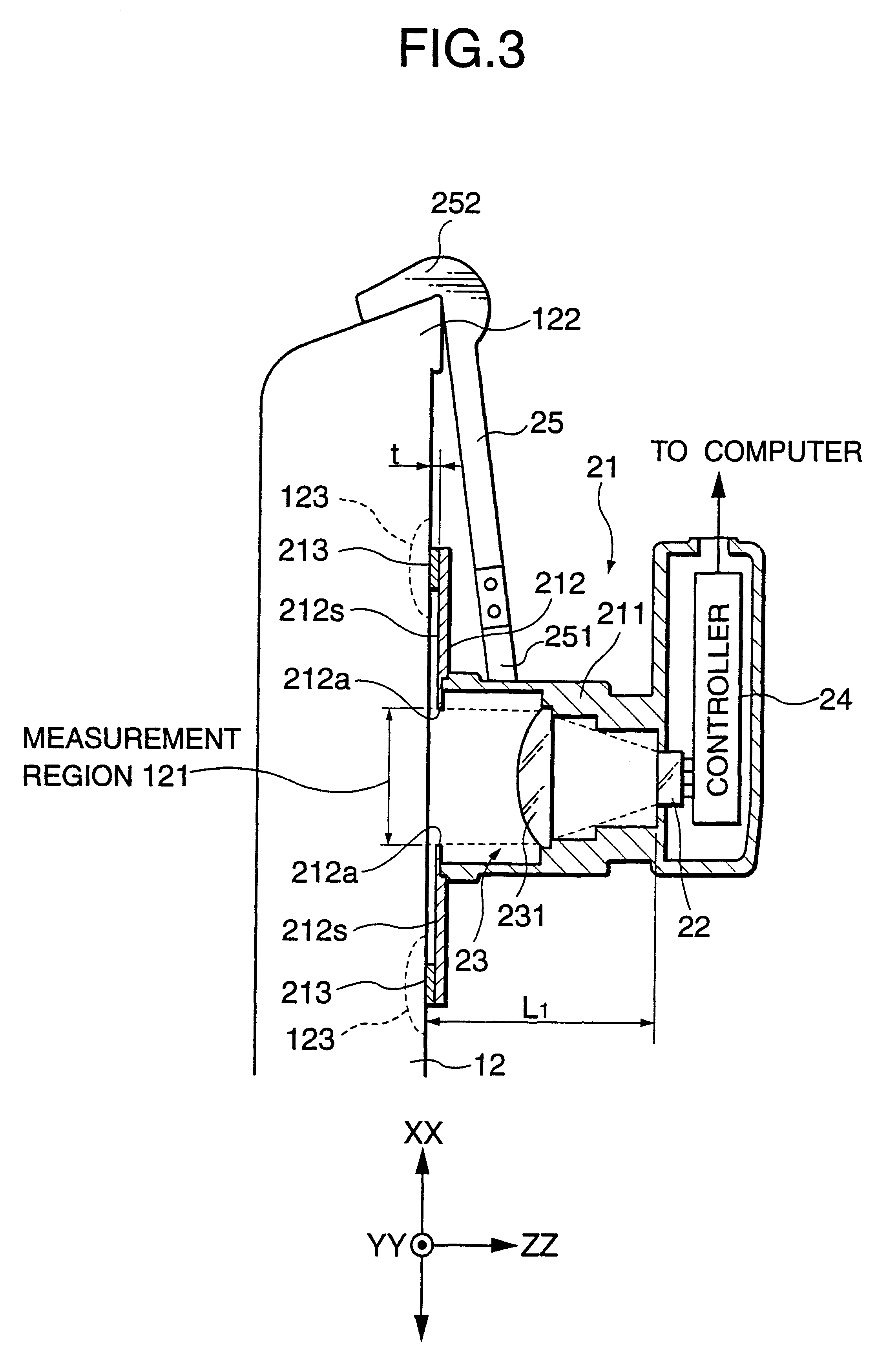
A calibration system of an LCD panel using an optical measuring apparatus with an optical system in accordance with the present invention is shown in FIG. 1. In the calibration system, an LCD panel 12 is electrically connected to a (personal) computer 11. Chromaticity, that is, tristimulus values of the LCD panel 12 is measured by an optical measuring apparatus 2, and result of measurement is inputted to the computer 11 through an interface such as RS232C and USB (Universal Serial Bus). The result of measurement is processed by a compensation program previously installed in the computer 11 for adjusting white balance of the LCD panel 12. As mentioned above, the light distribution of the LCD panel in the market generally varies from the symmetry in the vertical direction XX, but it is substantially symmetrical in the horizontal direction YY. Thus, it is assumed that the light distribution characteristics in the vertical...
second embodiment
the optical system 23 is shown in FIG. 10. In the second embodiment, any lens is used in the optical system 23. The distance between the opening 212a of the flange 212 and the photosensing plane RS of the photosensor 22 or the diameter of the opening 212a of the flange 212 is adjusted so that the ray emitted from, for example, the lower end 121b of the measurement region 121 with the maximum exit angle .alpha. reaches to the end of the photosensing plane RS of the photosensor 22.
third embodiment
the optical system 23 is shown in FIGS. 11 and 12. In the third embodiment shown in FIG. 11, a lens 232 having a focal length "f" is provided in a manner so that a principal point PP of the lens 232 in the object side is positioned at a position distant by a distance "f" from the measurement region 121, and the photosensing plane RS of the photosensor 22 is positioned at a position distant by a distance "f" from a principal point of the lens 232 in the image side. This configuration is generally called telecentric optical system in which the photosensor 22 serves as an aperture stop of the optical system 23.
As shown in FIG. 12, only the rays emitted from the measurement region 121 and having the exit angle equal to or larger than a predetermined angle .beta. and equal to or smaller than the maximum exit angle .alpha. reach to the photosensitive portion 221 to 224 of the photosensor 22. The exit angles .alpha. and .beta. depend on the focal length "f" of the lens 232 and the configur...
PUM
 Login to View More
 Abstract
Description
Claims
Application Information
 Login to View More