
Control device and method for a diesel engine and diesel engine
- Summary
- Abstract
- Description
- Claims
- Application Information
AI Technical Summary
Benefits of technology
Problems solved by technology
Method used
Image

Examples
first embodiment
The present invention will be described below in connection with a diesel engine of the common rail system.
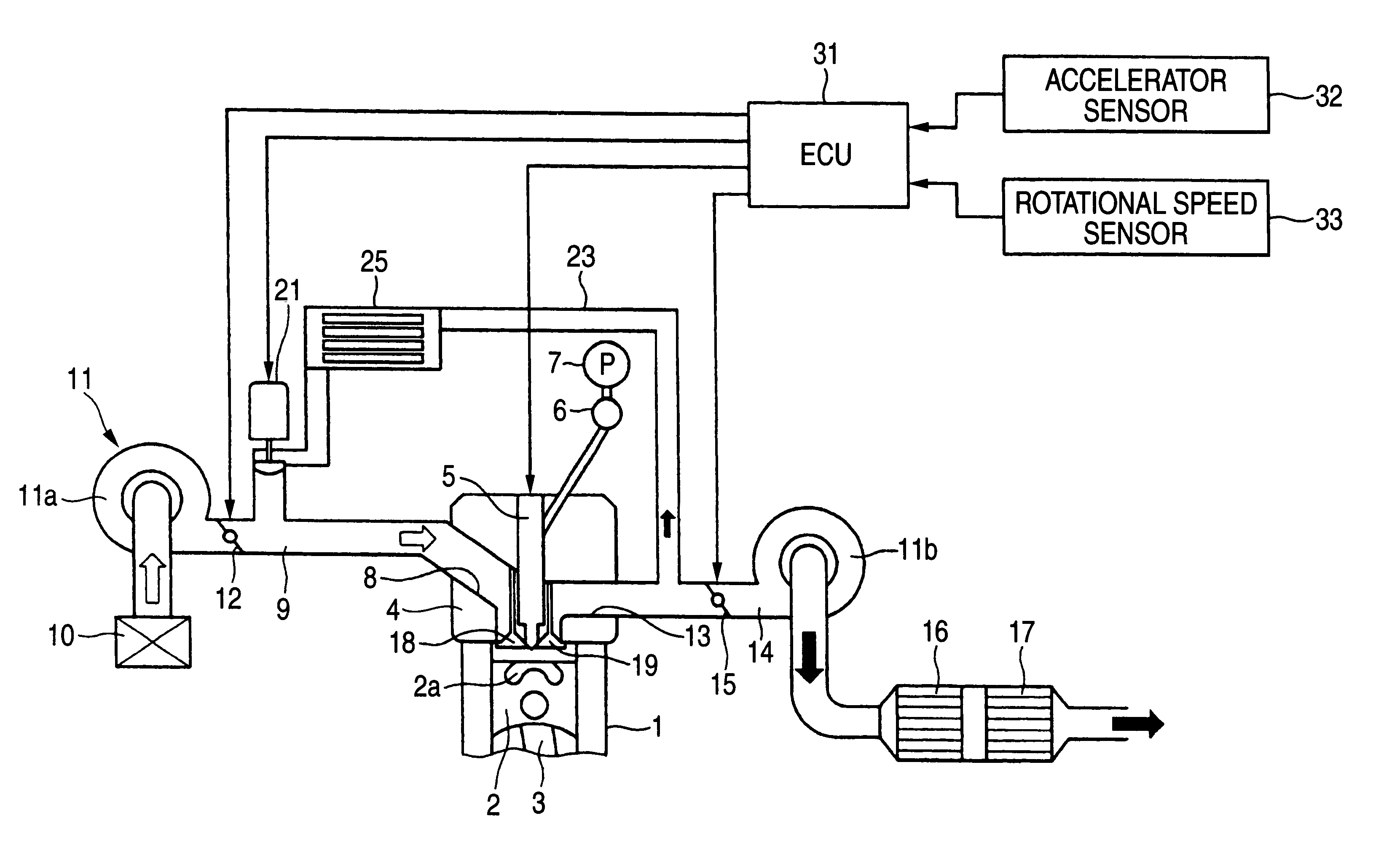
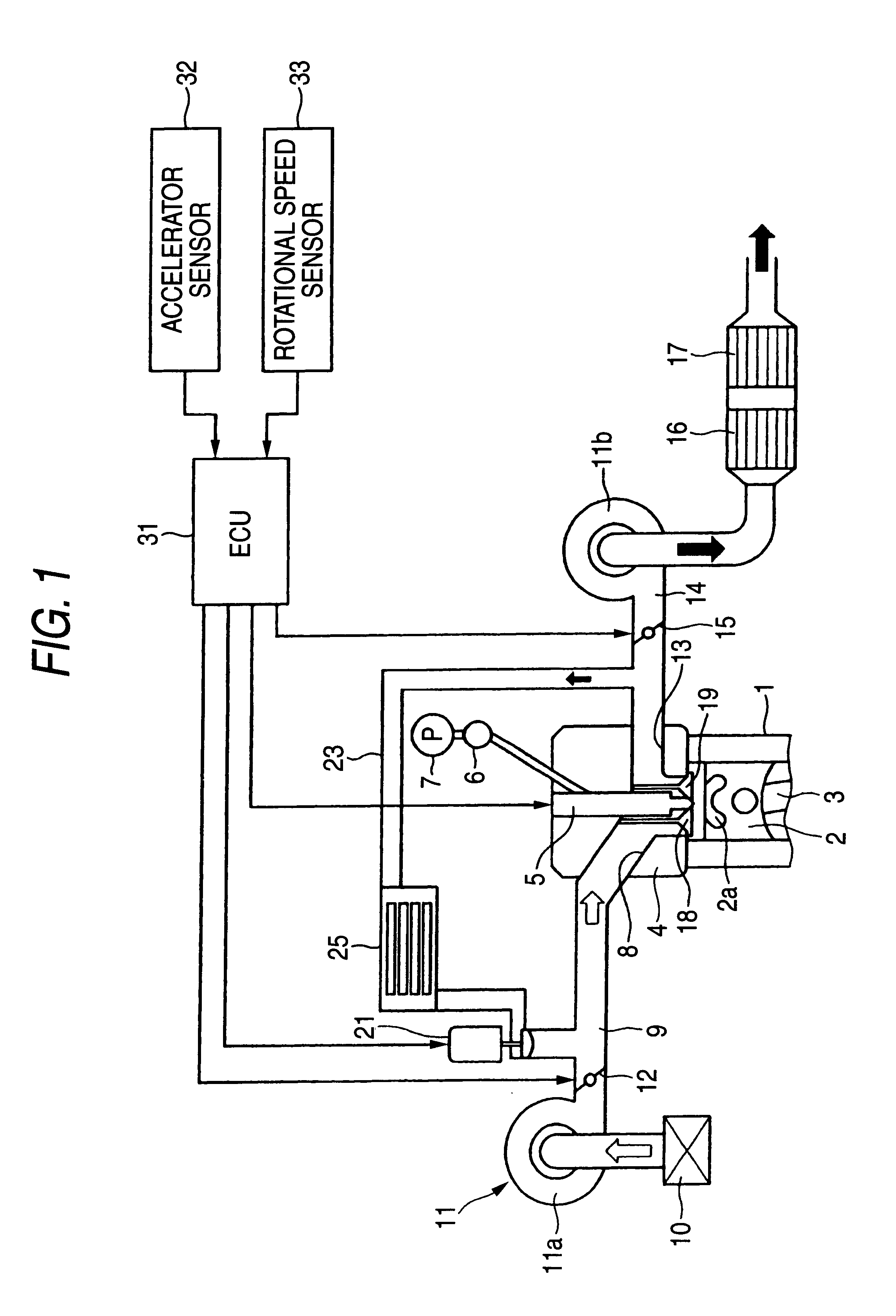
FIG. 1 is an overall constitutional view of the diesel engine according to the first embodiment. In FIG. 1, one-cylinder of the diesel engine is represented, in which a piston 2 disposed within a cylinder block 1 is connected via a connecting rod 3 to a crankshaft (not shown). In a cylinder head 4 of the engine, a fuel injection valve 5 is disposed to be confronted into the cylinder, and connected to a common rail 6 that is common to each cylinder. A fuel pump 7 is connected to the common rail 6 so that a high pressure fuel supplied from the fuel pump 7 is reserved within the common rail 6.
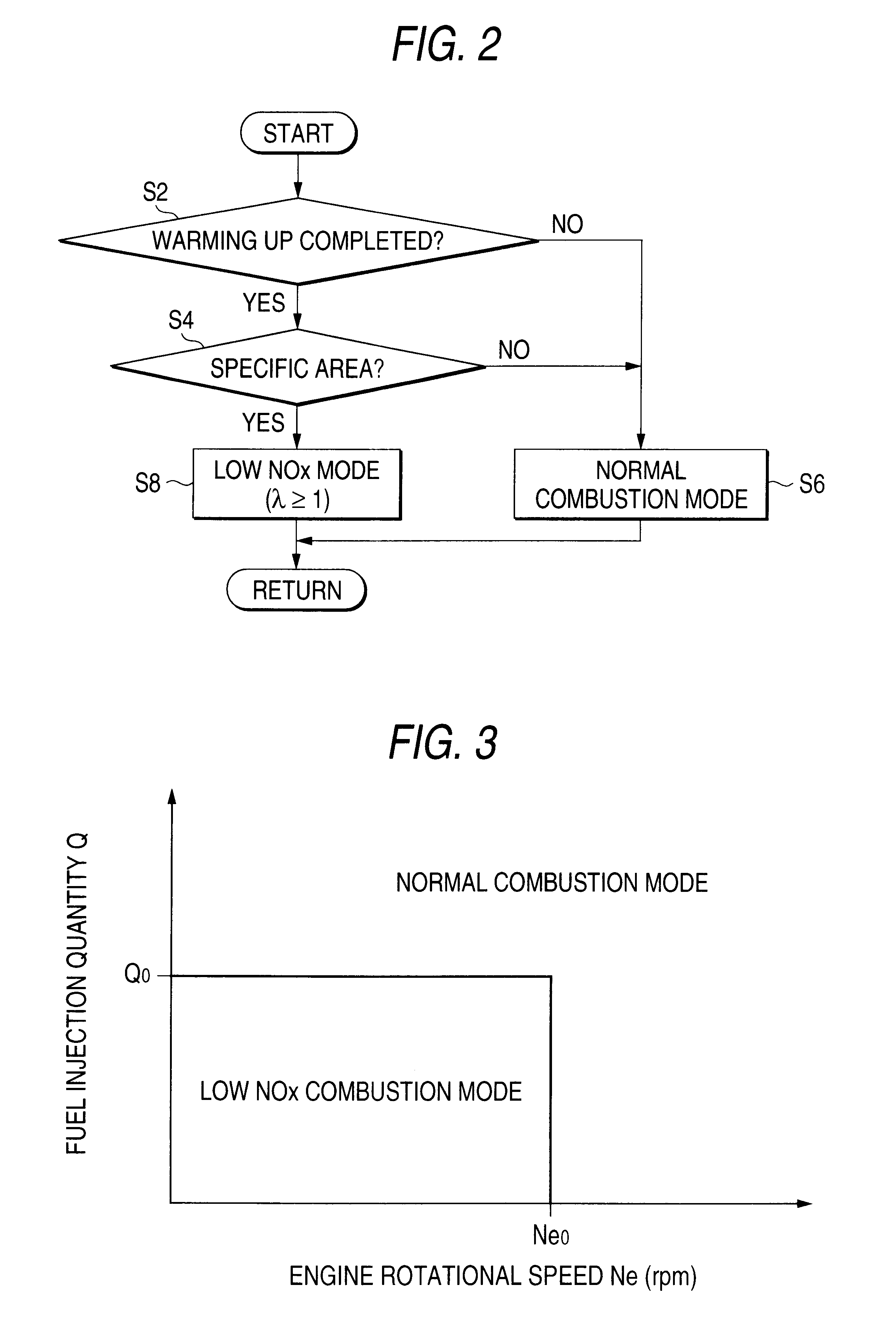
The fuel injection valve 5 is opened at a predetermined timing near the top dead center of compression, so that a high pressure fuel within the common rail 6 is injected from the fuel injection valve 5 to a cavity 2a in the head portion of the piston, ignited and combusted in the compressed a...
second embodiment
A second embodiment of the diesel engine embodying the present invention will be described below. The diesel engine of this embodiment is different from that of the first embodiment, in that a process of purging NOx occluded into the NO.sub.x catalyst 16 is additionally provided. Other parts are common. Hence, the description for the common parts is omitted, and different points are mainly explained.
In the low NO.sub.x combustion mode, the NO.sub.x emission is reduced, but the complete exhaust suppression is difficult. On the other hand, in the normal combustion mode, the NO.sub.x exhaust characteristics of the typical diesel engine are attained, whereby the exhausted NO.sub.x is occluded into the NO.sub.x catalyst 16, and prevented from being exhausted into the atmosphere. Thus, when the low NO.sub.x combustion mode is executed, the process of discharging and reducing NO.sub.x occluded into the NO.sub.x catalyst 16 is required. In this embodiment, NO.sub.x is purged by executing an...
PUM
 Login to View More
 Abstract
Description
Claims
Application Information
 Login to View More