
Shock absorber
a technology of shock absorber and shock absorber, which is applied in the direction of braking discs, slip couplings, gearing, etc., can solve the problems of reducing the lifetime of the shock absorber, too abrupt change of friction factor to control the transmission torque, and inability to supply sufficient grease to the sliding surface of the disk
- Summary
- Abstract
- Description
- Claims
- Application Information
AI Technical Summary
Benefits of technology
Problems solved by technology
Method used
Image

Examples
first embodiment
[0040
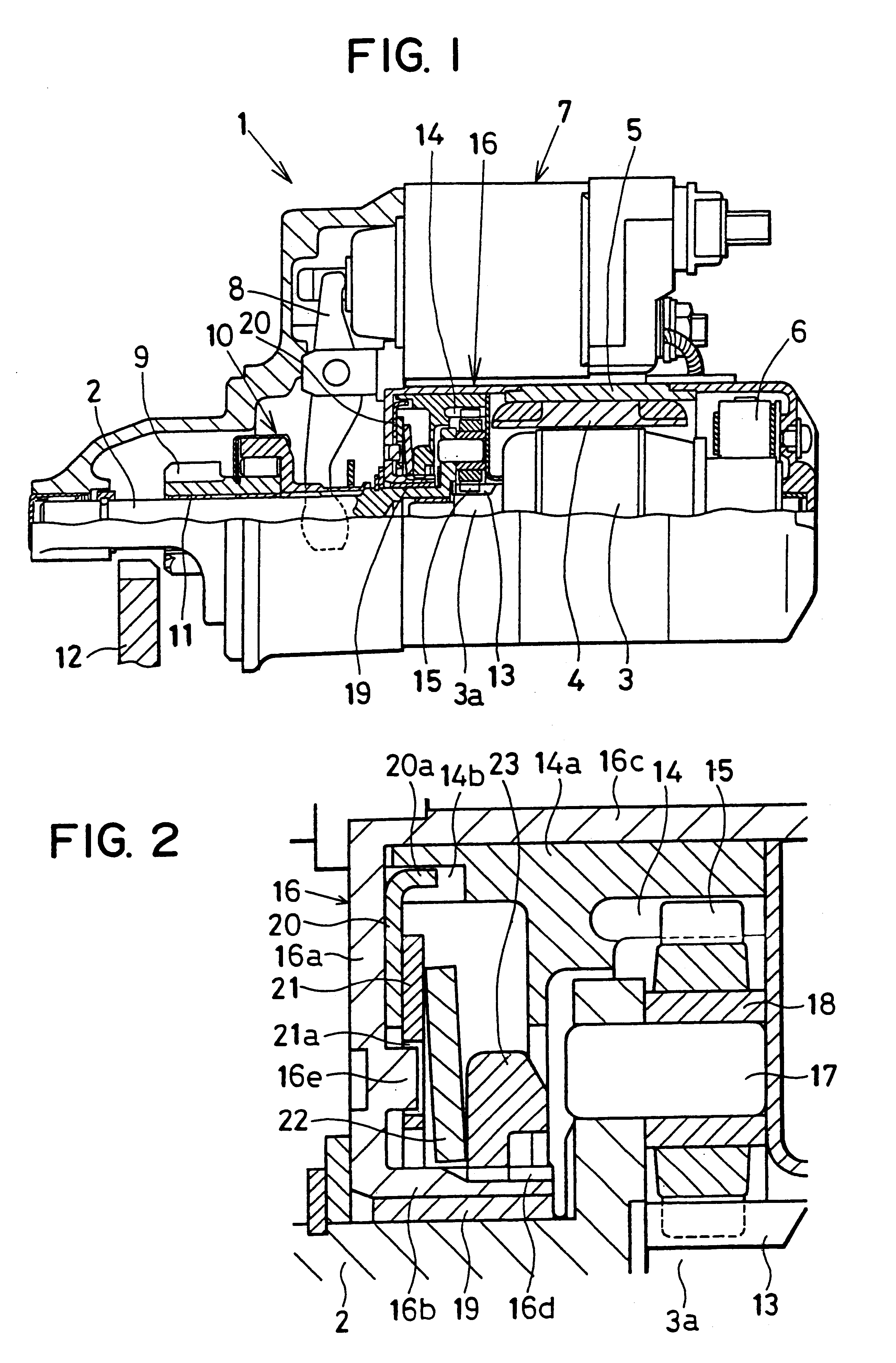
[0041]Shock absorber according to a first embodiment of the invention that is mounted into a starter is described with reference to FIGS. 1-4.
[0042]As shown in FIG. 1, starter 1 includes a speed reduction unit, output shaft 2 and a shock absorber according to a first embodiment of the invention. The speed reduction unit reduces the rotation speed of later described starter motor and transmits it to output shaft 2. The shock absorber absorbs an excessive torque or a shock applied to the speed reduction unit.
[0043]The starter motor is a well-known DC motor that is comprised of armature 3, stator poles 4, yoke 5 and brushes 6. When a key switch is turned on and a pair of internal contacts of magnet switch 7 is closed, armature 3 is energized through brushes 6 to rotate.
[0044]Magnet switch 7 opens or closes the internal contacts as a plunger (not shown) moves to drive pinion gear 9, together with one-way clutch 10, back and forth.
[0045]Pinion gear 9 is slidably fitted to the outer ...
second embodiment
[0072
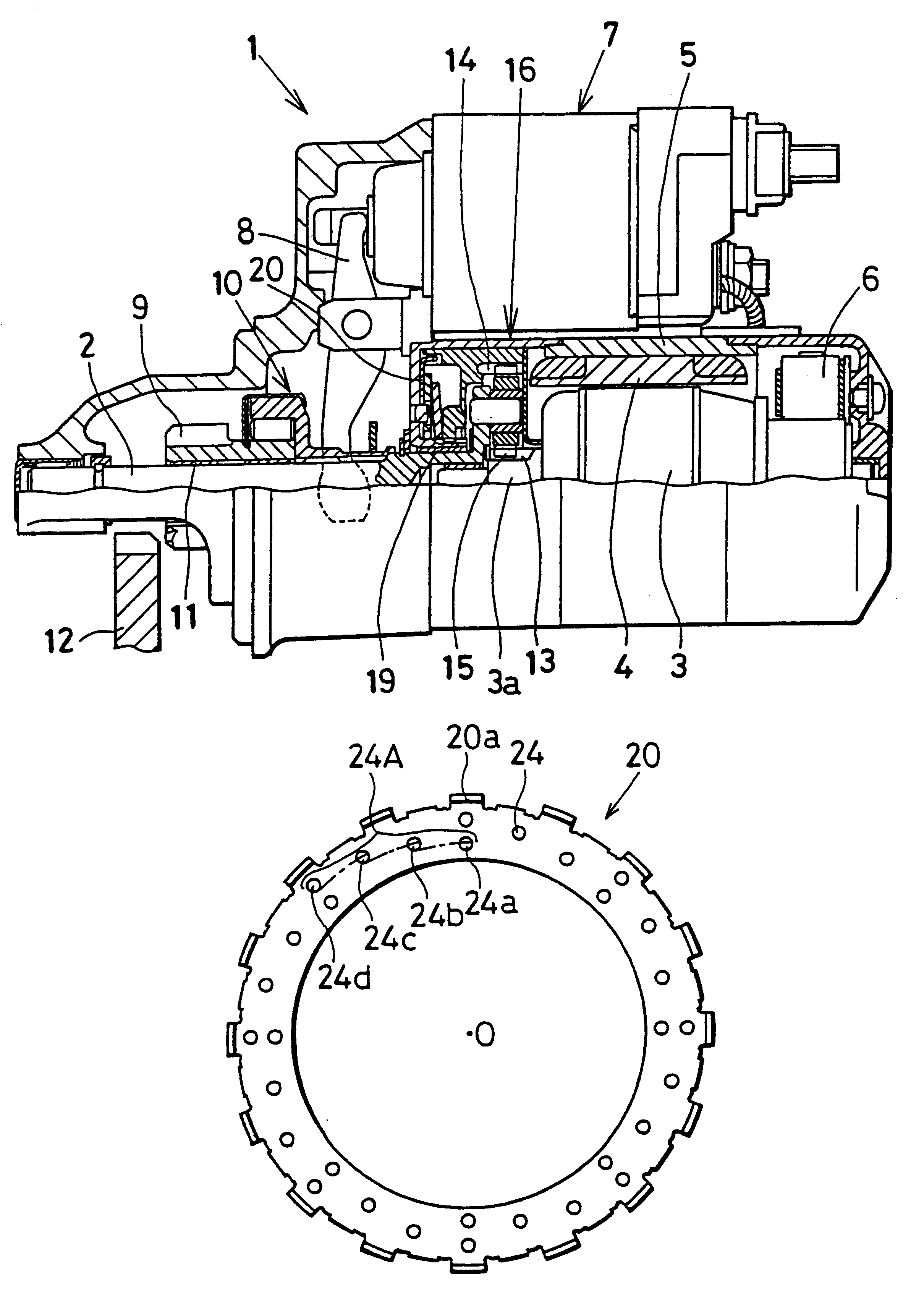
[0073]A shock absorber according to a second embodiment of the invention will be described with reference to FIGS. 5A and 5B.
[0074]Rotary disk 20 is a press-formed metal ring. Rotary disk 20 is disposed in contact with front wall 16a and is detained in internal gear 14 by a plurality of claws 20a, which are formed at the circumference of outer wall 14a, respectively inserted into the plurality of recesses 14b.
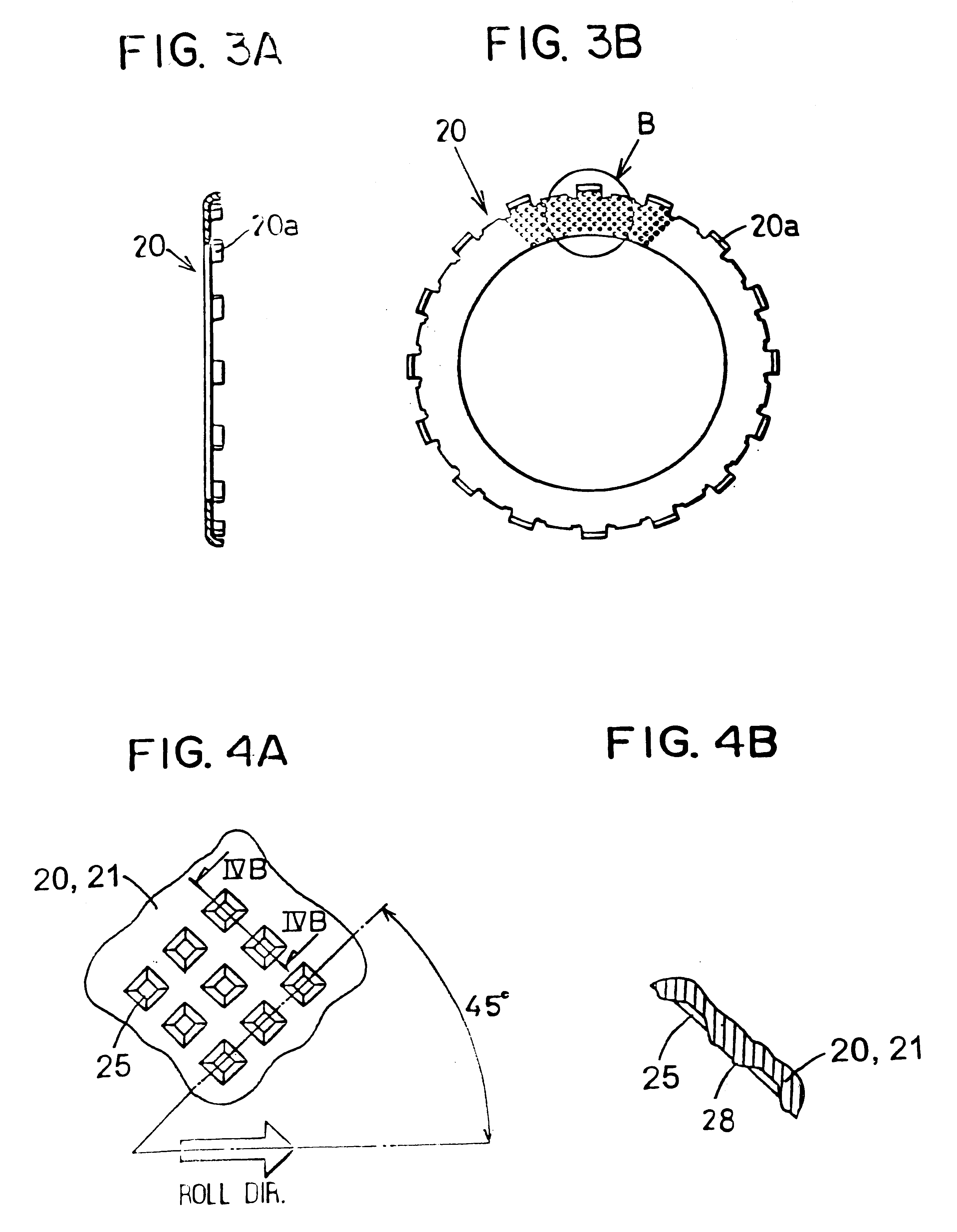
[0075]A plurality of projections or banks (not shown) is formed at opposite surfaces of rotary disk 20 in the same manner as described with reference to FIGS. 3A and 3B. Banks 28 are formed when a plurality of dimples 25 (depressions / not shown) is press-formed at the surfaces of rotary disk 20.
[0076]In addition, rotary disk 20 has a plurality of oil holes 24 penetrating the same in the thickness direction. The plurality of oil holes 24 is disposed almost evenly in the circumferential direction. Each group of four circumferentially lined oil holes 24 forms a spiral line ab...
third embodiment
[0086
[0087]Rotary disk 20 of a shock absorber according to a third embodiment of the invention is described with reference to FIG. 6.
[0088]Oil holes at the inner peripheral edge (or the outer peripheral edge) of rotary disk 20 can open inward. In this case, the same effect as the second embodiment can be obtained.
PUM
| Property | Measurement | Unit |
|---|---|---|
| angle | aaaaa | aaaaa |
| friction | aaaaa | aaaaa |
| circumference | aaaaa | aaaaa |
Abstract
Description
Claims
Application Information
 Login to View More