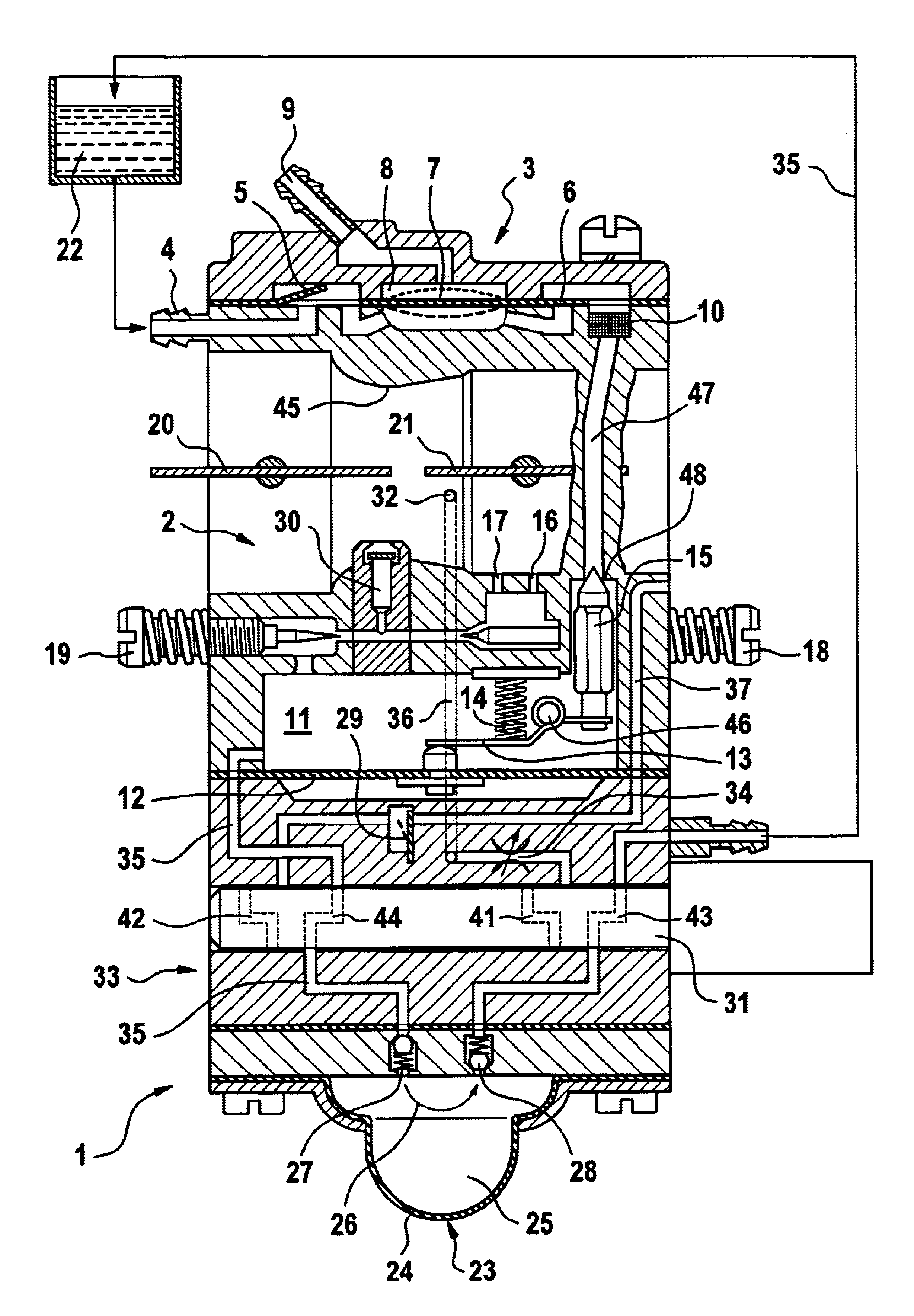
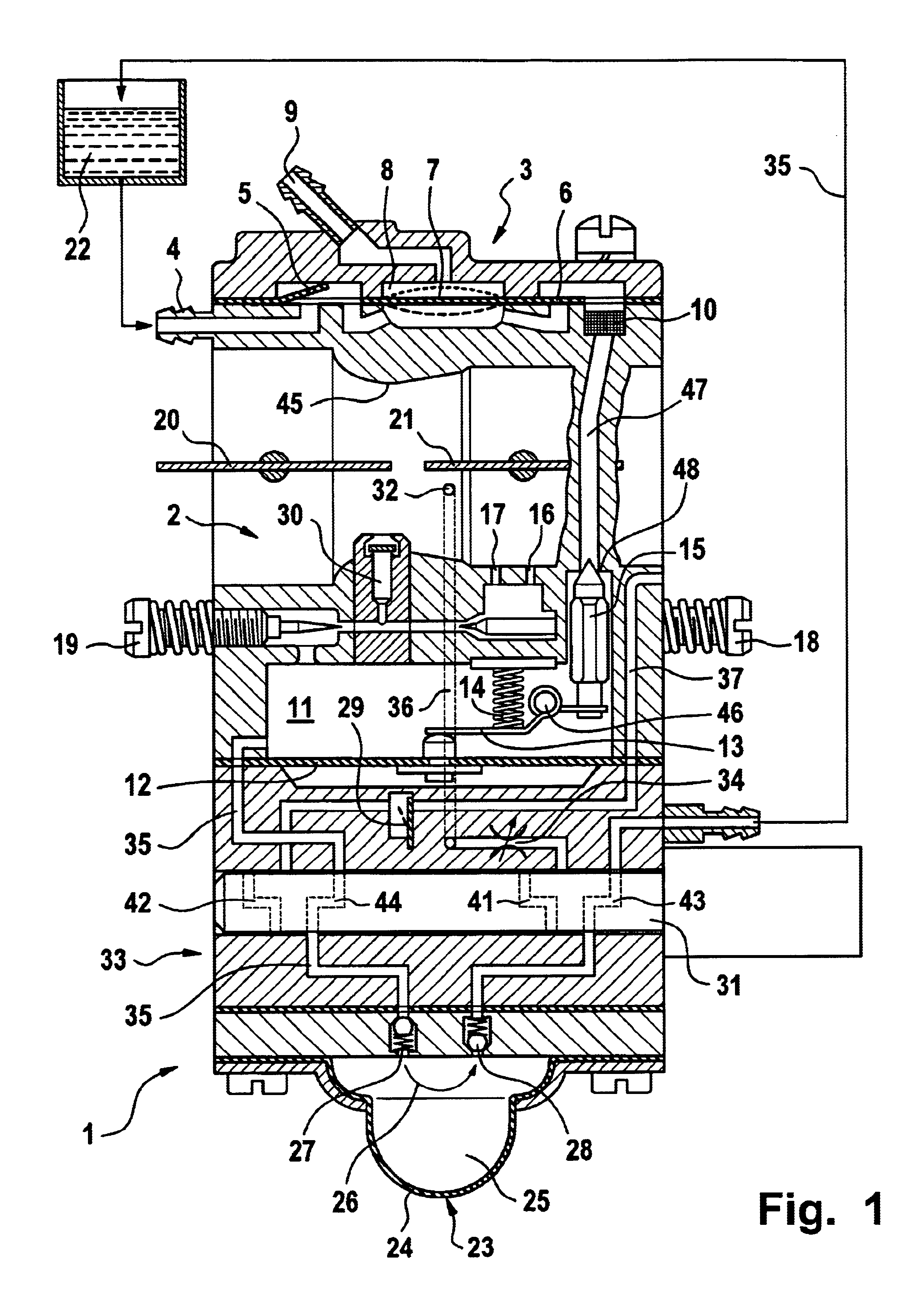
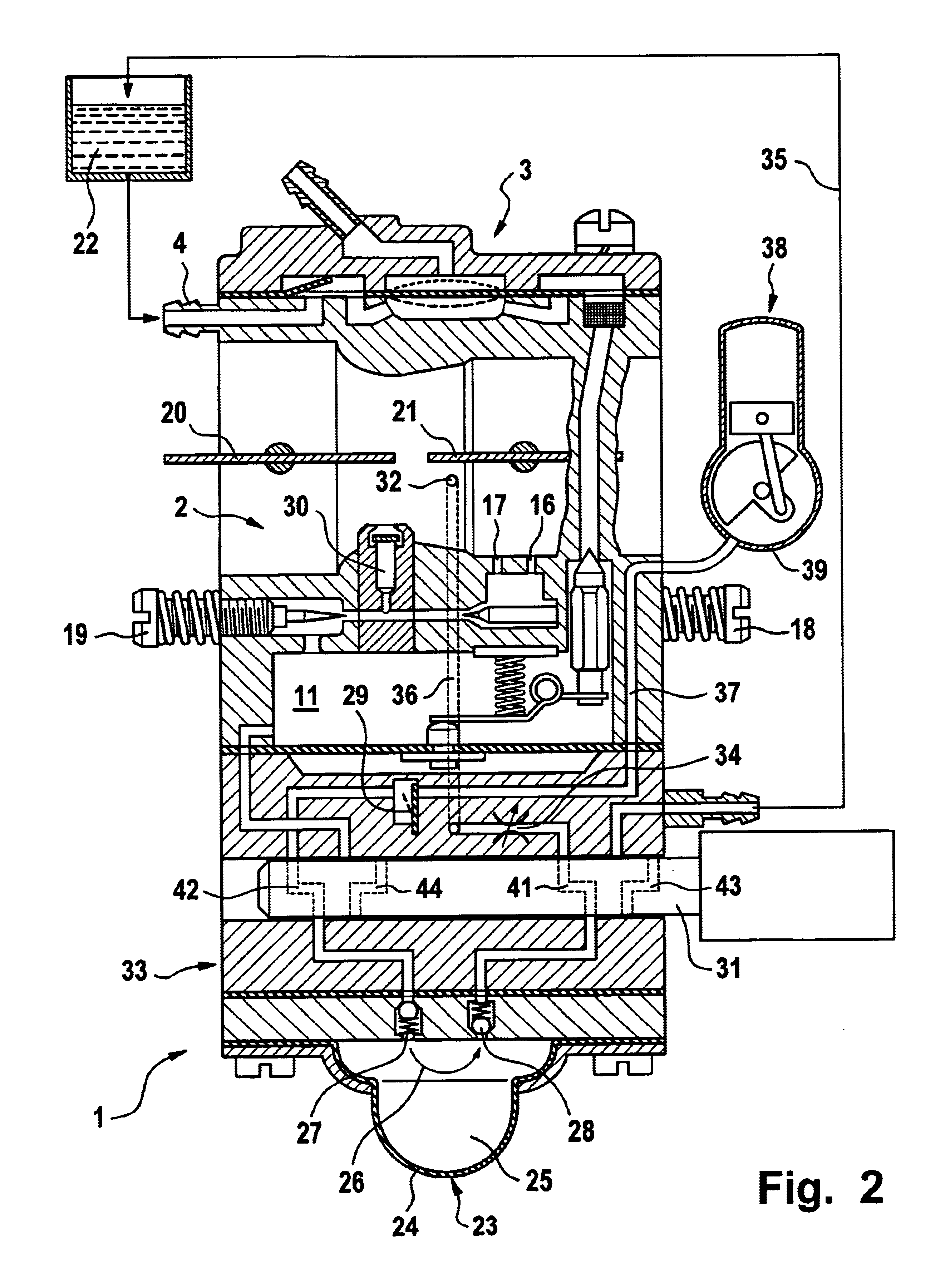
[0011]Due to the presence of the supply line from the
pump chamber of the scavenging pump into the air channel, additional fuel can be supplied to the air channel. Due to the enrichment of the mixture from the pump chamber in the start-up and run-up phases of the engine, in the operating state the carburetor can be set to a lesser supply of fuel. In the full
throttle range, the fuel consumption is thus reduced, whereupon the emissions are also reduced. The additional supply of fuel in the run-up phase causes the engine to already have a high output in this phase. Thus, the full output is not available only after run-up of the engine. The fuel is taken from the pump chamber of the scavenging pump. The pump chamber is thus nearly entirely emptied, so that the operator is forced to actuate the scavenging pump prior to the next start-up. This ensures that the regulating chamber is again completely filled with fuel. A filled pump chamber, which leads to the operator not actuating the scavenging pump, accompanied by simultaneous emptying of the regulating chamber, is thereby avoided.
[0012]It is provided that a first valve is disposed in the supply line that in particular in the run-up phase of the internal
combustion engine is open. Thus, fuel can be supplied to the engine in this phase of operation in a precisely controlled manner. In particular, a second valve is disposed in a pressure line that opens into the pump chamber. The pressure line expediently connects the
crankcase of the internal
combustion engine with the pump chamber. By means of the pressure conveyed via the pressure line into the pump chamber, the
discharge of fuel into the air channel is ensured. The valve permits the precise switching on and off of the pressure charge. To avoid a
fuel supply from the pump chamber, via the pressure line, into the
crankcase of the internal combustion engine, a
check valve, especially a diaphragm
check valve, is disposed in the pressure line. The first and second valves are expediently coupled in such a way that both valves are either opened or closed. By charging the scavenging pump with pressure via the pressure line, there is ensured that fuel can flow out of the pump chamber to the air channel.
[0014]It is provided that a
throttle valve is disposed in the supply line. As a result, it is possible to regulate the amount of fuel additionally introduced into the air channel via the supply line. In particular, a
check valve is disposed in the supply line, with the opening pressure of the check valve being greater than the pressure that during idling of the internal combustion engine prevails in the pressure line. The check valve can, for example, have an opening pressure of 100 to 600 mbar, especially 200 to 400 mbar. Due to the check valve, a supply of fuel via the supply line is prevented during idling of the internal combustion engine.
[0015]The first, second, third and fourth valves are advantageously formed in a common valve slide. In this way, the valves are reliably coupled with one another. An appropriate valve slide or
rotary valve can be produced in a straightforward manner. It is robust and can be easily operated. The diaphragm carburetor is provided with a pivotably mounted
butterfly valve in the air channel, and upstream of the
butterfly valve has a pivotably mounted
choke valve. The position of at least one valve is advantageously coupled with the position of the
choke valve. In particular, with choke valve open, the first valve is opened and the third valve is closed. During start-up of the engine, the regulating chamber can thus first be flooded with fuel. The choke valve is already closed for the start-up of the engine. The engine is then started. During opening of the choke valve, the first valve is opened, so that additional fuel is conveyed to the air channel in the run-up phase.
[0016]To prevent actuation of the scavenging pump in the run-up phase and in the operating phase, a cover element is provided, the position of which is coupled to the position of the third valve, and which cover element releases the scavenging pump when the third valve is opened. This ensures that the scavenging pump can only be used to draw fuel into the regulating chamber, and a pumping of fuel into the air channel via the first valve and the supply line is prevented.


 Login to View More