

System and method for using multiple working memories to improve microprocessor security
a working memory and microprocessor technology, applied in the field of unpredictability of microprocessors or microcomputers, can solve problems such as difficult investigation, difficult circuit testing, and particularly tricky circuits and fastidiousness
- Summary
- Abstract
- Description
- Claims
- Application Information
AI Technical Summary
Benefits of technology
Problems solved by technology
Method used
Image

Examples
second embodiment
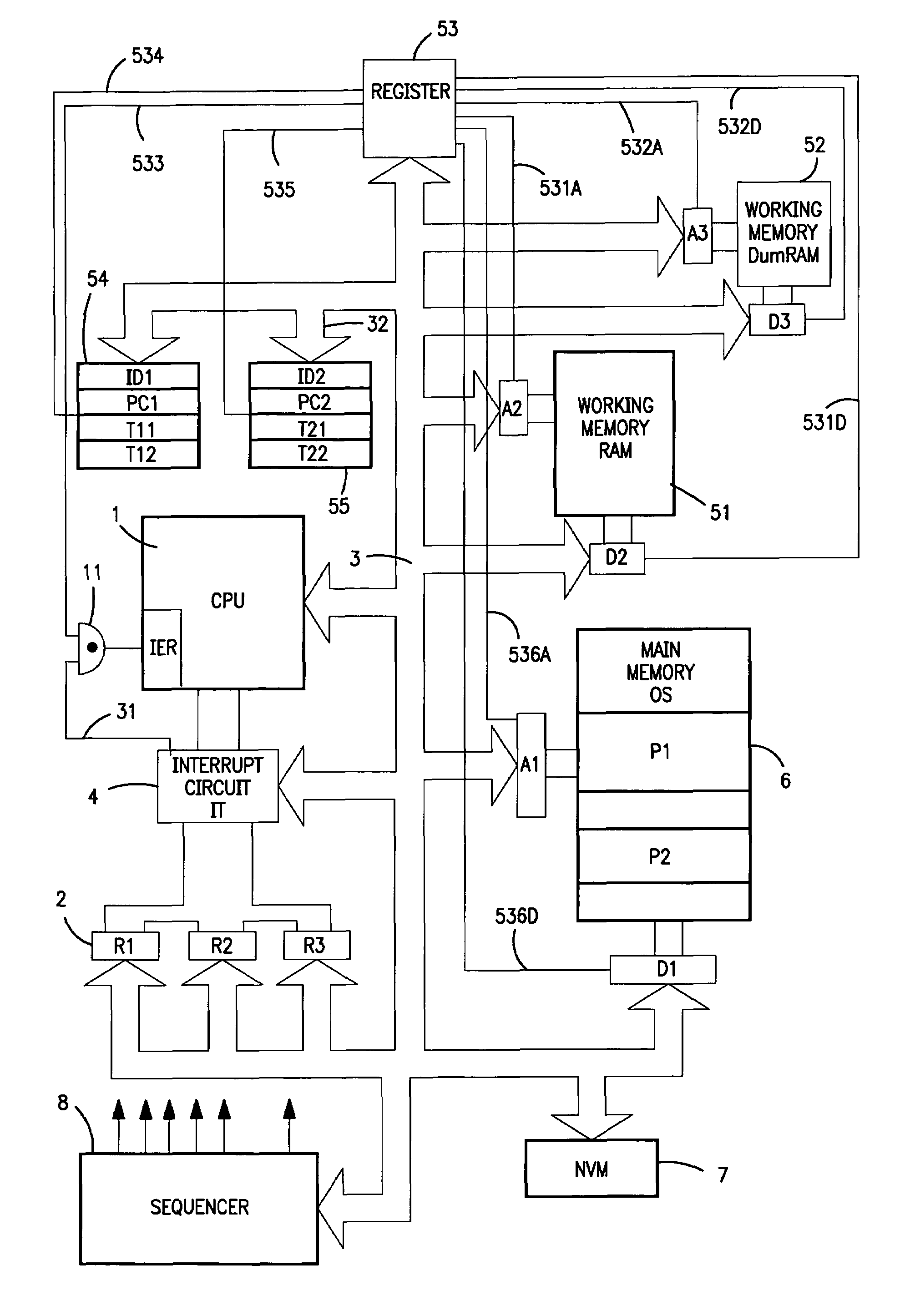
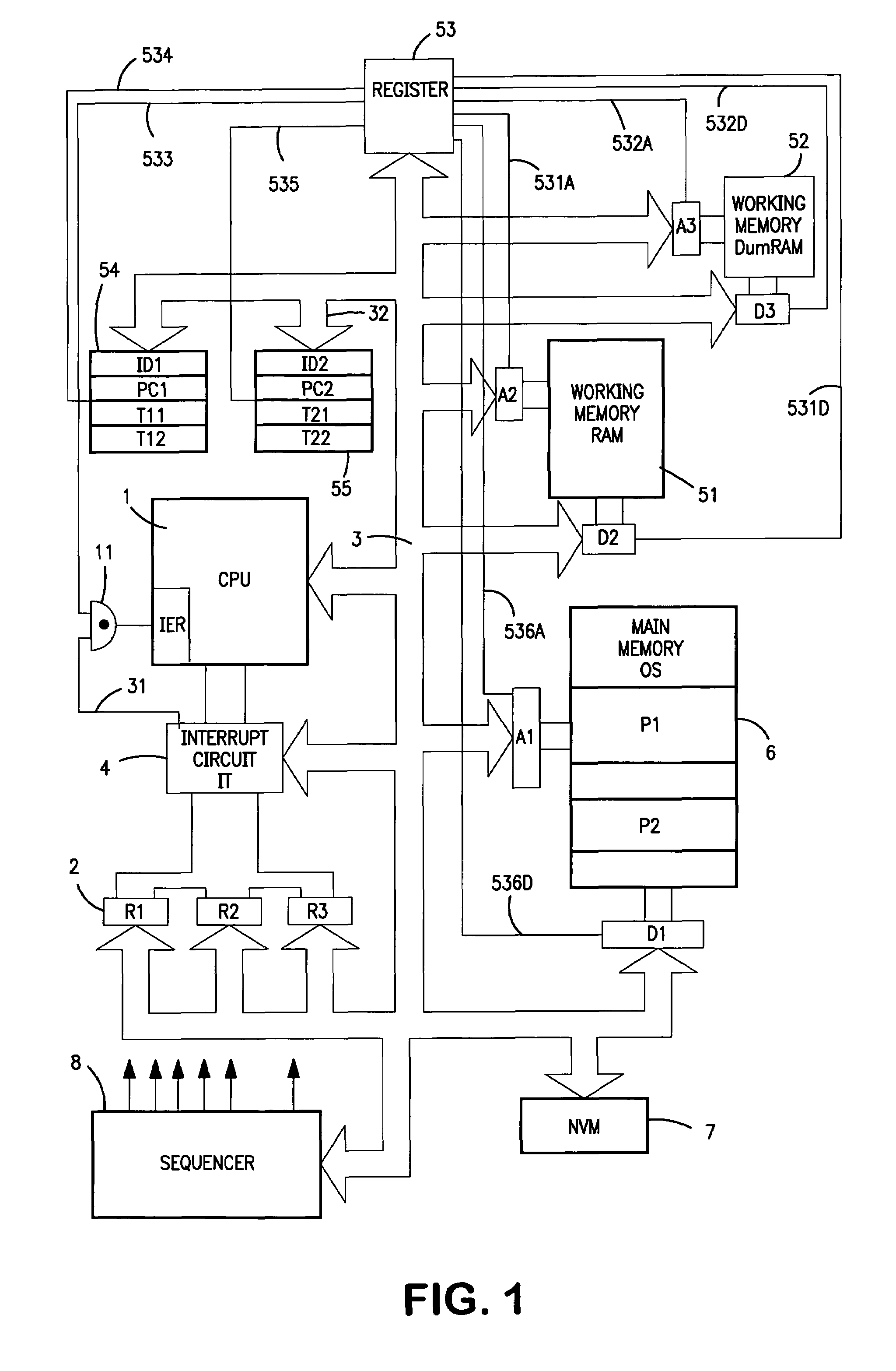
[0060]In a second embodiment, when the processor switches the circuit (53) at the same time, it activates a timer (R3) initialized either by random generator (2) or from the content of non-volatile memory NVM (7). Said NVM of the E2 PROM type, for instance, or a ferro-electric unit, can indeed contain a single number modified each time the NVM is used. When the timer (R3) expires, after an unpredictable period of time, it triggers return to the main program and also switches the switching circuit (53) to bring the main memory back into the working space. This mechanism can be executed either by a conventional interruption or by direct action of the timer (R3) on the switching circuit (53) and by action on registers (PC1) and (PC2), checking the execution of the programs by the processing unit (1) such as (PC1) and (PC2).
[0061]In an alternative embodiment, it is possible to use as secondary program (P2), any part of main program (P1) initially pointing to an address chosen at random ...
third embodiment
[0065]In a third embodiment, the random generator (2) can be interrogated by the processor (1) via the bus (3) by a read instruction in order to find out its status, or by directly reading a determined pulse or by grouping several of them or yet again by considering the content of register (R2) loaded from random generator 9 (2). When the main program needs protection, it transfers control to the secondary program in a similar way to the mechanism seen previously.
[0066]Naturally, it is possible to combine the effects of the previous embodiments by having, on the one hand, a random clock and, on the other, the possibility of interrupting the run-through of the main program either by itself or by a random interruption system which it either authorizes or not.
[0067]It is also evident that the run-through of the main program is accomplished according to absolutely unpredictable sequencing which depends either on the random generator or on the program or on the timer or on the secondary ...
fourth embodiment
[0068]A fourth embodiment also illustrated in FIG. 1 allows the use of RAMs (51) and (52) simultaneously. Indeed, if it is assumed that it is possible to detect the switching of the memories and the associated registers, it might be possible to carry out analyses by eliminating the sequences using the dummy memory (52). To avoid this eventuality, this embodiment means that the memories (51) and (52) can be validated in parallel during an initial phase. Obviously, this presupposes that memory (52) in the case at hand, has a size equal to at least that of the zone used by program (P1) in memory (51) when working with the latter. In this way, the content of the two memory zones used by program (P1) respectively in memories (51) and (52) are initialized and used by this program in an identical manner during this first phase. One alternative may consist in validating by loading switching circuit (53) with the necessary configuration only one of the two registers (D2) or (D3) during the r...
PUM
 Login to View More
 Abstract
Description
Claims
Application Information
 Login to View More