Bioluminescence regenerative cycle (BRC) for nucleic acid quantification
Inactive Publication Date: 2006-11-28
THE BOARD OF TRUSTEES OF THE LELAND STANFORD JUNIOR UNIV
View PDF20 Cites 15 Cited by
Summary
Abstract
Description
Claims
Application Information
AI Technical Summary
This helps you quickly interpret patents by identifying the three key elements:
Problems solved by technology
Method used
Benefits of technology
Benefits of technology
[0011]The present invention fulfills an unresolved need in the art by providing methods for accurately detecting and / or quantifying target analytes, such as nucleic acids, in samples. In preferred embodiments, the number of target nucleic acids in a sample may be accurately determined over a seven order of magnitude range. The disclosed methods provide increased sensitivity and accuracy of target molecule quantification compared to prior art methods. The disclosed methods are generally referred to as “bioluminescenceregenerative cycle” or BRC.
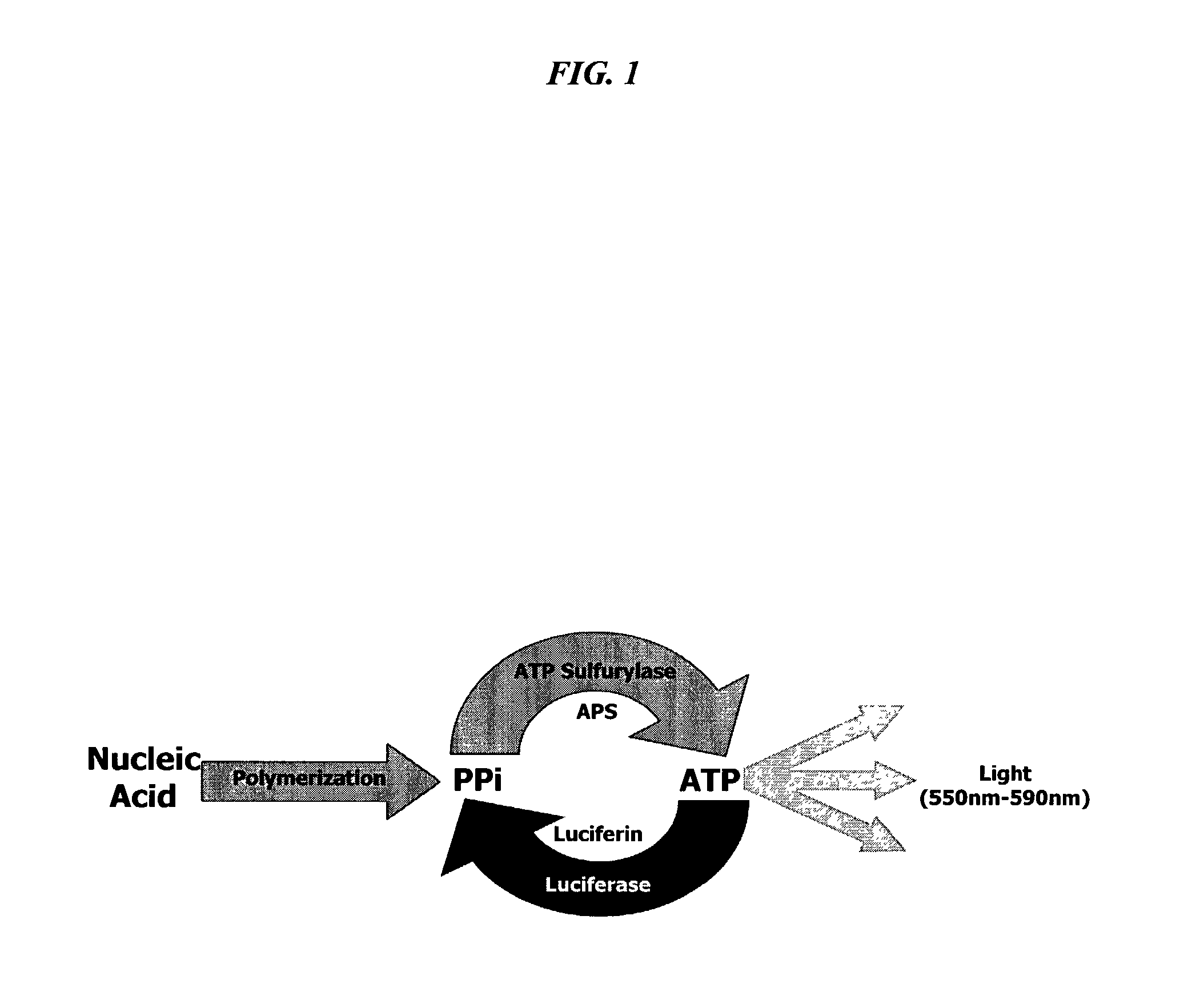
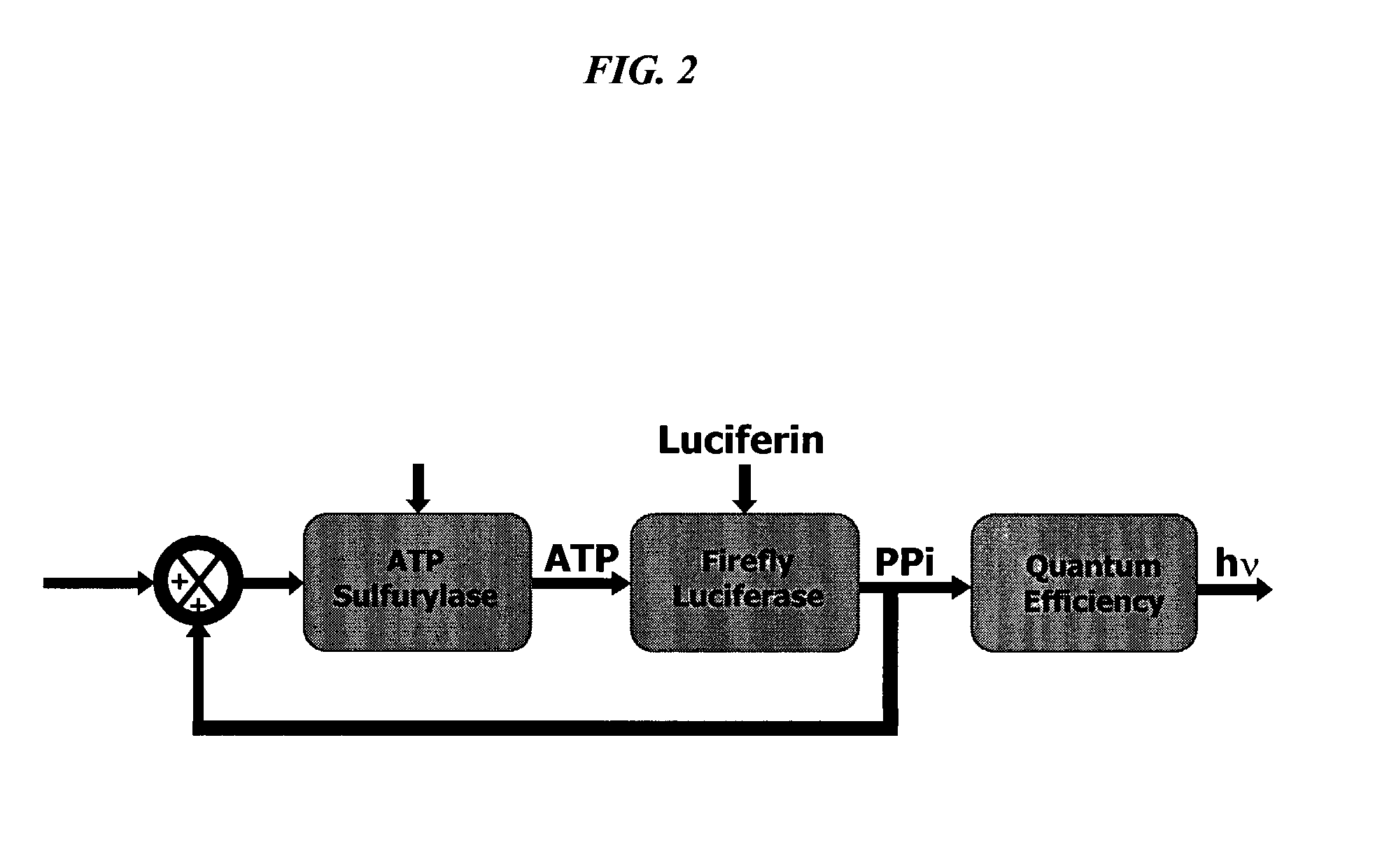
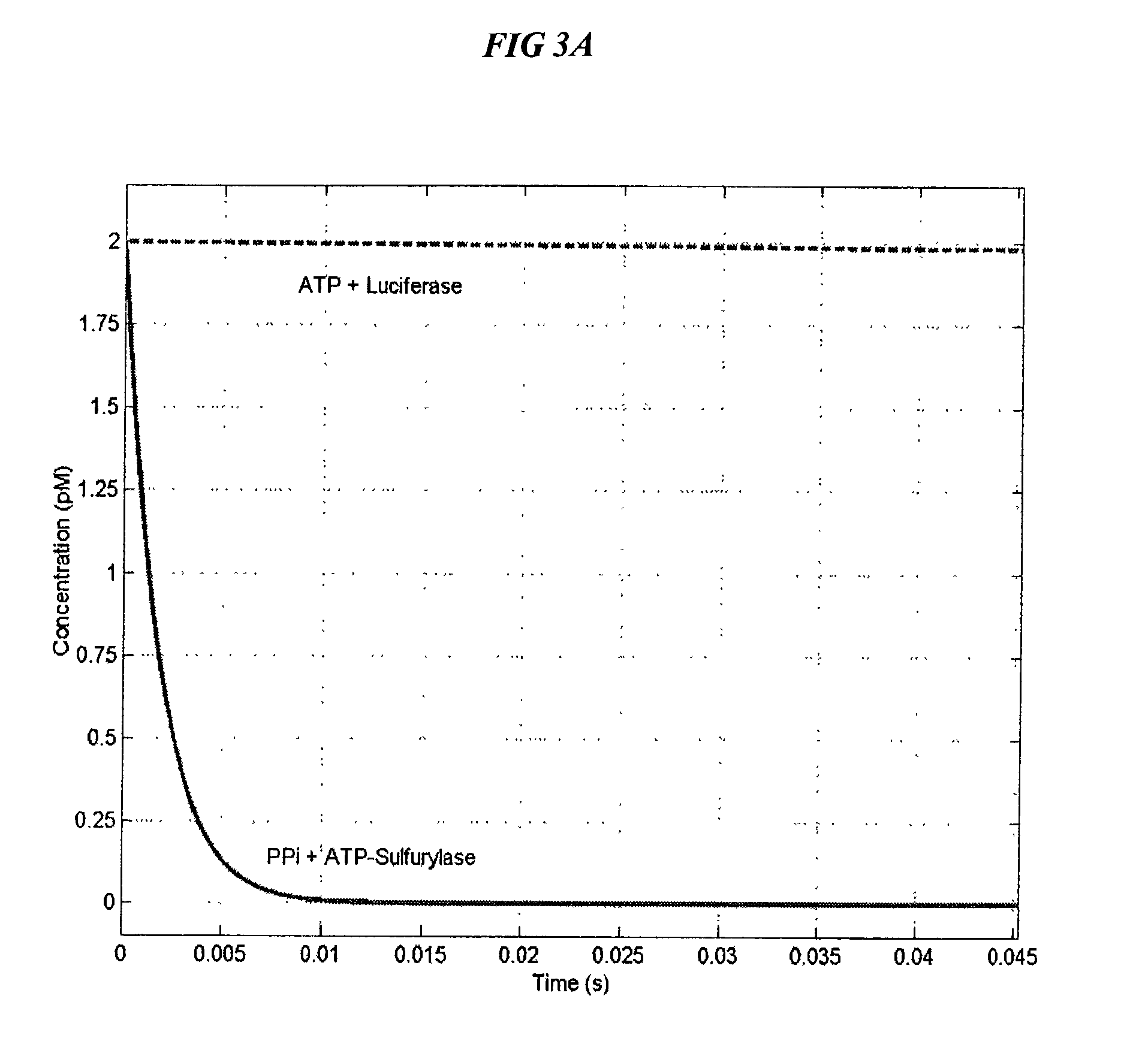
[0015]In particular embodiments of the invention, pyrophosphate is generated by a reaction such as PCR, transcription and / or DNA replication. In preferred embodiments, sequence specific primers are used to limit replication to a particular target nucleic acid in the sample. The sequence specific primers are designed to not bind to other nucleic acids that may be present in the sample. In more preferred embodiments, the pyrophosphate producing reaction is allowed to proceed to completion before BRC analysis. Once the reaction is complete, the pyrophosphate is reacted with APS in the presence of ATP sulfurylase to produce ATP and sulphate. The ATP is reacted with oxygen and luciferin in the presence of luciferase to yield oxyluciferin, AMP and pyrophosphate. For each molecule of pyrophosphate that is cycled through BRC, a photon of light is emitted and one molecule of pyrophosphate is regenerated. Because of the relative kinetic rates of luciferase and ATP sulfurylase, a steady state is reached in which the concentrations of ATP and pyrophosphate and the level of photon output remain relatively constant over an extended period of time. The number of photons may be counted over a time interval to determine the number of target nucleic acids in the sample. The very high sensitivity of BRC is related in part to the integration of light output over time, in contrast to other methods that measure light output at a single time point or at a small number of fixed time points. The ability to vary the length of time over which photon integration occurs also contributes to the very high dynamic range for nucleic acid molecule quantification. The detection noise is also significantly reduced by increasing the length of integration.
Problems solved by technology
Fluorescent detection is too insensitive to detect very low levels of a target nucleic acid in a sample.
Thus, detection of small changes in the level of expression of a particular gene, as might be attempted for high through-put screening of potential inhibitors and / or activators of gene expression, may not be feasible using a fluorescence detection system with microarrays.
However, precise quantification of the amount of target present may be complicated by a variety of factors, such as contaminating nuclease activity or variability in the efficiency of amplification.
Existing methods of SNP detection may suffer from insufficient sensitivity or an unacceptably high level of false positive and / or false negative results.
Method used
the structure of the environmentally friendly knitted fabric provided by the present invention; figure 2 Flow chart of the yarn wrapping machine for environmentally friendly knitted fabrics and storage devices; image 3 Is the parameter map of the yarn covering machine
View more
Image
Smart Image Click on the blue labels to locate them in the text.
Viewing Examples
Smart Image
Click on the blue label to locate the original text in one second.
Reading with bidirectional positioning of images and text.
[0089]Total RNA extracts may be obtained from blood, tissues or cell lines using commercially available kits (e.g., Ambion, Austin, Tex.; Qiagen, Valencia, Calif.; Promega, Madison, Wis.). CDNA may be synthesized using a SuperScript™ or other commercial kit (Invitrogen Life Technologies, Austin, Tex.). Where preferred, polyadenylated mRNA may be purified by oligo(dT) column chromatography or other known methods.
[0090]In an exemplary embodiment, first strand cDNA synthesis employed an RNA / primer mixture containing 5 μl total RNA and 1 μl of 0.5 μg / μl oligo(dT) random primer or gene specific primer, incubated at 70° C. for 10 min and then placed on ice for at least 1 min. A reaction mixture containing 2 μl 10× buffer (0.1 M Tris-Acetate pH 7.75, 5 mM EDTA, 50 mM Mg-acetate, 2 mM kinase free dNTP and 0.1 M dithiothreitol) in which dATP was replaced with (α-thio dATP was added to the RNA / primer mixture, mixed gently, collected by brief centrifugation and...
[0104]SNPs have been detected by hybridization of total RNA incubated with gene specific or allelespecific primers and / or probes (Higgins et al, Biotechniques 23:710–714, 1997; Newton et al. Lancet 2:1481–1483, 1989; Goergen et al, J Med Virol 43:97–102, 1994; Newton et al, Nucleic Acids Res 17:2503–2516, 1989). Using the methods disclosed herein, SNPs may be detected by BRC, using sequence specific extension primers designed to bind to the template with the 3′ end of the primer located over the base of interest (SNP site) (FIG. 7). In preferred embodiments, the primer sequence is selected so that the end of the primer to which nucleotides will be attached is base-paired with the polymorphic site. In certain embodiments, where the SNP is located in a coding sequence, the primer may be allowed to hybridize to total RNA or polyadenylated mRNA. (Alternatively, to detect non-coding SNPs genomic DNA or PCR amplified genomic DNA may be used as the t...
example 3
SNP Detection Using cDNA Templates
[0106]In alternative embodiments, SNPs may be detected from cDNA templates. Complementary DNAs may be prepared by standard methods, as disclosed above, and hybridized with gene specific or allele specific primers (FIG. 7) in 20 mM Tris-HCl (pH 7.5), 8 mM MgCl2 or other standard conditions. The primers are designed to bind to the template with the 3′ end located over the polymorphic position. The template / primer fragments are then used as substrates in a primer extension reaction, as discussed above. Pyrophosphate generation, detected by the BRC reaction, indicates the presence of a SNP sequence that is complementary to the primer. As discussed above, gene specific primers also may be used in combination with single dXTPs.
the structure of the environmentally friendly knitted fabric provided by the present invention; figure 2 Flow chart of the yarn wrapping machine for environmentally friendly knitted fabrics and storage devices; image 3 Is the parameter map of the yarn covering machine
Login to View More
PUM
Property
Measurement
Unit
Substance count
aaaaa
aaaaa
Substance count
aaaaa
aaaaa
Login to View More
Abstract
The present invention concerns methods of quantifying nucleic acids using a bioluminescenceregenerative cycle (BRC). In BRC, steady state levels of bioluminescence result from processes that produce pyrophosphate. Pyrophosphate reacts with APS in the presence of ATP sulfurylase to produce ATP. The ATP reacts with luciferin in a luciferase-catalyzed reaction, producing light and regenerating pyrophosphate. The pyrophosphate is recycled to produce ATP and the regenerative cycle continues. Because the kinetic properties of ATP sulfurylase are much faster than luciferase, a steady state results wherein concentrations of ATP and pyrophosphate and the rate of light production remain relatively constant. Photons are counted over a time interval to determine the number of target molecules present in the initial sample. The BRC process has a controllable dynamic range up to seven orders of magnitude and is sensitive enough to detect a few thousand molecules of target nucleic acid.
Description
[0001]The present application claims the benefit under 35 U.S.C. §119(e) of provisional Patent Application Serial No. 60 / 302,909, filed on Jul. 3, 2001, entitled “Gene Expression by Analyzing DNA Optical Extension Signature,” by Hassibi and Pourmand.[0002]The invention described herein was made with Government support under grant 5 P01 HG00205 from the National Institutes of Health. The Federal Government may have certain rights in the subject invention.BACKGROUND OF THE INVENTION[0003]1. Field of the Invention[0004]The present invention relates to the field of nucleic acid detection and / or quantification. More particularly, the present invention concerns novel approaches to detection and / or quantification of gene expression, single nucleotide polymorphisms (SNPs), protein-protein interaction, real time PCR and / or pathogentyping.[0005]2. Description of Related Art[0006]Methods of precise and highly sensitive detection and / or quantification of nucleic acids are of use for a variety ...
Claims
the structure of the environmentally friendly knitted fabric provided by the present invention; figure 2 Flow chart of the yarn wrapping machine for environmentally friendly knitted fabrics and storage devices; image 3 Is the parameter map of the yarn covering machine
Login to View More
Application Information
Patent Timeline
Application Date:The date an application was filed.
Publication Date:The date a patent or application was officially published.
First Publication Date:The earliest publication date of a patent with the same application number.
Issue Date:Publication date of the patent grant document.
PCT Entry Date:The Entry date of PCT National Phase.
Estimated Expiry Date:The statutory expiry date of a patent right according to the Patent Law, and it is the longest term of protection that the patent right can achieve without the termination of the patent right due to other reasons(Term extension factor has been taken into account ).
Invalid Date:Actual expiry date is based on effective date or publication date of legal transaction data of invalid patent.


 Login to View More