Check patentability & draft patents in minutes with Patsnap Eureka AI!

Space-efficient, side-channel attack resistant table lookups

Inactive Publication Date: 2006-11-28
IBM CORP
View PDF9 Cites 18 Cited by
  • Summary
  • Abstract
  • Description
  • Claims
  • Application Information

AI Technical Summary

Benefits of technology

[0017]In a first aspect this patent provides methods and apparatus to create efficient side channel attack resistant implementation of table lookups. This generally results in use of less RAM than the size of the table being accessed. In addition, in many embodiments of the present invention, the invention solves problems related to information leakage when accessing tables having large indices.
[0018]An additional aspect of the presentation is provision of a substantial improvement of other approaches which provided resistance against side-channel attacks using as much RAM as the size of the table being accessed by exploiting tradeoffs between RAM usage and additional accesses to ROM. This tradeoff is advantageous in applications where the cost of requiring extra access to ROM is significantly less than the cost of including additional RAM resources into the device.
[0019]Another aspect of the invention is that the RAM usage and ROM access tradeoff is achievable in a manner that preserves the resistance of the implementation to side channel vulnerabilities.

Problems solved by technology

Some of these methods and mechanisms deal with the problem of maintaining the integrity of information while it is in storage or in transit, others deals with the issue of ensuring that the information is available only to authorized entities and access is denied to entities not so authorized.
However, in situations where information security is an issue, implementing a Table lookup is substantially harder.
It is well known that information security can be seriously compromised if Side-Channel information is available to unauthorized entities.
This makes the implementation of a Table lookup much more complex in this scenario.
In addition, implementing Table lookup on resource constrained information processing devices such as chip cards, cryptographic tokens etc., poses a special challenge since these devices are less shielded from the environment and therefore have larger leakage of information via various side-channels.
Use of these techniques result in devices which inherently leak less information on the side-channels than devices which are not thus protected.
However, the leakage is not entirely eliminated.
In most situations, even after the application of these physical protections, there is enough information leakage so that implementations of information security techniques on such devices can be attacked using statistical side-channel attacks such as DPA, DEMA, higher-order DPA, higher-order DEMA etc.
This makes statistical tests involving several experiments impossible, since the chance of the adversary making the correct assumptions for each run is extremely low.
While this yields secure computation, it is not clear how one can do effective computation under this requirement since no bit depending directly on the data and key can be manipulated at any cycle.
Ignoring the initial setup time, the performance penalty in performing computation using just the k shares is a factor of k. Our results which have been proved based on the bit encoding scheme would also work for this case but the bounds they yield are based only on the characteristics of the noise within the chip, and hence may not be optimal.
However, the mechanism proposed to deal with Table lookups, which is to create a random rearrangement of the original table (which has to be in RAM ) is inefficient, since the random rearrangement of a table in RAM will take as much space as the size of the table.
Thus in prior art, reducing the exposures from side-channels during table lookups has been the most challenging since many good countermeasures require much more Read / Write memory (such as RAM) than these devices can spare.
Further, the limited addressing capabilities of such devices often complicates lookups of large tables, sometimes leading to new side-channel exposures.
Many chip cards have no more than 256 bytes of RAM and the available RAM is even smaller and this means that good known countermeasures cannot be applied to such cards to protect against side channel attacks for algorithms such as DES, COMP 128 etc.
This leads to problems if the smart card is required to access a table of bytes with larger index size than 256.
As a result of these limitations, heretofore side-channel attack resistant implementations many algorithms which utilized the Table lookup operation required the use of more expensive devices which had more RAM, or these implementations were either unacceptably slow or are still susceptible to side channel attacks.


Method used

the structure of the environmentally friendly knitted fabric provided by the present invention; figure 2 Flow chart of the yarn wrapping machine for environmentally friendly knitted fabrics and storage devices; image 3 Is the parameter map of the yarn covering machine
View more

Image

Smart Image Click on the blue labels to locate them in the text.
Viewing Examples
Smart Image
  • Space-efficient, side-channel attack resistant table lookups
  • Space-efficient, side-channel attack resistant table lookups
  • Space-efficient, side-channel attack resistant table lookups

Examples

Experimental program
Comparison scheme
Effect test

Embodiment Construction

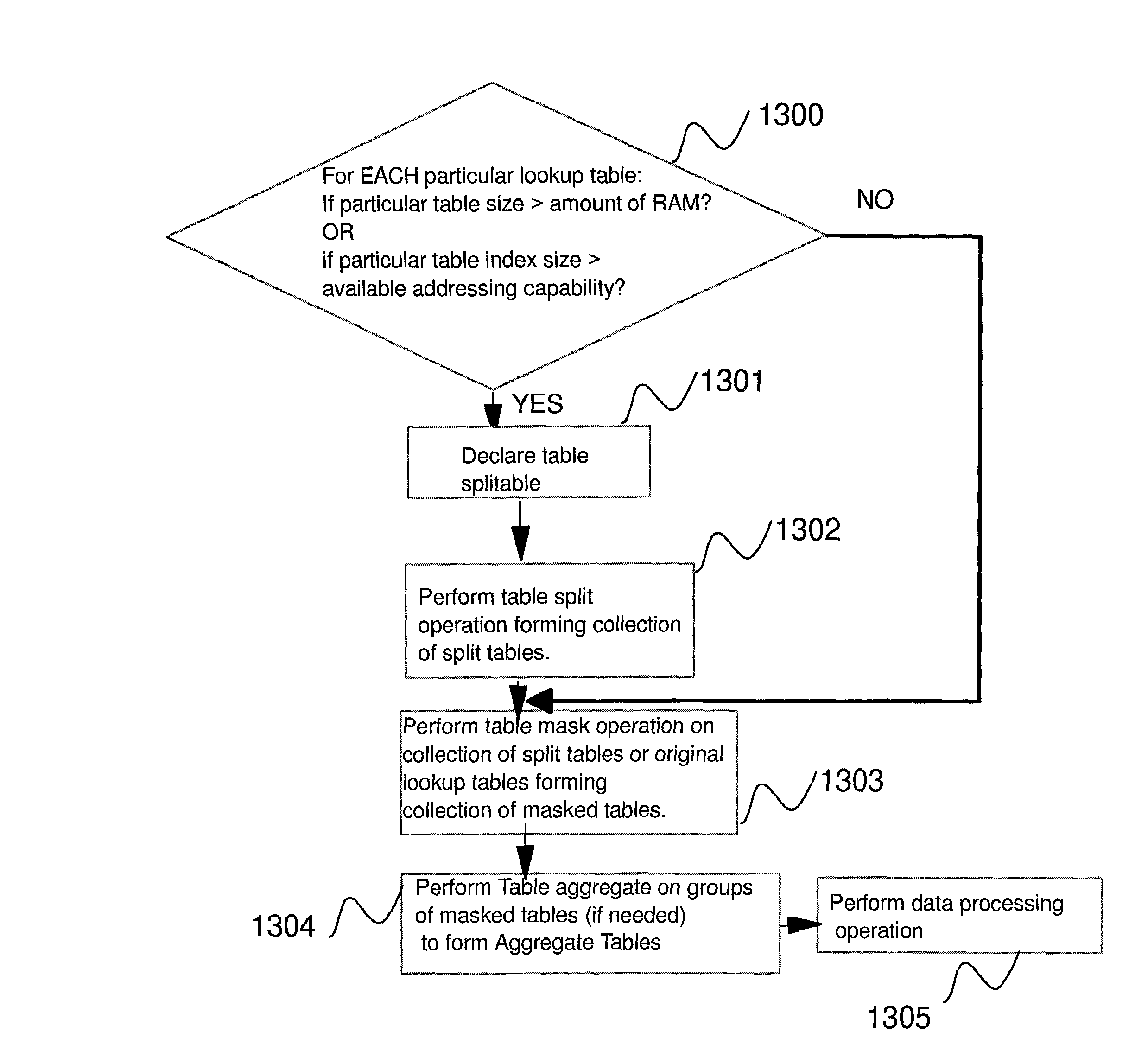
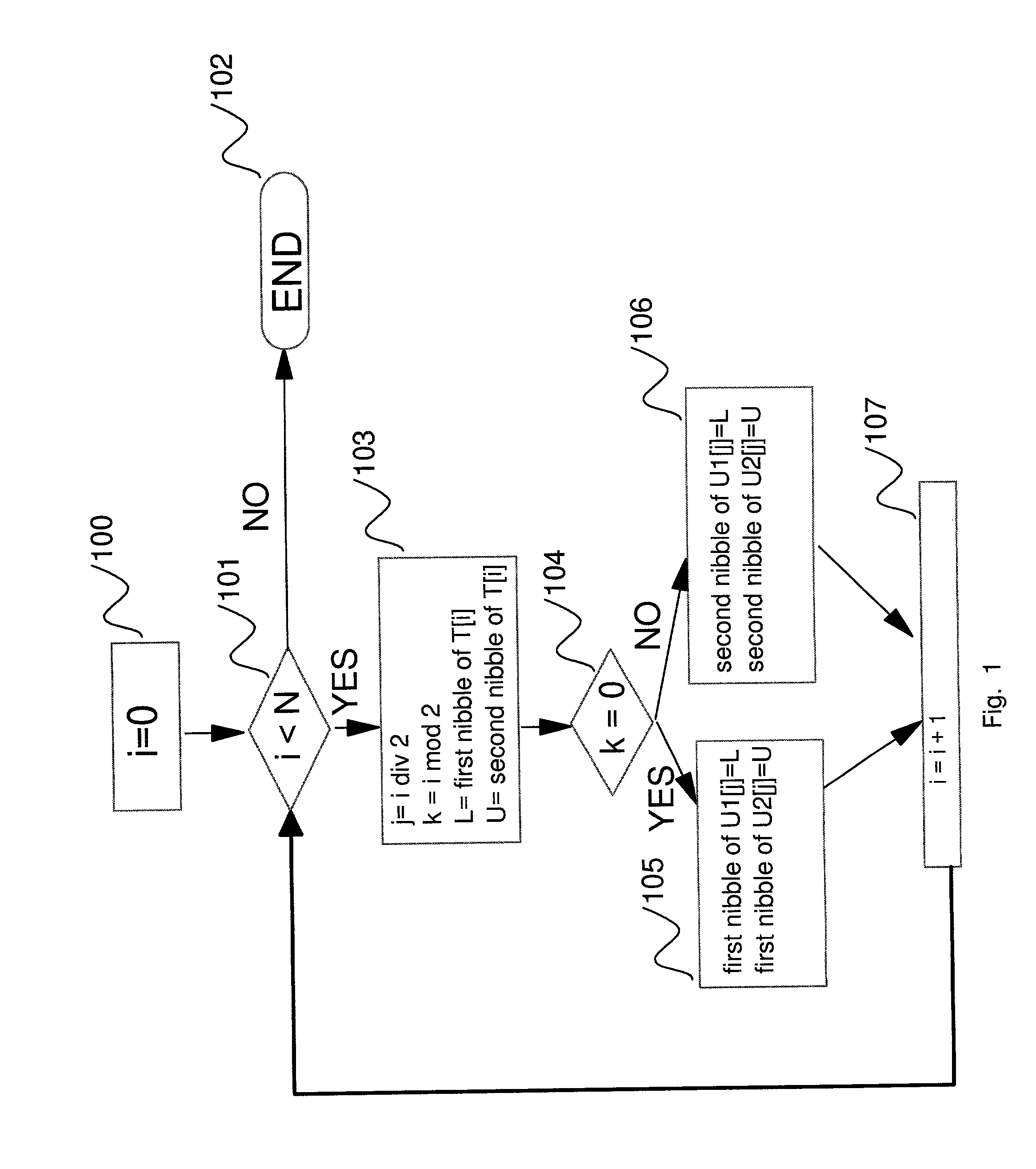
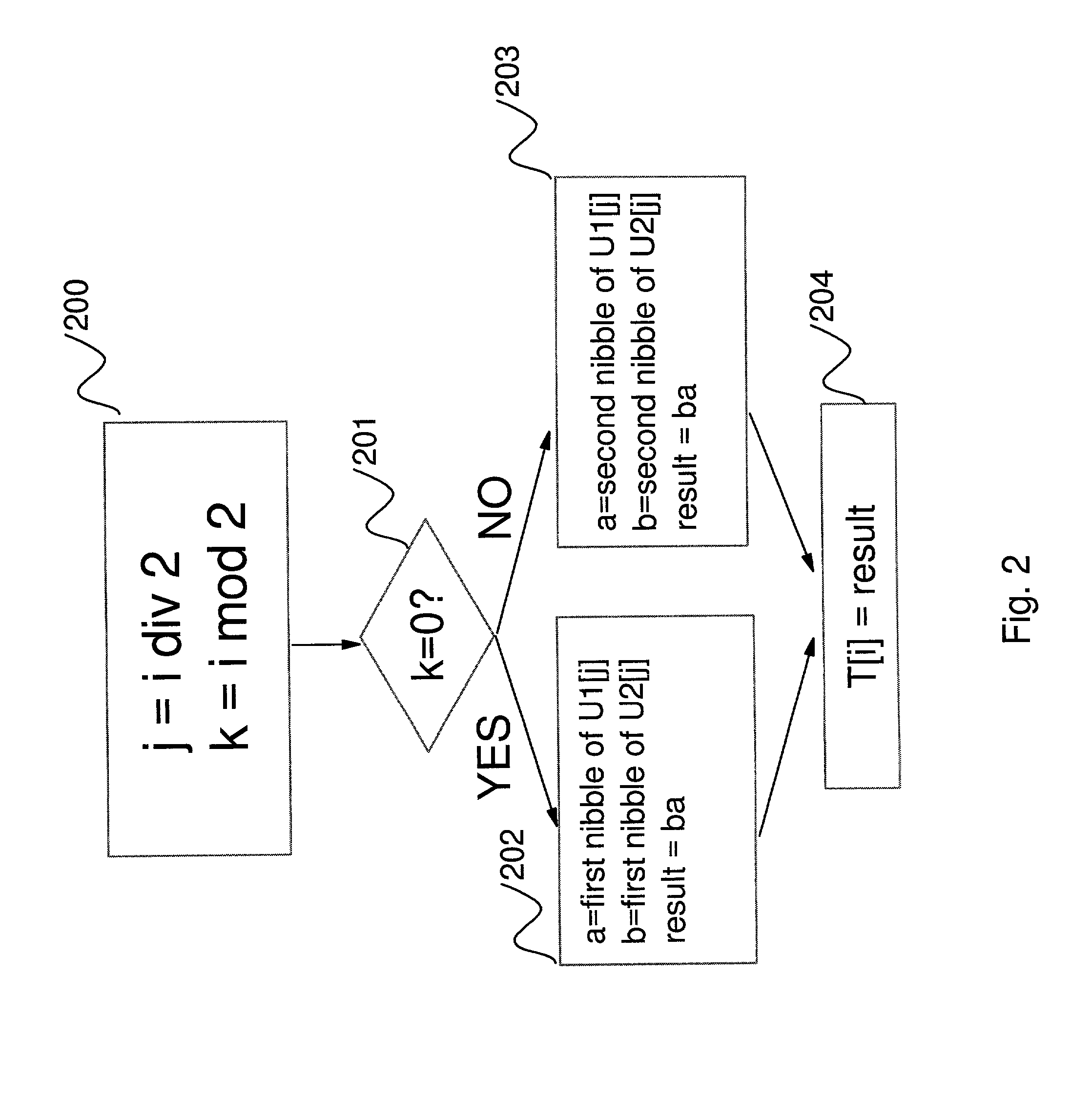
[0036]This patent provides ways to create an efficient side channel attack resistant implementation of table lookups using much less RAM than the size of the table being accessed. In addition, in many cases this solution also takes care of the problem of dealing with tables having index size which is too large to be lookup up in a single operation.

[0037]One of the problems being solved by this invention is the following: An information processing operation needs to be performed involving lookups of at least one known lookup table. Each particular table from said at least one known lookup table having a particular lookup table size and a particular lookup table index size. There is a certain amount of available RAM for this operation and the operation needs to be implemented efficiently within the available amount of RAM in a manner which resists side-channel attacks. In mathematical notation, therefore we have p known lookup tables T1, T2, T3, . . . , Tp for some integer p>0 and we ...

the structure of the environmentally friendly knitted fabric provided by the present invention; figure 2 Flow chart of the yarn wrapping machine for environmentally friendly knitted fabrics and storage devices; image 3 Is the parameter map of the yarn covering machine
Login to View More

PUM

No PUM Login to View More

Abstract

Methods, apparatus and computer software and hardware products providing method, apparatus and system solutions for implementing table lookups in a side-channel attack resistant manner. Embodiments are provided for devices and situations where there is limited amount of RAM memory available or restrictions on memory addressing. The solutions solve problems associated with look up tables with large indices, as well as problems associated with looking up large sized tables or a collection of tables of large cumulative size, in limited devices, in an efficient side-channel attack resistant manner. These solutions provide defenses against both first-order side channel attacks as well as higher-order side channel attacks. One aspect of the present invention is the creation of one or more random tables which are used possibly in conjunction with other tables to perform a table lookup. This denies an adversary information about the table lookup from the side channel and thereby imparting side-channel resistance to the table lookup operation. Another aspect of the present invention is the use of a combination of some operations such as Table Split, Table Mask and Table Aggregate, to achieve this side-channel resistance within the limited amounts of available RAM and limited memory addressing capabilities of the device performing table lookups.

Description

PRIORITY[0001]This application claims priority to Provisional application entitled, “A Technique for Space-Efficient, Side-Channel Attack Resistant Table Lookups”, filed, Aug. 14, 2001, assigned Ser. No. 60 / 312,204.CROSS REFERENCE[0002]This application is cross-referenced to U.S. patent application, entitled, “METHOD AND DEVICE FOR SECURELY HANDLING INFORMATION IN A CRYPTOGRAPHIC INFORMATION PROCESSING SYSTEM,” assigned Ser. No. 09 / 240,503, filed Jan. 29, 1999, now abandoned, which is incorporated herein by reference in entirety for all purposes.FIELD OF INVENTION[0003]This invention relates to the field of information security. More particularly, it relates to processing of sensitive data.BACKGROUND OF THE INVENTION[0004]The field of information security deals with methods and mechanisms to protect sensitive information. Some of these methods and mechanisms deal with the problem of maintaining the integrity of information while it is in storage or in transit, others deals with the ...

Claims

the structure of the environmentally friendly knitted fabric provided by the present invention; figure 2 Flow chart of the yarn wrapping machine for environmentally friendly knitted fabrics and storage devices; image 3 Is the parameter map of the yarn covering machine
Login to View More

Application Information

Patent Timeline
no application Login to View More
IPC IPC(8): H04K1/00H04L9/00G06F21/00
CPCG06F21/556H04L9/0612H04L9/002H04L2209/043H04L2209/08
Inventor CHARI, SURESH N.RAO, JOSYULA R.ROHATGI, PANKAJSCHERZER, HELMUT
Owner IBM CORP
Features
  • R&D
  • Intellectual Property
  • Life Sciences
  • Materials
  • Tech Scout
Why Patsnap Eureka
  • Unparalleled Data Quality
  • Higher Quality Content
  • 60% Fewer Hallucinations
Social media
Patsnap Eureka Blog
Learn More