Check patentability & draft patents in minutes with Patsnap Eureka AI!

Method for interference source identification

a technology for source identification and interference, applied in the field of method for source identification, can solve the problems of expensive hardware, difficult identification of interference sources, and insufficient information

Inactive Publication Date: 2007-05-15
ASCOM NETWORK TESTING
View PDF4 Cites 9 Cited by
  • Summary
  • Abstract
  • Description
  • Claims
  • Application Information

AI Technical Summary

Benefits of technology

"The invention provides a method to identify the source of interference signals in a mobile radio network. The method eliminates carrier signals and measures the time offset of signals on interfered frequencies. By comparing the time offsets of signals with the same frequency as the interference signal, the method identifies the interference source. This method is cost-effective and efficient, and can help improve network performance."

Problems solved by technology

The peaks make the identification of an interference source difficult.
If the database is not kept up to date the information is useless.
Some solutions need continuous sampling of the received signal, which requires expensive hardware.

Method used

the structure of the environmentally friendly knitted fabric provided by the present invention; figure 2 Flow chart of the yarn wrapping machine for environmentally friendly knitted fabrics and storage devices; image 3 Is the parameter map of the yarn covering machine
View more

Image

Smart Image Click on the blue labels to locate them in the text.
Viewing Examples
Smart Image
  • Method for interference source identification
  • Method for interference source identification
  • Method for interference source identification

Examples

Experimental program
Comparison scheme
Effect test

Embodiment Construction

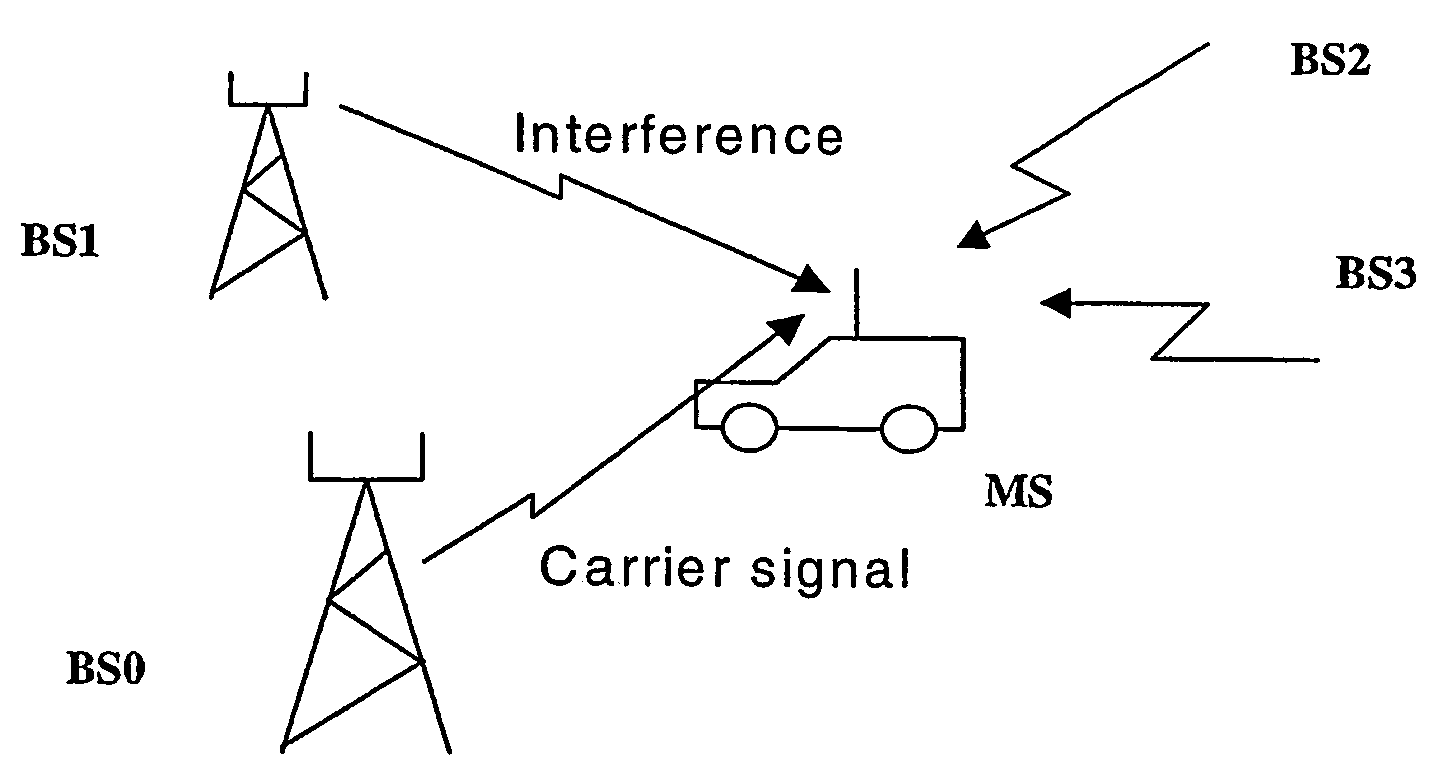
[0031]FIG. 1 shows a simplified diagram of a part of a mobile radio system, for instance a GSM system with a sending base station BS0 and an interfering base station BS1 on near distance from BS0. Only two base stations are shown for the sake of simplicity, however it is understood that the system includes several more interfering base stations BS2,BS3, . . . as indicated. Base stations BS0,BS1, . . . are transmitting radio signals to a mobile station MS which is using the method according to the present invention. The mobile station MS can be in an operator's vehicle in which equipment using the method of the present invention is installed and is managed by educated personnel.

[0032]The signals transmitted between the base station BS0 and the mobile station MS are TDMA-signals transmitted by a carrier, i.e. a determined frequency which is one of a number of frequencies characteristic for that area (cell) which the base station BS0 is serving. The radio signal from BS0 is considered ...

the structure of the environmentally friendly knitted fabric provided by the present invention; figure 2 Flow chart of the yarn wrapping machine for environmentally friendly knitted fabrics and storage devices; image 3 Is the parameter map of the yarn covering machine
Login to View More

PUM

No PUM Login to View More

Abstract

The present invention relates to a method to identify one or more interference sources in a mobile radio system, preferably in a GSM radio network for mobile telephones. A received signal (r) consists of a wanted signal and a number of interference signals of which one is a dominating interference signal and where all signals includes a known training sequence (TK1,TK2, . . . ). The carrier is estimated and subtracted from the received signal (r) giving a remaining interference signal (s).This signal is correlated against known training sequences (TKj, j=0,1,2, . . . ,7) resulting in a training sequence associated with the interfering signal. According to the invention, the identification code (BCC) of a possible interference source (BS1) from said training sequence is determined. After that, a number of candidates (CA1,CA2, ), each corresponding with a certain cell from the identification code (BCC) are determined and also the frequency which is disturbed and the timing offset (t1,t2, . . . FIG. 7) for the frequencies used by said candidates. Finally it is investigated if one or more (fa,fb) of these have the same time offset as the interference signal (t0) resulting in that at least one candidate (CA3) with the best matching offsets on its frequencies is identified as the interference source.

Description

BACKGROUND OF THE INVENTION[0001]The present invention relates to a method to identify one or more interference sources in a mobile radio system, preferably in a GSM radio network for mobile telephones.DESCRIPTION OF PRIOR ART[0002]In a GSM radio network, frequencies must be reused since there is a limited number of frequencies available for a GSM radio network operator. The reuse of frequencies causes interference; i.e. the radio signal received at a certain point is a mixture of the carrier signal and signals from other sources. The carrier signal originates from the serving cell (the cell the mobile has a radio link to) and the interfering signal often from other GSM cells.[0003]An important task for a GSM radio network operator is to reduce the amount of interference in the network. Clever frequency planning where frequencies are reused as sparsely as possible does this. However, since the traffic in GSM network increases, the frequencies must be reused tighter and tighter (with...

Claims

the structure of the environmentally friendly knitted fabric provided by the present invention; figure 2 Flow chart of the yarn wrapping machine for environmentally friendly knitted fabrics and storage devices; image 3 Is the parameter map of the yarn covering machine
Login to View More

Application Information

Patent Timeline
no application Login to View More
Patent Type & Authority Patents(United States)
IPC IPC(8): H04B1/00H04B15/00H04W24/00
CPCH04W24/00
Inventor LARSSON, KJELLSVENSSON, BJORNGUSTAFSSON, JORGEN
Owner ASCOM NETWORK TESTING
Features
  • R&D
  • Intellectual Property
  • Life Sciences
  • Materials
  • Tech Scout
Why Patsnap Eureka
  • Unparalleled Data Quality
  • Higher Quality Content
  • 60% Fewer Hallucinations
Social media
Patsnap Eureka Blog
Learn More