

Cell-based switch fabric with distributed scheduling
a cell-based switch fabric and distributed scheduling technology, applied in the field of high-capacity switch fabric, can solve the problems of limiting the throughput of the switch, affecting the smooth operation of the switch, so as to achieve compact and efficient, low memory requirements
- Summary
- Abstract
- Description
- Claims
- Application Information
AI Technical Summary
Benefits of technology
Problems solved by technology
Method used
Image

Examples
Embodiment Construction
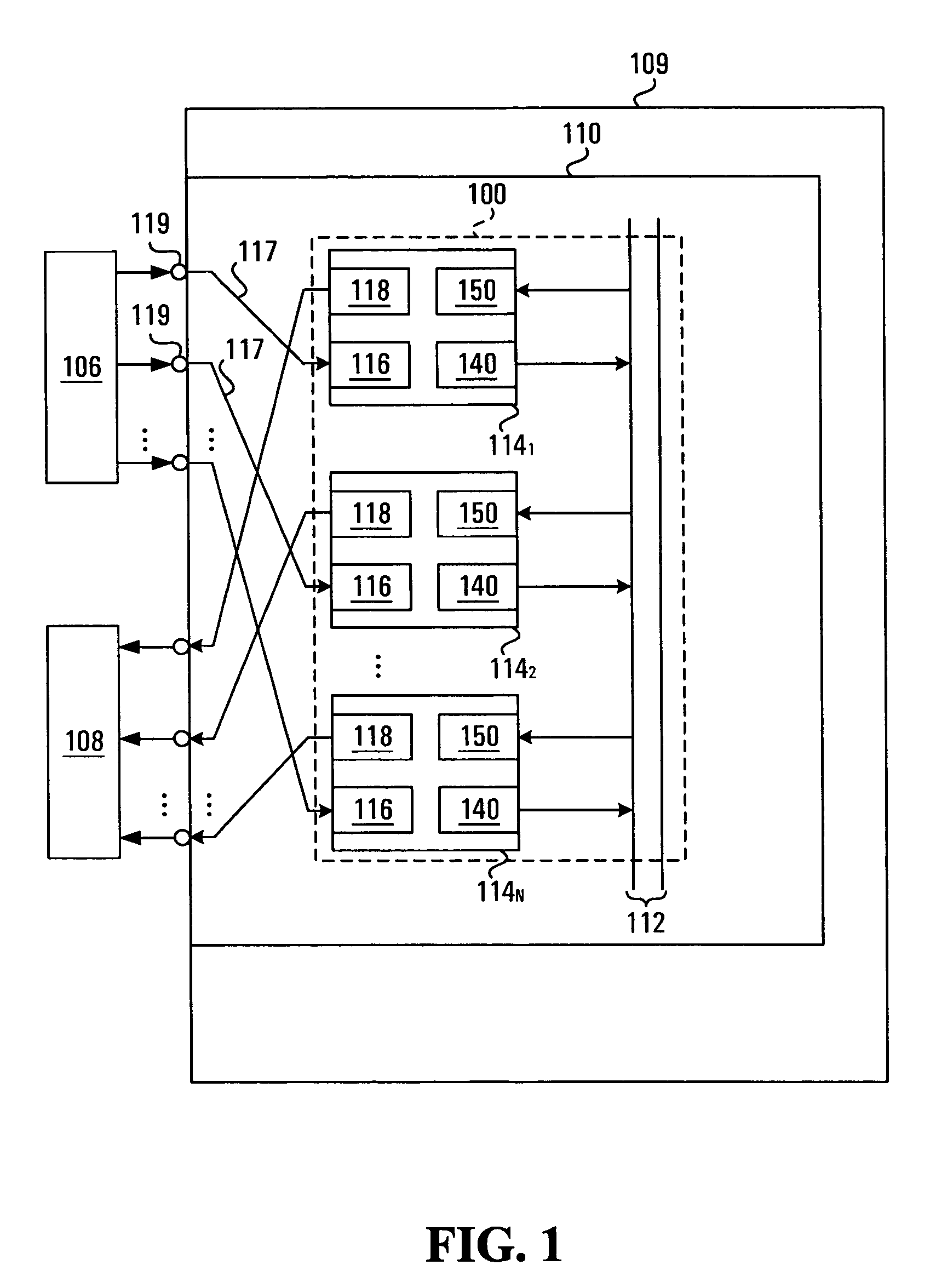
[0039]With reference to FIG. 13, there is shown a packet switch 105, comprising one or more line cards 106, 108, also referred to in the art as tributary cards. The line cards 106, 108 are connected at one end to a core network 107 or to other packet switches or routers. The line cards 106, 108 are connected at another end to one or more switch cards 109. Line cards 106 receive packets from the core network 107 and transmit them to the switch cards 109, while line cards 108 receive switched packets from the switch cards 109 and transmit them to the core network 107. In many embodiments, the line cards 106 are bi-directional. A mid-plane (not shown) may be provided to facilitate interconnection between the line cards 106, 108 and the switch card(s) 109.
[0040]Each switch card 109 has a plurality of input ports and a plurality of output ports. From the point of view of an individual switch card 109, the line cards 106 are input line cards as they supply packets to the input ports of th...
PUM
 Login to View More
 Abstract
Description
Claims
Application Information
 Login to View More