
Combined system responses in a chip multiprocessor
a multi-processor and integrated system technology, applied in the field of processors, can solve problems such as the number of processor cores affecting the operation of the computer system
- Summary
- Abstract
- Description
- Claims
- Application Information
AI Technical Summary
Problems solved by technology
Method used
Image

Examples
Embodiment Construction
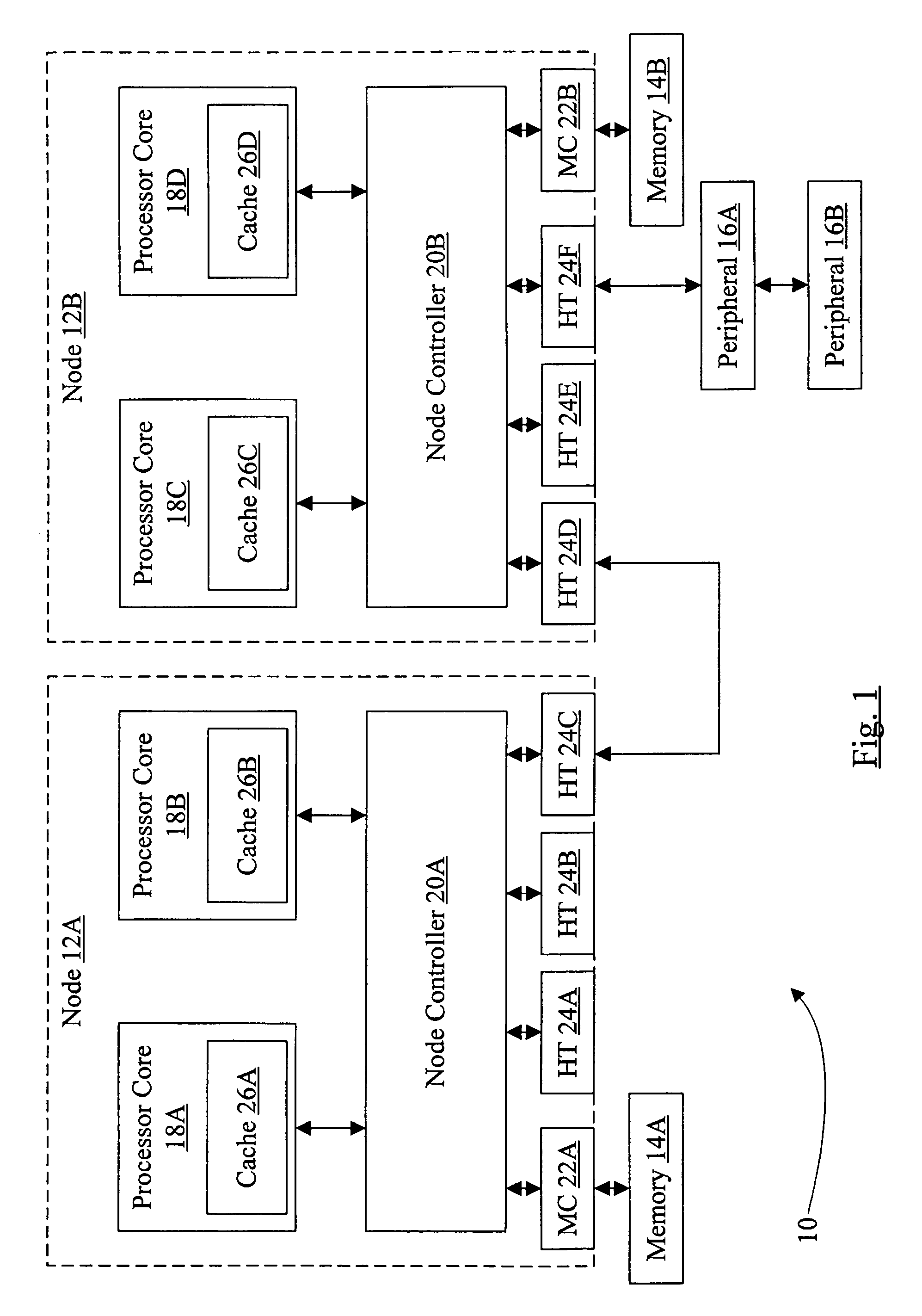
[0018]Turning now to FIG. 1, a block diagram of one embodiment of a computer system 10 is shown. In the illustrated embodiment, the computer system 10 includes nodes 12A-12B, memories 14A-14B, and peripheral devices 16A-16B. The nodes 12A-12B are coupled, and the node 12B is coupled to the peripheral devices 16A-16B. Each of the nodes 12A-12B are coupled to respective memories 14A-14B. The node 12A comprises processor cores 18A-18B coupled to a node controller 20A which is further coupled to a memory controller 22A and a plurality of HyperTransport™ (HT) interface circuits 24A-24C. The node 12B similarly comprises processor cores 18C-18D coupled to a node controller 20B which is further coupled to a memory controller 22B and a plurality of HT interface circuits 24D-24F. The HT circuits 24C-24D are coupled (via an HT interface, in this embodiment) and the HT circuit 24F is coupled to the peripheral device 16A, which is coupled to the peripheral device 16B in a daisy-chain configurati...
PUM
 Login to View More
 Abstract
Description
Claims
Application Information
 Login to View More