
Method for fabricating semiconductor device and display device
a technology of display device and semiconductor, applied in the direction of liquid/solution decomposition chemical coating, superimposed coating process, instruments, etc., can solve the problems of increasing cost, reducing yield, and inability to meet users' needs, so as to reduce defects and reduce unevenness.
- Summary
- Abstract
- Description
- Claims
- Application Information
AI Technical Summary
Benefits of technology
Problems solved by technology
Method used
Image

Examples
embodiment mode 1
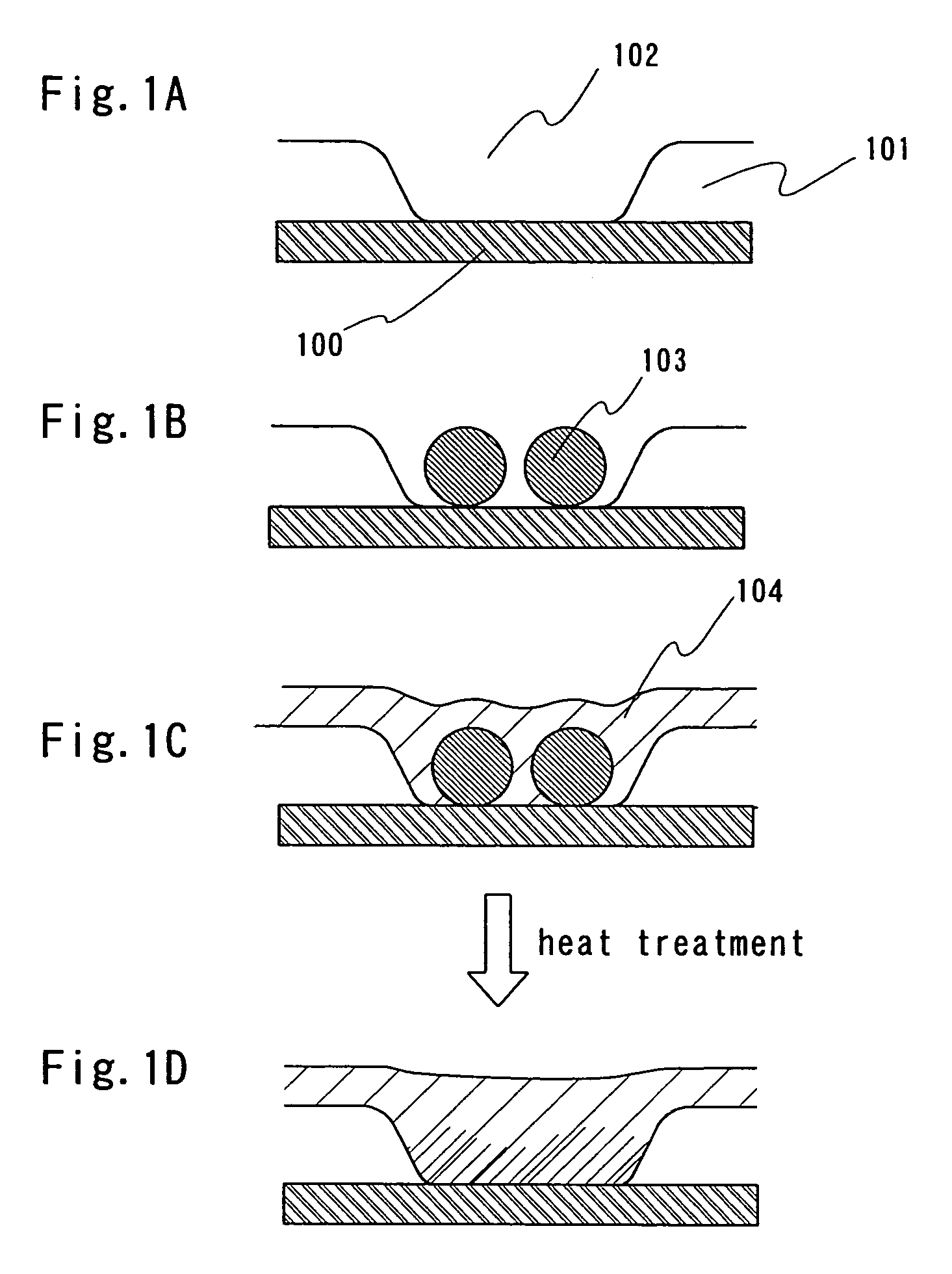
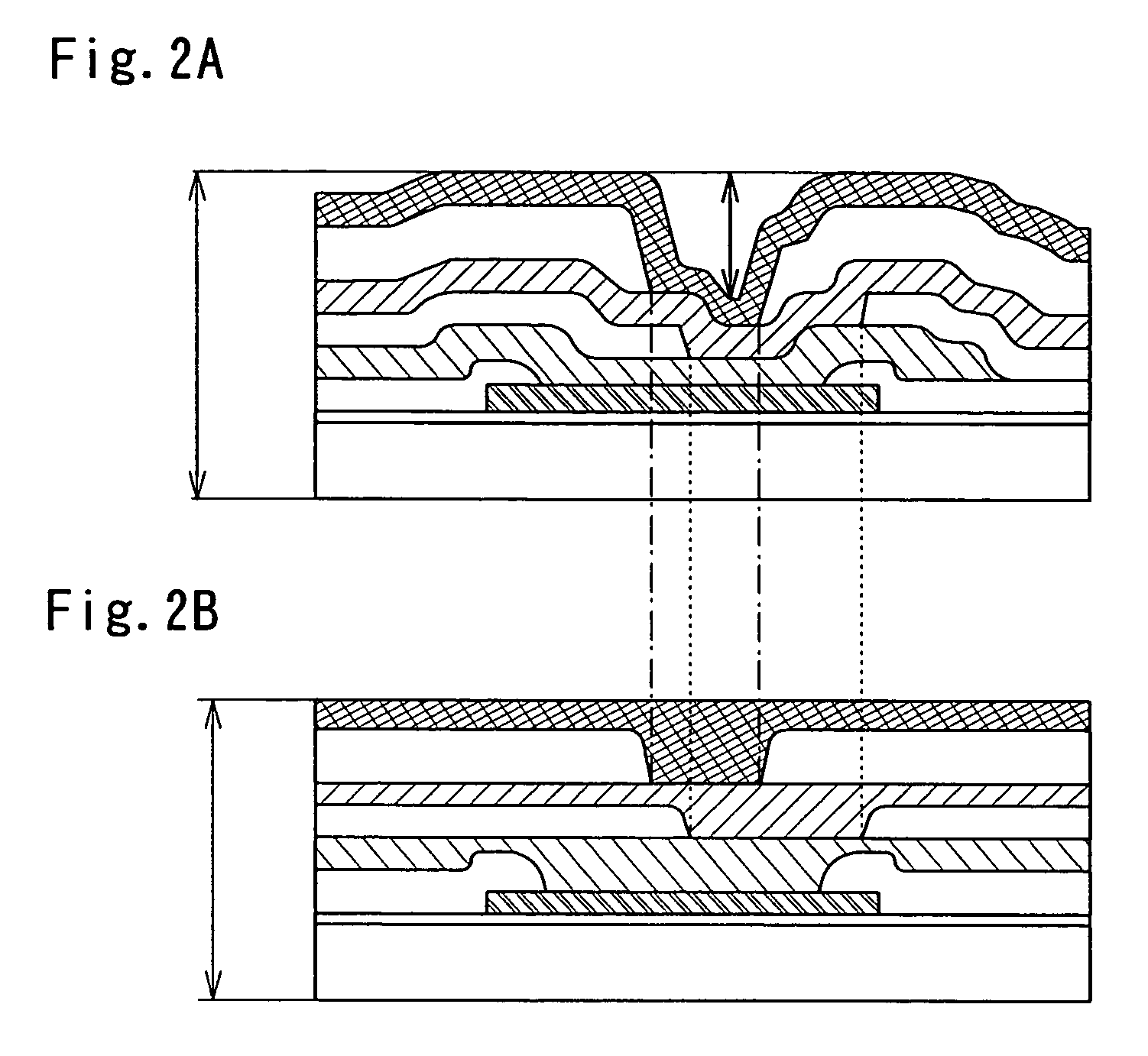
[0038]An embodiment mode of the invention will be described with reference to FIGS. 1A to 2B.
[0039]In FIGS. 1A to 1D, a contact hole 102 is formed in an insulating film 101 (FIG. 1A), and the wiring 104 is formed over the insulating film 101 over a conductive layer 100 on a surface. Thus, the wiring 104 is connected to the conductive layer 100 through the contact hole 102.
[0040]Next, a contact hole 102 is filled with conductive fine particles 103 (FIG. 1B). Material which has high wettability with a material of a wiring 104 may be used for the conductive fine particles 103.
[0041]Next, a wiring 104 is formed so as to cover at least the conductive fine particles 103 and a part of the contact hole 102 (FIG. 1C). Since the conductive fine particles 103 uses material having high wettability with a material of the wiring 104, the conductive fine particles 103 can be easily dispersed in the wiring material, and a contact can be made. Thus, planarization of the contact hole can be realized ...
embodiment mode 2
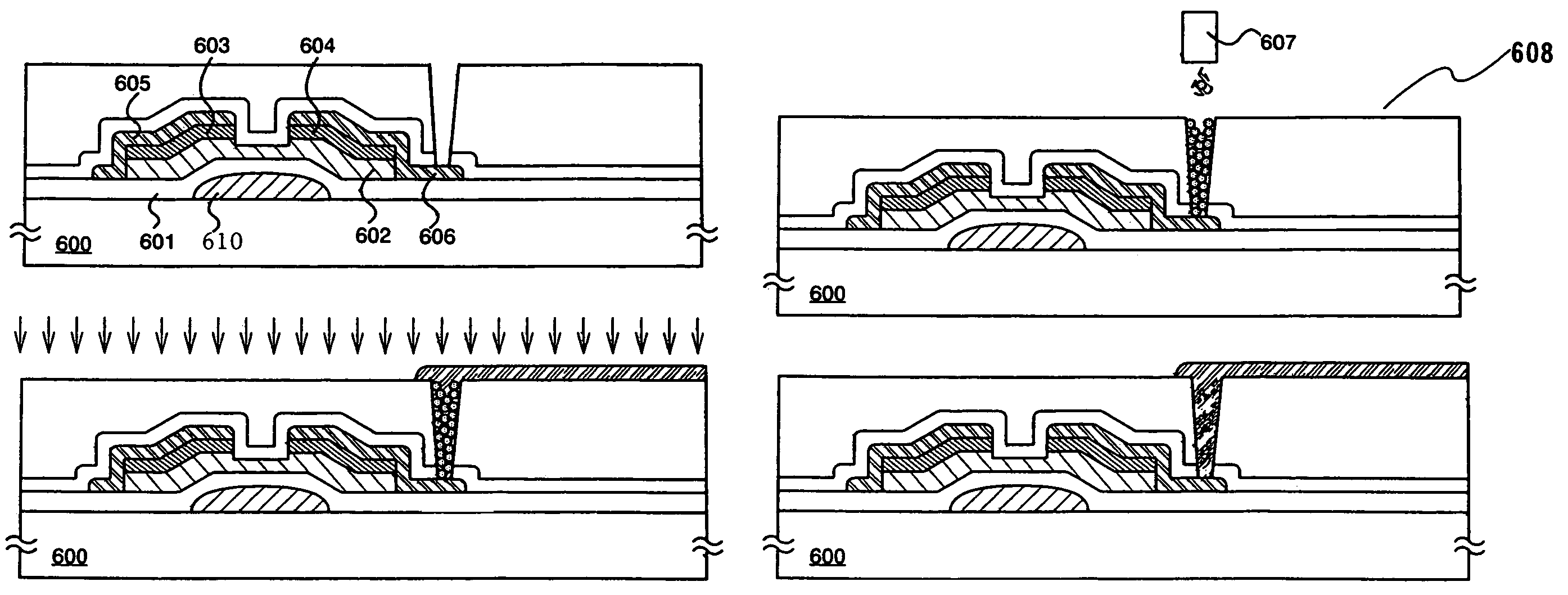
[0044]An embodiment mode of the invention will be described with reference to FIGS. 5A to 5D. In this embodiment mode, a contact hole 102 can be selectively filled with a dispersion liquid 108 containing the conductive fine particles 103 by employing droplet discharging method, thereby obtaining planarity.
[0045]The droplet discharging method is commonly referred to as an ink-jet method. In the technology, droplets of a solution to be applied are discharged from a nozzle 107 and applied to a certain area. In the invention, the technology is applied using a special ink in which the conductive fine particles 103 are dispersed.
[0046]The contact hole 102 formed in the insulating film 101 is filled with the dispersion liquid 108 containing the conductive fine particles 103 discharged from the nozzle 107 of a drop discharging device so that the wiring 104 can be electrically connected to the conductive layer 100 in the lower layer.
[0047]The filling of the contact hole by droplet dischargin...
embodiment mode 3
[0056]Another embodiment mode of the invention will be described with reference to FIGS. 7A to 7E. A dispersion liquid 108 of conductive fine particles 103 is applied all over the insulating film where a contact hole 102 is formed by an application method such as spin coating so as to be connected to a conductive layer 100. Next, a material having a shape which does not damage the substrate surface, such as a silicon resin plate (in this embodiment mode, a spatula 111 of silicon resin is used) is pushed to the substrate surface and moved so as to fill the contact hole 102 with the applied dispersion liquid 108 containing the conductive fine particles 103. Concurrently, the dispersion liquid 108 containing the conductive fine particles 103 adhered to an undesired portion is removed. Thus, only inside the contact hole 102 can be selectively filled with the dispersion liquid 108 containing the conductive fine particles 103.
[0057]Other than by spin coating, the contact hole can also be ...
PUM
| Property | Measurement | Unit |
|---|---|---|
| diameter | aaaaa | aaaaa |
| evaporating temperature | aaaaa | aaaaa |
| melting point | aaaaa | aaaaa |
Abstract
Description
Claims
Application Information
 Login to View More