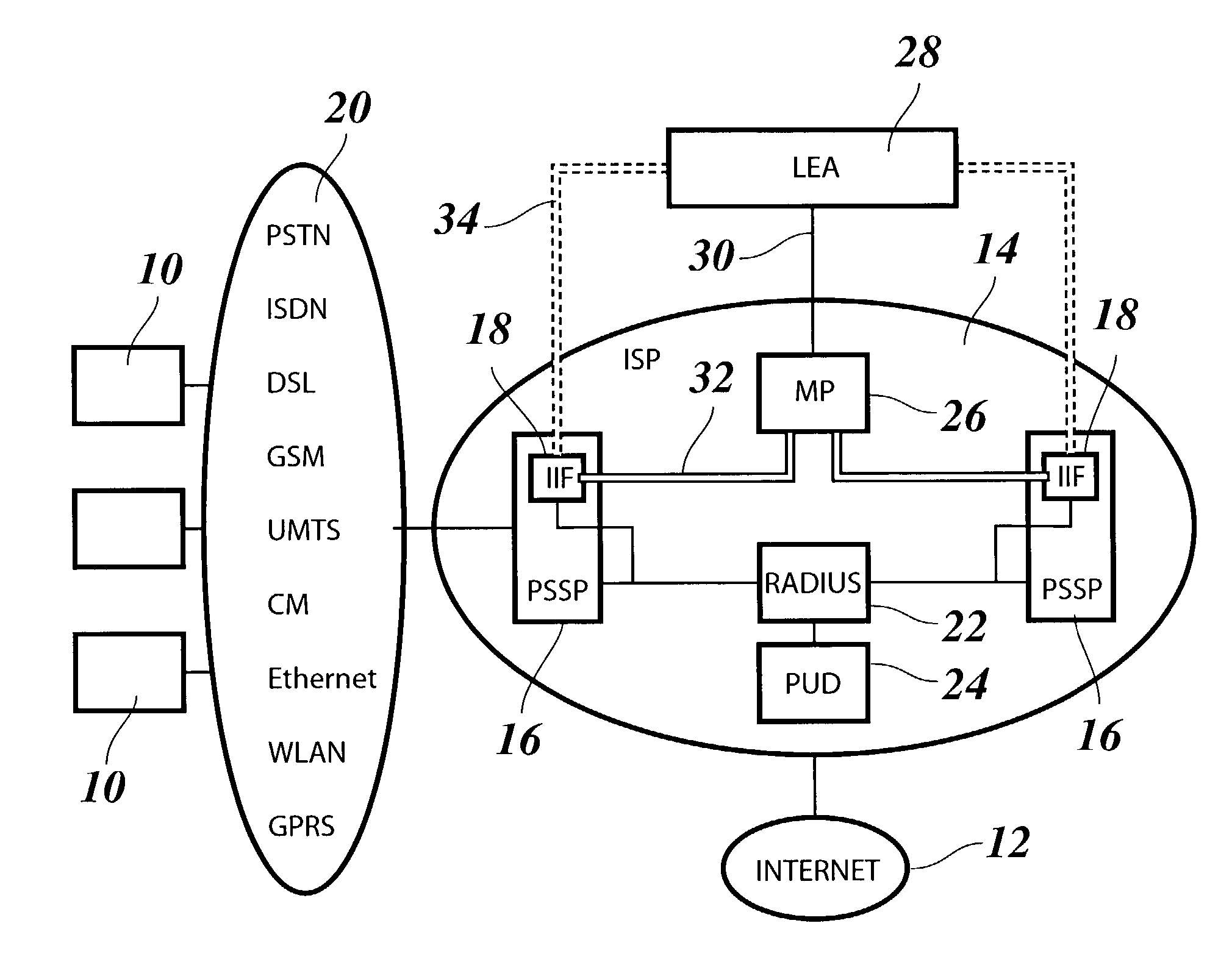
[0023]It is an
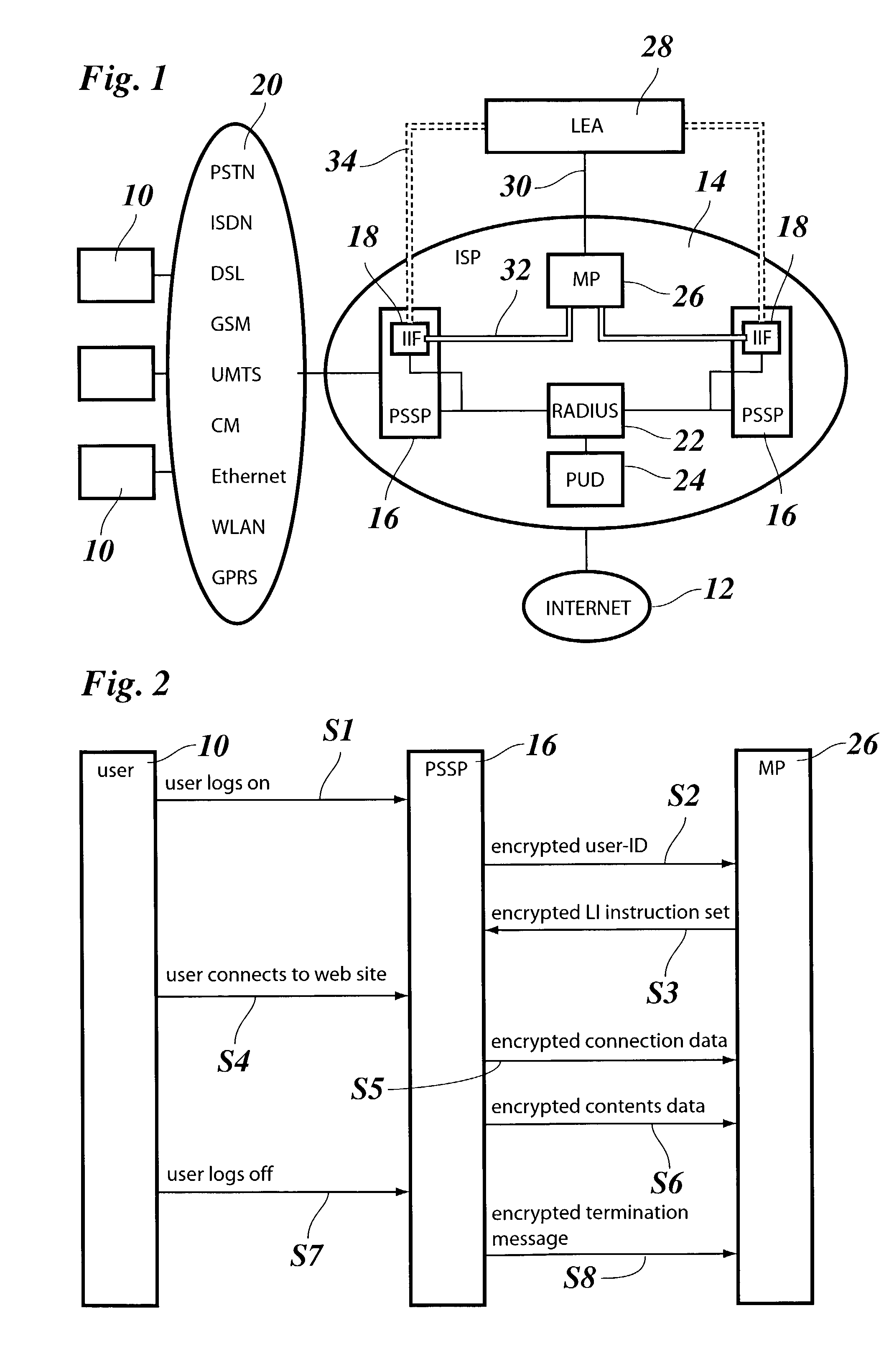
advantage of the invention that the traffic between the PSSP and the mediation device and also most of the traffic between the PSSP and IMC is encrypted, so that it cannot be understood by an observer monitoring the traffic (
encryption of the target-ID sent to the IMC may however be dispensed with). Thus, even the
service provider's employees, for whom it would most likely be possible to monitor the traffic, cannot easily discover the identity of the lawful interception target. From the viewpoint of secrecy requirements, it is a further
advantage that it is not necessary to implement the functionality of the IMC at each individual PSSP. The IMC and the mediation device may be located remote from the PSSP(s) and may thus be centralized, so that considerable
cost savings can be achieved without violating secrecy requirements. Further, since no information on the identity of the lawful interception targets is permanently present at the individual PSSPs, and, if present, is stored in encrypted form or in an encrypted file, the personnel having access only to the PSSPs will not be able to identify the interception targets or determine if a true interception target is accessing that particular PSSP. The identity of the interception targets will only be known to a very limited number of employees, if any, who have access to the information stored in the single IMC or relatively few centralized IMCs, or have special operator privileges not available to non-security screened staff. It is understood that only a few staff members of the
service provider, if any, have access to a secured area or locked room where the IMC may be located as well as the Mediation Device.
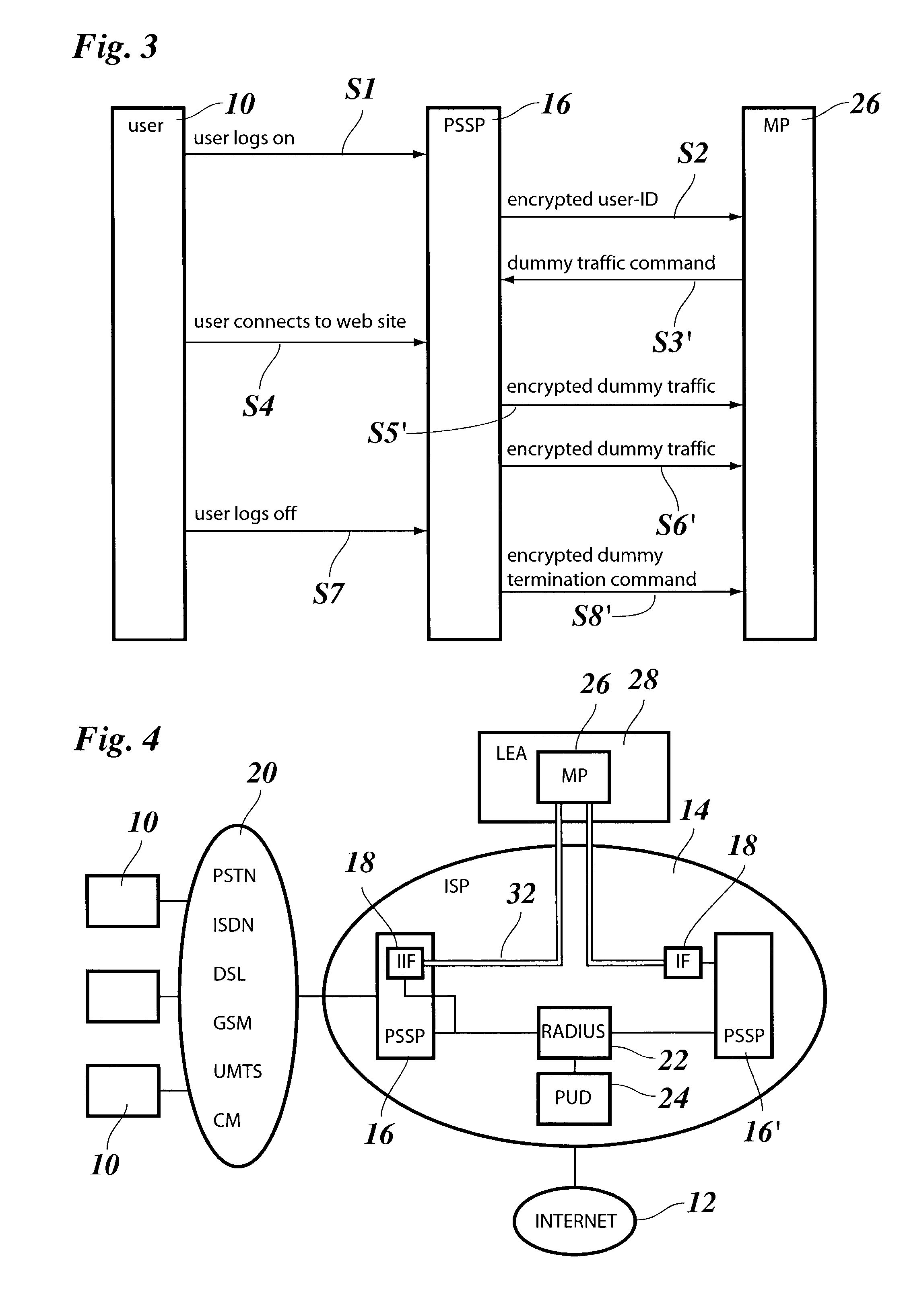
[0024]According to another important feature of the invention the security and secrecy is further enhanced by obscuring even the fact that interception-related traffic occurs between the PSSP and the mediation device. To this end, the interception instruction set sent from the IMC to the PSSP may specify that even in those cases in which the user is not to be intercepted or is not even a lawful interception target at all,
dummy data traffic is created between the PSSP and the mediation device, so that an unauthorized observer who may monitor the encrypted
data traffic cannot decide whether the traffic he sees is only dummy traffic or a hint to an actual interception process.
[0025]This enables the service provider to outsource the operation of the IMC and / or the mediation device to a
third party company, which may
handle all interception warrants presented from law
enforcement agencies on the service-provider's behalf, without any employee of the service provider knowing about the details of a warrant.
[0026]The dummy interception traffic may be triggered by real
packet arrival events at the PSSP or, alternatively, by random events or any other events, such as
timer expiry. However, the dummy traffic shall not contain any subscriber data. In case that real subscriber traffic was used as triggering event for the dummy traffic, the contents are scrambled and made useless, so that the
receiver or an observer cannot gather any useful information on the actual subscriber traffic. Thus, in
spite of the dummy traffic, the privacy of the subscriber will be protected in case that the subscriber is not a lawful interception target.
[0027]Optionally, the invention may further include one or more of the following features:
[0028]Sending re-classification messages from the IMC to the PSSP in order to reclassify an already active user to a different interception mode when, for example, a new interception warrant has to be implemented for an already active user, a warrant for an active user shall be terminated when the duration of the warrant has expired, a warrant for an active user is being withdrawn prior to expiration, or when the scope of a warrant for an active user is being changed necessitating a reclassification, e.g. from partial to full interception, or from no-interception to dummy-interception, or from dummy interception to no-interception.


 Login to View More
  Login to View More