
Materials and methods for controlling isotope effects during fractionation of analytes
a technology material, applied in the science of proteomics, can solve the problems of significant errors in protein/peptide quantitation and identification, and achieve the effect of improving the accuracy of isotope abundance ratio measurement and reducing or eliminating systematic errors in measuremen
- Summary
- Abstract
- Description
- Claims
- Application Information
AI Technical Summary
Benefits of technology
Problems solved by technology
Method used
Image

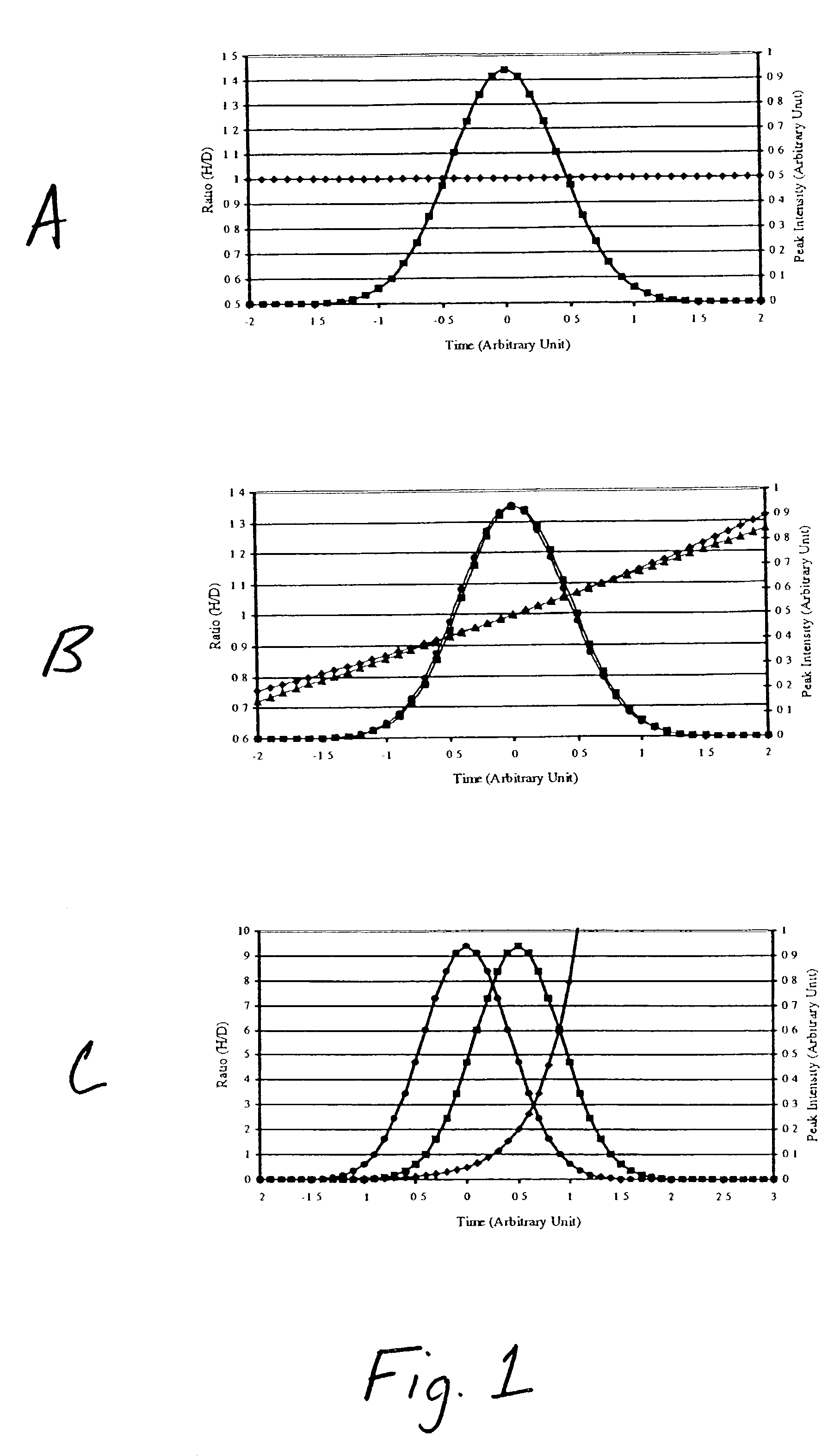
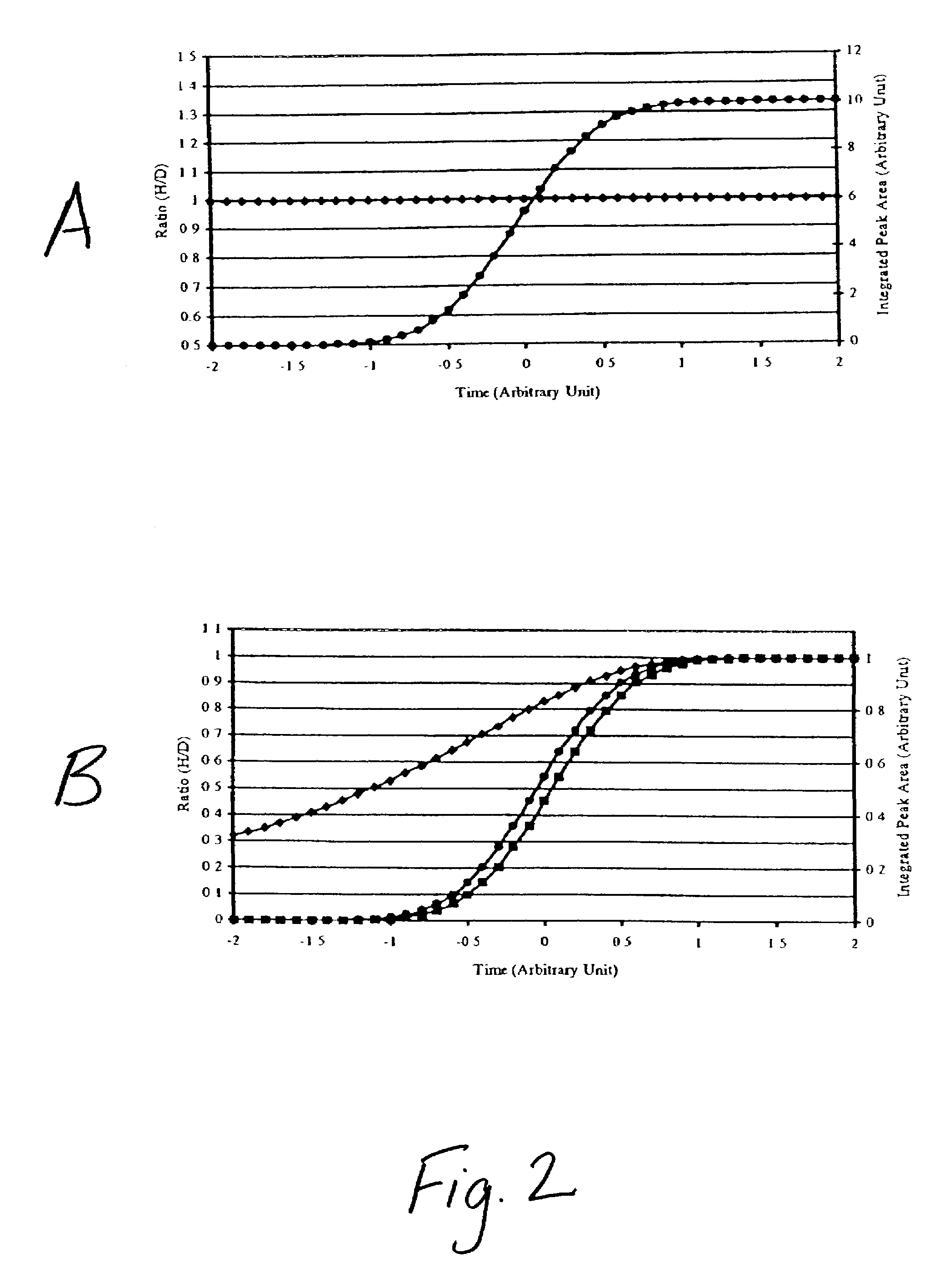
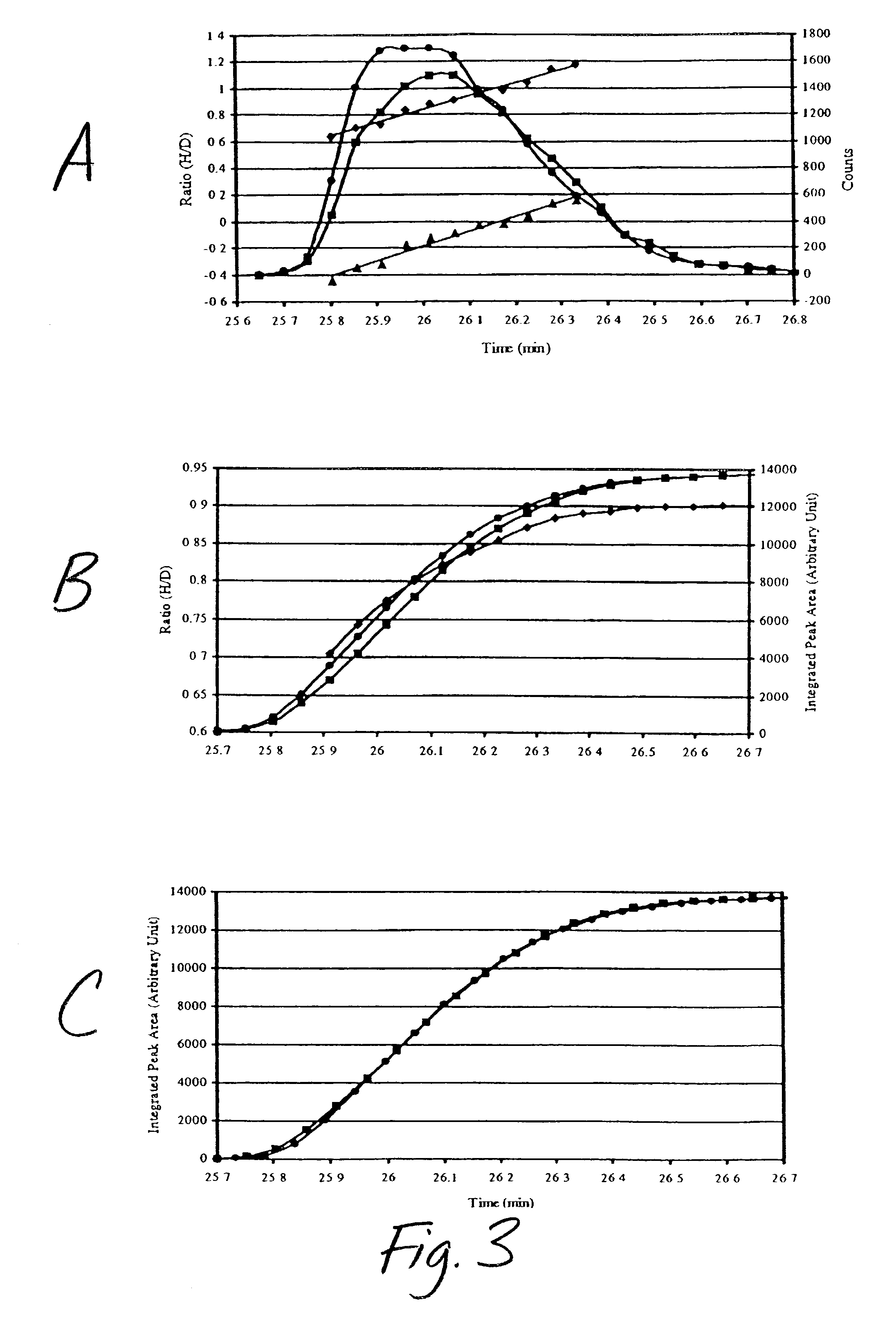
Examples
example 1
Fractionation of Isotopically Labeled Peptides in Quantitative Proteomics
[0157]This study examines the extent to which isotopic forms of peptides having the same amino acid sequence are resolved by reversed-phase chromatography and assesses the degree to which resolution of these isotopically different forms of a peptide impact quantification.
Materials and Methods
[0158]Materials. Human angiotensin I (Asp-Arg-Val-Tyr-Ile-His-Pro-Phe-His-Leu-OH), HPLC-grade acetonitrile (ACN), N-hydroxysuccinimide, N-acetoxysuccinimide, monobasic sodium phosphate, dibasic sodium phosphate, acetic-d6-anhydride, succinic anhydride, and succinic-d4-anhydride were purchased from Sigma-Aldrich Co. (St. Louis, Mo.). The PepMap C18 4.6 i.d. (internal diameter)×250 mm was purchased from Applied Biosystems (Framingham, Mass.). Double-deionized water (ddI H2O) was produced by a Milli-Q Gradient A10 System from Millipore Co. (Bedford, Mass.). All reagents were used directly without further purification.
[0159]Syn...
example 2
Minimizing Chromatographic Resolution Using 13C / 12C-Coded Peptide Isoforms
[0200]This experiment was conducted to determine the magnitude of the isotope effect with a commercial deuterated coding agent and to assess the degree to which isotope effects can be minimized with a 13C labeled derivatizing agent.
Materials and Methods
[0201]Materials. Bovine serum albumin (BSA), HPLC grade acetonitrile (ACN), succinic anhydride, acetyl chloride, phosphorus pentoxide, dithiothreitol (DTT), iodoacetic acid (IAA), urea, tris(hydroxymethy)aminomethane (Tris base), tris(hydroxymethyl)aminomethane hydrochloride (Tris acid), calcium chloride were purchased from Sigma-Aldrich (St. Louis, Mo.). Trifluoroacetic acid (Sequanal Grade) was obtained from Pierce (Rockford, Ill.). Sequencing grade modified trypsin was purchased from Promega (Madison, Wis.). Butanedioic acid-13C4 was supplied by Isotec (Miamisburg, Ohio). The ICAT kit was purchased from Applied Biosystems (Framingham, Mass.). A C18 column (2....
example 3
High Throughput Proteomics by Minimizing Isotopic Fractionation and Intelligent Data Acquisition (IDA)
[0223]This work further demonstrates that the isotopic fractionation can be minimized by using reagents containing 13C or 18O instead of 2H, which in turn allows accurate quantification of relative protein expression / modification levels and high throughput identification of up or down-regulated proteins by real time ratio determination (RTRD) and intelligent data acquisition (IDA). An accurate ratio between experimental and control samples can be determined in the early stage of their elution peak, and only those peptides that are significantly up or down-regulated need to be fragmented.
Materials and Methods
[0224]Materials. Cytochrome c, HPLC grade acetonitrile (ACN), N-hydroxysuccinimide, ammonium bicarbonate, succinic anhydride, acetic anhydride, acetyl chloride, phosphorus pentoxide, urea, hydroxylamine hydrochloride were purchased from Sigma-Aldrich (St. Louis, Mo.). Trifluoroac...
PUM
| Property | Measurement | Unit |
|---|---|---|
| Force | aaaaa | aaaaa |
| Volume | aaaaa | aaaaa |
| Volume | aaaaa | aaaaa |
Abstract
Description
Claims
Application Information
 Login to View More