Supercharge Your Innovation With Domain-Expert AI Agents!

Zoom lens system, imaging device and camera

a zoom lens and imaging device technology, applied in the field of zoom lens systems, imaging devices and cameras, can solve the problems of not meeting the requirements of digital cameras of recent years, the width of the view angle at a wide angle limit and the inability to simultaneously realize the size reduction, etc., and achieve the effect of reducing thickness

Inactive Publication Date: 2010-07-13
PANASONIC CORP
View PDF32 Cites 2 Cited by
  • Summary
  • Abstract
  • Description
  • Claims
  • Application Information

AI Technical Summary

Benefits of technology

The solution enables a compact and thin camera design with a wide view angle and zooming ratio exceeding 3.2, while maintaining optical performance and reducing overall length during non-use.

Problems solved by technology

Nevertheless, width of the view angle at a wide-angle limit and size reduction are not simultaneously realized.
In particular, from the viewpoint of size reduction, requirements in digital cameras of recent years are not satisfied.

Method used

the structure of the environmentally friendly knitted fabric provided by the present invention; figure 2 Flow chart of the yarn wrapping machine for environmentally friendly knitted fabrics and storage devices; image 3 Is the parameter map of the yarn covering machine
View more

Image

Smart Image Click on the blue labels to locate them in the text.
Viewing Examples
Smart Image
  • Zoom lens system, imaging device and camera
  • Zoom lens system, imaging device and camera
  • Zoom lens system, imaging device and camera

Examples

Experimental program
Comparison scheme
Effect test

embodiments i-1 to i-2

, II-1 to II-2 and III-1 to III-2

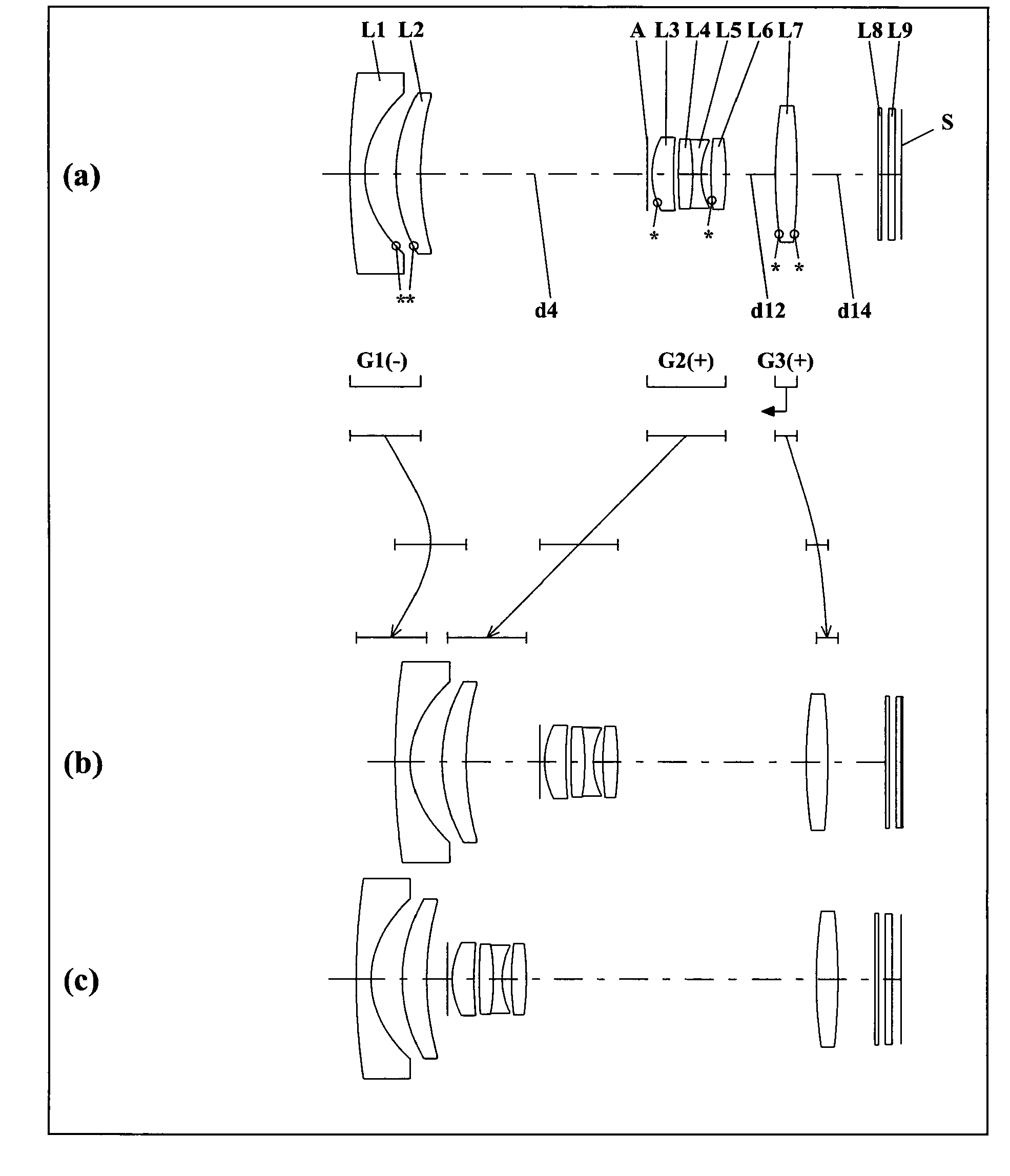
[0170]FIG. 1 is a lens arrangement diagram of a zoom lens system according to Embodiments I-1, II-1 and III-1. FIG. 4 is a lens arrangement diagram of a zoom lens system according to Embodiments I-2, II-2 and III-2.

[0171]FIGS. 1 and 4 show respectively a zoom lens system in an infinity in-focus condition. In each figure, part (a) shows a lens configuration at a wide-angle limit (in the minimum focal length condition: focal length fW), part (b) shows a lens configuration at a middle position (in an intermediate focal length condition: focal length fM=√(fW·fT)), and part (c) shows a lens configuration at a telephoto limit (in the maximum focal length condition: focal length fT). Further, in each figure, straight or curved arrows provided between part (a) and part (b) show the movement of each lens unit from the wide-angle limit to the telephoto limit through the middle position. Moreover, in each figure, an arrow provided to a lens unit indicates focus...

embodiments i-3

, II-3 and III-3

[0314]FIG. 7 is a schematic construction diagram of a digital still camera according to Embodiments I-3, II-3 and III-3. In FIG. 7, the digital still camera comprises: an imaging device having a zoom lens system 1 and an image sensor 2 composed of a CCD; a liquid crystal display monitor 3; and a body 4. The employed zoom lens system 1 is a zoom lens system according to Embodiment I-1, II-1 or III-1. In FIG. 7, the zoom lens system 1 comprises a first lens unit G1, a diaphragm A, a second lens unit G2 and a third lens unit G3. In the body 4, the zoom lens system 1 is arranged on the front side, while the image sensor 2 is arranged on the rear side of the zoom lens system 1. On the rear side of the body 4, the liquid crystal display monitor 3 is arranged, while an optical image of a photographic object generated by the zoom lens system 1 is formed on an image surface S.

[0315]A lens barrel comprises a main barrel 5, a moving barrel 6 and a cylindrical cam 7. When the cy...

numerical examples i-1

, II-1 and III-1

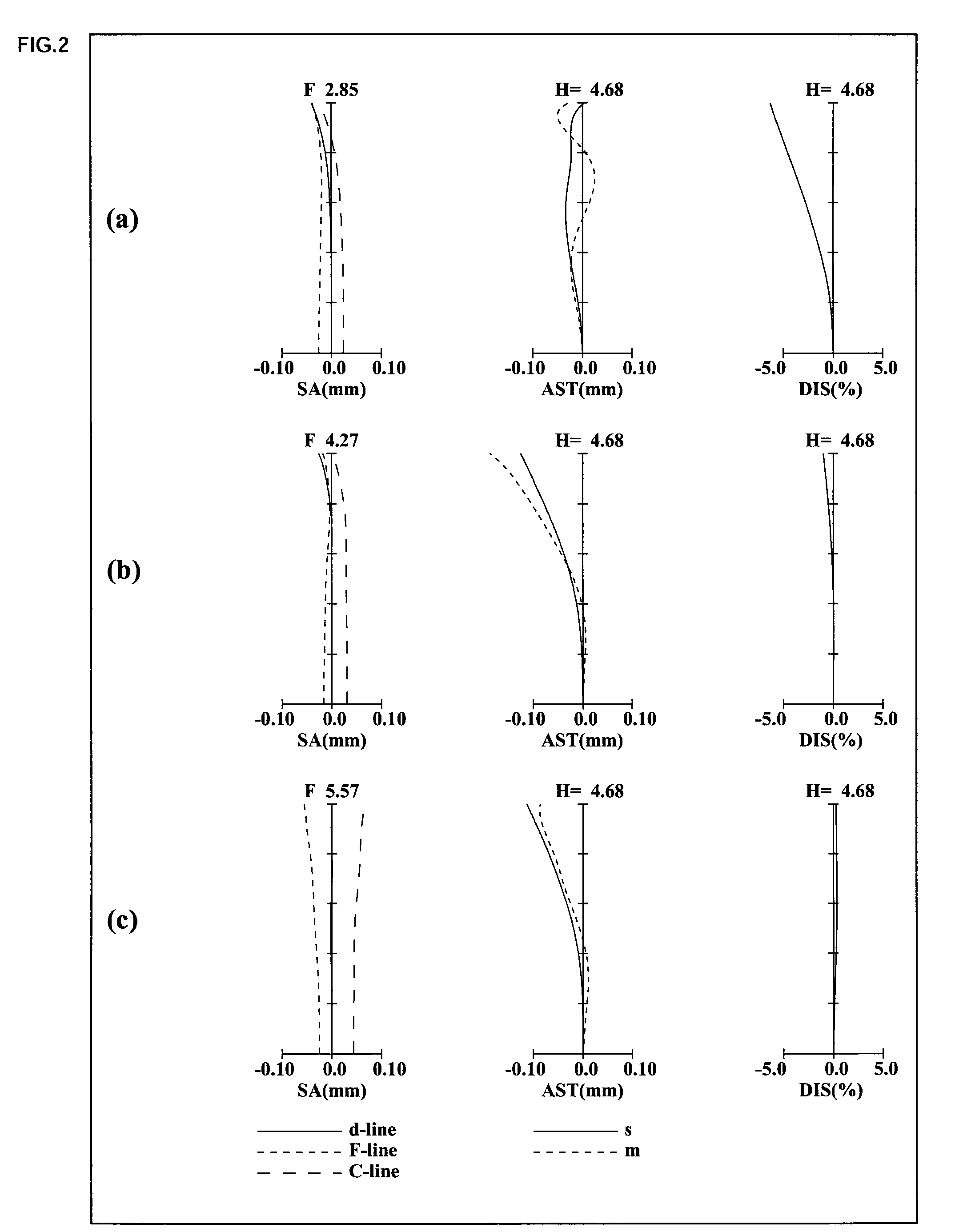
[0329]The zoom lens systems of Numerical Examples I-1, II-1 and III-1 correspond respectively to Embodiments I-1, II-1 and III-1 shown in FIG. 1. Table 1 shows the surface data of the zoom lens systems of Numerical Examples I-1, II-1 and III-1. Table 2 shows the aspherical data. Table 3 shows various data.

[0330]

TABLE 1(Surface data)Surface numberrdndvdObject surface∞∞ 151.085001.100001.9000134.5 2*6.688002.30000 3*12.122001.750002.1400117.0 421.50000Variable 5 (Diaphragm)∞0.35000 6*5.700001.587001.8047041.0 729.046000.37500 838.037001.046001.7291654.7 9−16.500000.630001.7618226.6105.491000.7000011*17.681001.100001.6654755.212−20.90300Variable13*33.436001.600001.6654755.214*−49.83400Variable15∞0.280001.5168064.216∞0.5000017∞0.500001.5168064.218∞0.3700019∞0.29815Image surface∞

[0331]

TABLE 2(Aspherical data)Surface No. 2K = −1.56675E+00, A4 = 4.70570E−04, A6 = 4.66416E−06,A8 = −9.97845E−07, A10 = 4.97712E−08, A12 = −1.08769E−09,A14 = 8.99770E−12Surface No. 3K = 0.00000E+...

the structure of the environmentally friendly knitted fabric provided by the present invention; figure 2 Flow chart of the yarn wrapping machine for environmentally friendly knitted fabrics and storage devices; image 3 Is the parameter map of the yarn covering machine
Login to View More

PUM

No PUM Login to View More

Abstract

A zoom lens system comprising a first lens unit having negative power, a second lens unit having positive power and a third lens unit having positive power, wherein: the first lens unit comprises a first lens element having a concave surface at least on the image side and negative power and a second lens element having a convex surface at least on the object side and positive power; the second lens unit comprises a single third lens element, a cemented lens element of two lens elements having power of mutually different signs and a single sixth lens element; in zooming, all of the lens units move along an optical axis; and conditions (1): 5.0<αiW<20.0 and (I-2): n11≧1.9 (where, 3.2<fT / fW and ωW>35, αiW is an incident angle of a principal ray to an image sensor at a maximum image height at a wide-angle limit, n11 is a refractive index of the first lens element to the d-line, ωW is a half view angle at a wide-angle limit, and fT and fW are focal lengths of the entire system at a telephoto limit and a wide-angle limit, respectively) are satisfied.

Description

CROSS-REFERENCE TO RELATED APPLICATION[0001]This application is based on application Nos. 2007-142629, 2007-142630 and 2007-142631 filed in Japan on May 29, 2007, the contents of which are hereby incorporated by reference.BACKGROUND OF THE INVENTION[0002]1. Field of the Invention[0003]The present invention relates to a zoom lens system, an imaging device and a camera. In particular, the present invention relates to: a zoom lens system that has a remarkably reduced thickness at the time of accommodation so as to be suitable for a lens barrel of so-called retraction type and that is still provided with a wide view angle at a wide-angle limit and with a zooming ratio exceeding 3.2; an imaging device employing this zoom lens system; and a thin and compact camera employing this imaging device.[0004]2. Description of the Background Art[0005]Remarkably strong demands are present for size reduction of cameras such as digital still cameras and digital video cameras (simply referred to as dig...

Claims

the structure of the environmentally friendly knitted fabric provided by the present invention; figure 2 Flow chart of the yarn wrapping machine for environmentally friendly knitted fabrics and storage devices; image 3 Is the parameter map of the yarn covering machine
Login to View More

Application Information

Patent Timeline
no application Login to View More
Patent Type & Authority Patents(United States)
IPC IPC(8): G02B15/14
CPCG02B15/177G02B27/646G02B15/143507
Inventor YAMADA, KATSUYOSHITSUGU, KEIKIMIYATAKE, YOSHITOISHIMARU, KAZUHIKO
Owner PANASONIC CORP
Features
  • R&D
  • Intellectual Property
  • Life Sciences
  • Materials
  • Tech Scout
Why Patsnap Eureka
  • Unparalleled Data Quality
  • Higher Quality Content
  • 60% Fewer Hallucinations
Social media
Patsnap Eureka Blog
Learn More