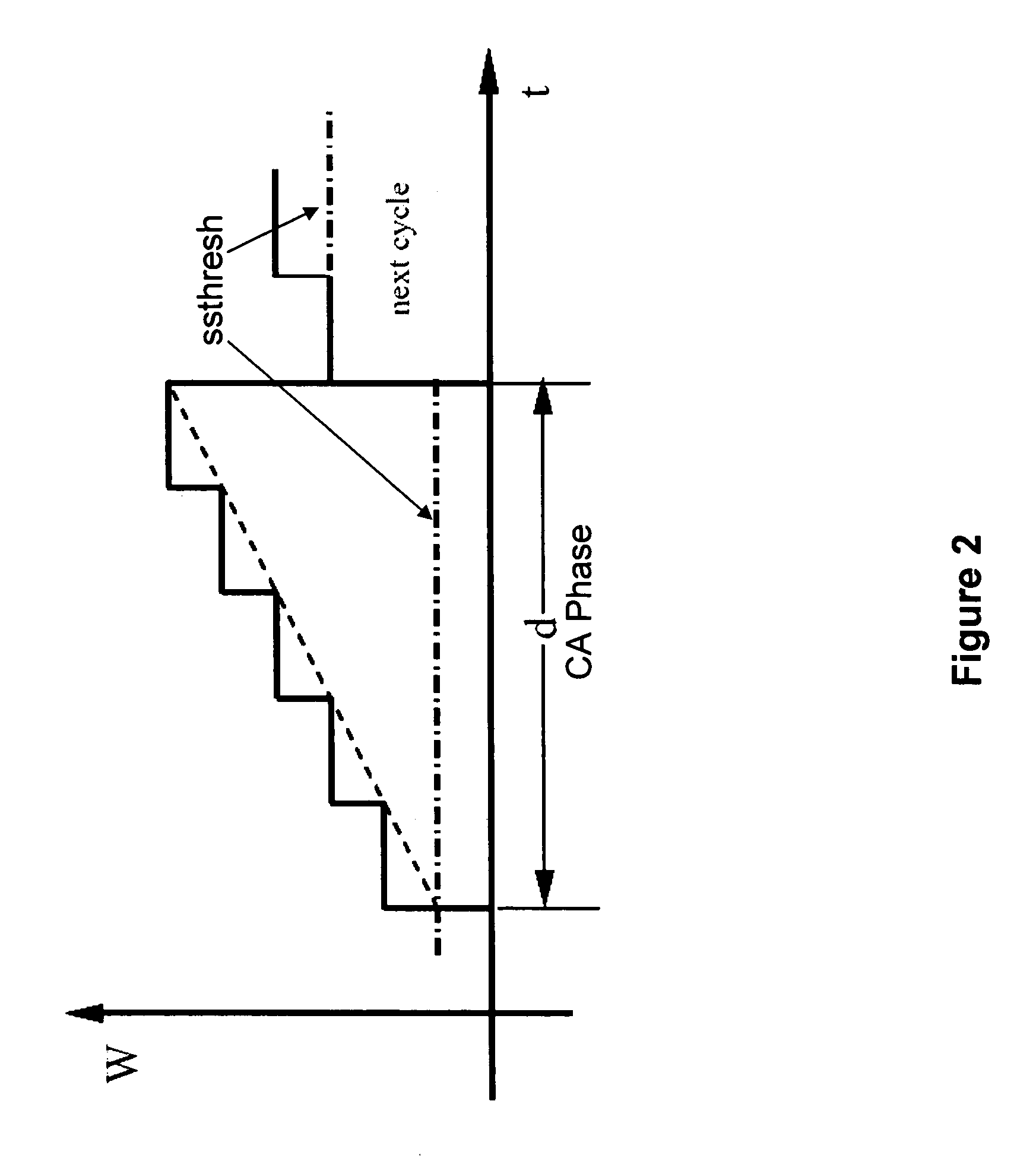
[0008]To optimize the TCP throughput, different congestion window size variation patterns are modelled and the window size for each round of a specific cycle is evaluated. The evaluated window sizes are used by a throughput optimization framework. The progression of each TCP cycle of the TCP source is characterised in terms of rounds, with each round having a specific window size which defines the number of TCP segments to be transmitted. The essence of the optimization lies in the selective protection of TCP segments depending on their transmission round in a current cycle. The loss of a TCP segment early in a cycle is detrimental to TCP throughput, and hence should be prevented via transmission protection over the wireless link. The transmission protection can be rendered through a high segment success probability, which can be attained via adaptive link layer measures, e. g. by selecting different modulation and coding schemas, greater transmission power, etc.
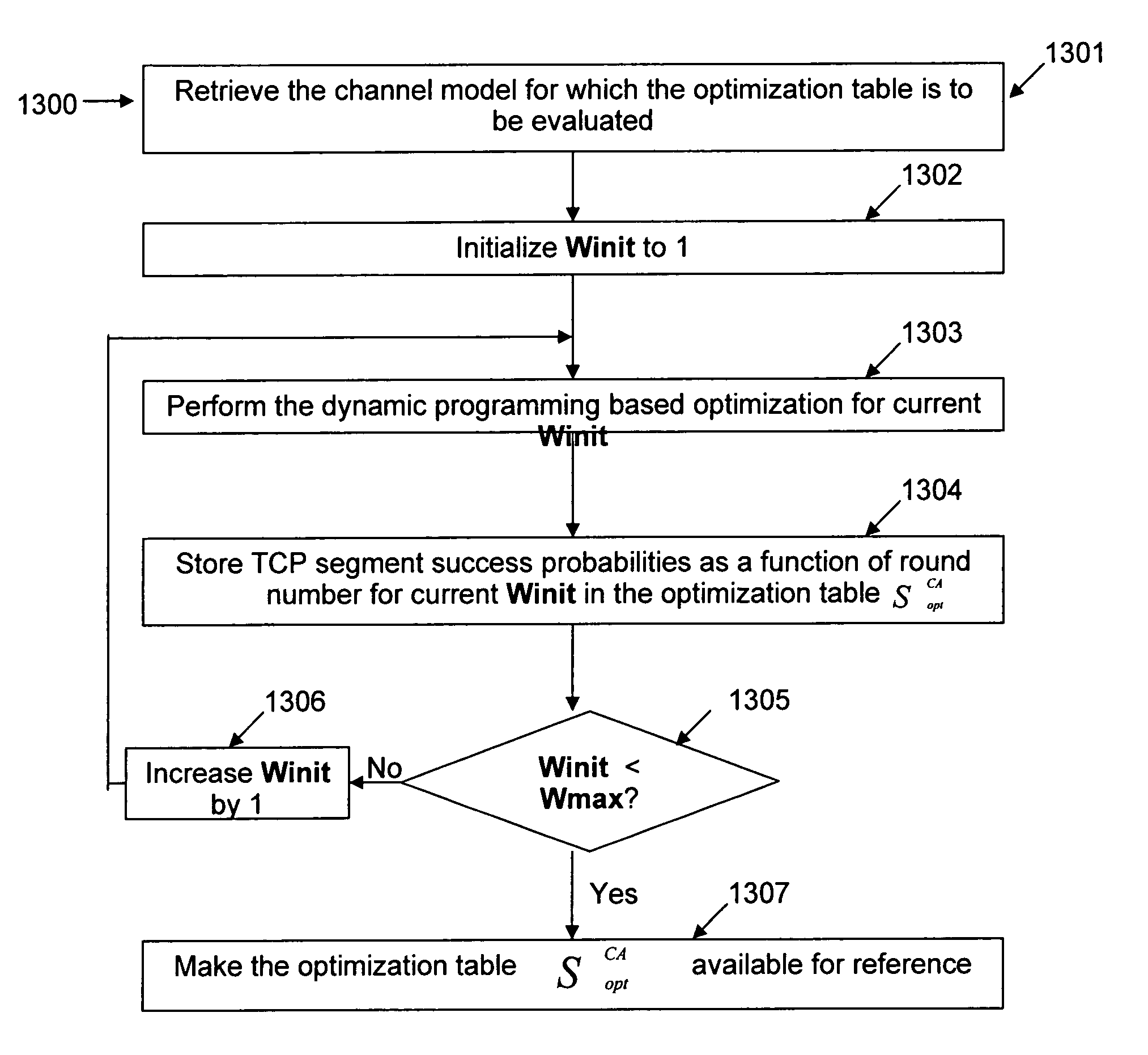
[0019]In a preferred embodiment, a dynamic programming based framework for optimizing the TCP throughput is used. In particular, step d) of calculating the target TCP segment success probabilities is based on finite-period dynamic programming methods, wherein the calculated target TCP segment success probabilities are obtained by minimizing the cost-to-go.
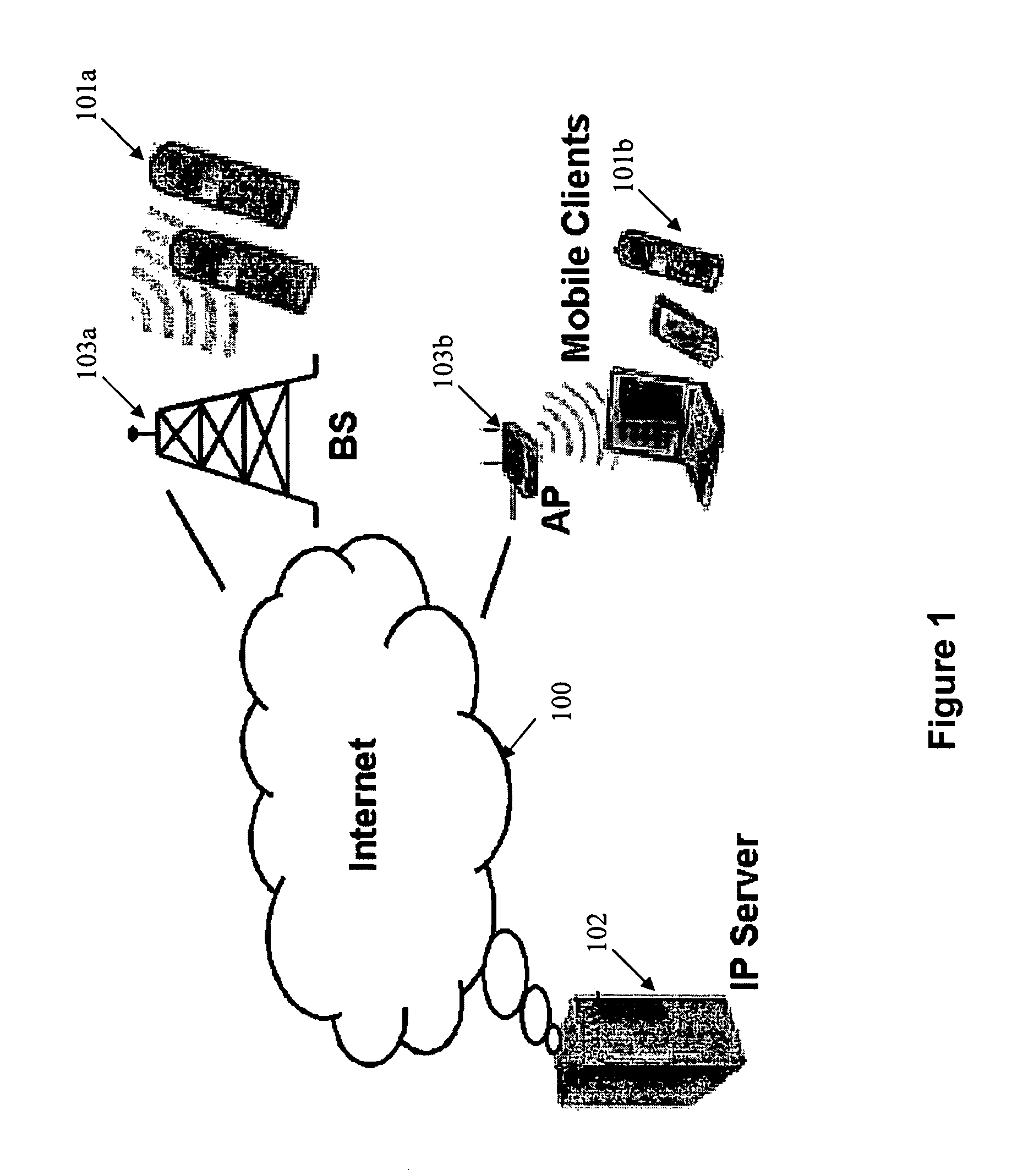
[0022]An exemplary method suggests the modulation, coding and transmission power levels to be employed for data transmission by a wireless device to optimize the uplink throughput of a TCP connection between the device and an Internet host. Consequently, an embodiment of the present invention may be used for improving the uplink speed for Internet based applications, web browsing, file transfers and alike, in mobile devices. Such an embodiment may include, for example, tunnelling of TCP dynamics information concerning information of the congestion window size variation patterns used by the transport layer down to the link layer of the user's end device, parsing of this information by the link-layer, solution of the optimization framework, i. e. calculating the target success probabilities based on observed channel conditions or reference of predetermined heuristics obtained by offline solutions of the optimization framework, and determination of the modulation and coding scheme for the blocks or frames to be transmitted by the link layer.
[0023]Yet another exemplary method of the present invention suggests the modulation and coding schemes to be used at a base station or an access point to optimize the downlink throughput of TCP connection between an Internet host and a mobile device. Consequently, an embodiment of the present invention may be used for improving the download speed for Internet applications in mobile devices. Such an embodiment may include transfer by the Internet host of TCP dynamics information to the link-layer of a base station or access point, reference at the base station or access point to online or heuristics based solution for determination of modulation and coding schemes for the data to be transmitted by the link layer, and exercising of TCP dynamics aware link adaptation by the base station or access point for optimization of TCP throughput.
[0024]Still another exemplary method of the present invention may be used by network operators providing data services via the cellular wireless access technologies like, for example, EGPRS and UMTS. The web download speed for clients subscribed to a wireless Internet Service Provider can be sufficiently improved by exercising TCP dynamics aware link adaptation measures at the base stations. Similarly the uplink speed of Internet can be improved via suitable link adaptation at user devices. In another embodiment, the present invention may also be used for enhancing TCP performance in wireless local area networks based on IEEE 802.11 technologies thereby improving, for example, the user wireless access experience in hotspots like train stations, restraints, cafes. The IEEE 802.11 compliant access points and user devices would in this case exercise TCP dynamics aware link adaptation methods suggested in this invention.
[0029]This is achieved by determining in step f), whether the current window size is less than a predetermined window size value. If it is not the TCP segment is transmitted via at least one link-layer block by using the link quality control procedure of EGPRS. In particular, the link quality control procedure comprises link adaptation (LA) and the incremental redundancy (IR). With the link quality control low error rate modulation schemes and / or high coding rate schemas can be performed to protect the early rounds.


 Login to View More
  Login to View More