
Biaryl substituted azabicyclic alkane derivatives
a technology of azabicyclic alkane and biaryl, which is applied in the direction of antibacterial agents, drug compositions, immunological disorders, etc., can solve the problems of limiting the ability of patients to function normally, addictive and acutely toxic, and not all the effects mediated by nicotine are desirabl
- Summary
- Abstract
- Description
- Claims
- Application Information
AI Technical Summary
Benefits of technology
Problems solved by technology
Method used
Image

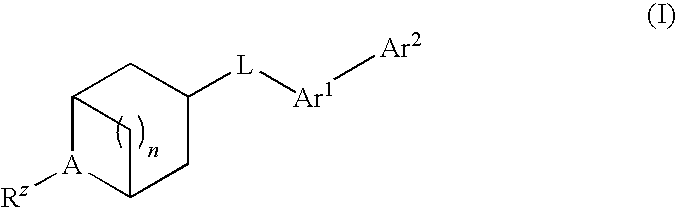
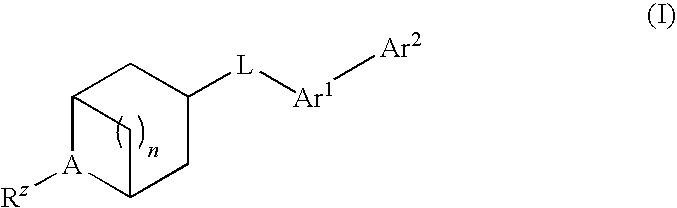
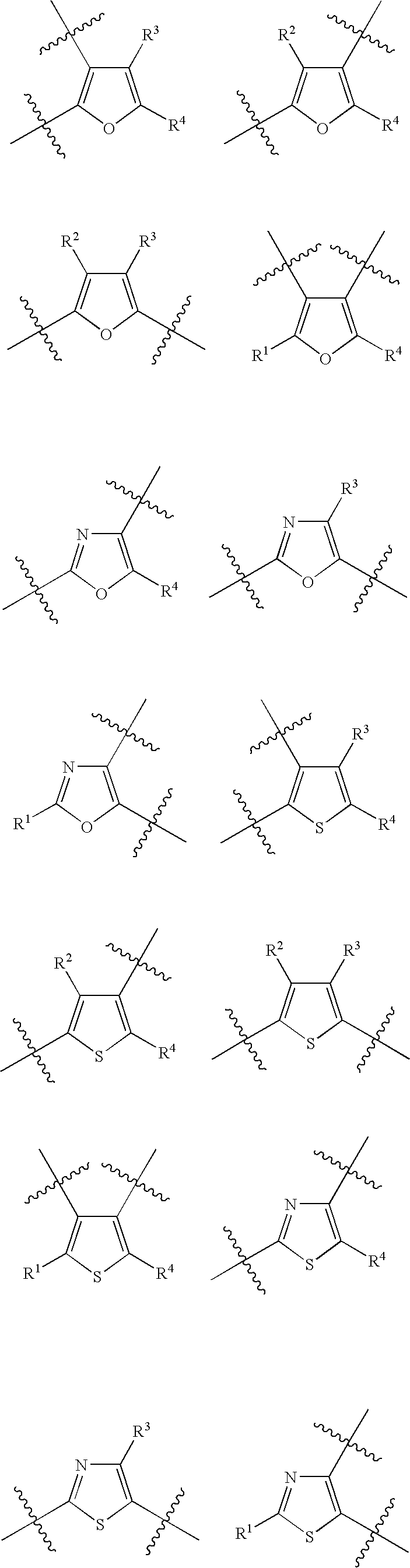
Examples
example 1
2-[(endo)-8-Methyl-8-azabicyclo[3.2.1]octan-3-yloxy]-5-(1H-indol-5-yl)-thiazole bis(hydrochloric acid)
example 1a
5-Bromo-2-[(endo)-8-methyl-8-azabicyclo[3.2.1]octan-3-yloxy]thiazole
[0227]Tropine (Aldrich, 420 mg, 3.0 mmol) in THF (anhydrous, Aldrich, 20 mL) was treated with potassium tert-butoxide (Aldrich, 350 mg, 3.50 mmol) at ambient temperature for 1.0 hour. A solution of 2,5-dibromothiazole (Aldrich, 969 mg, 4.0 mmol) in THF (anhydrous, Aldrich, 10 mL) was added to the above solution at 10-20° C. The mixture was then stirred at ambient temperature for 3 hours. The mixture was quenched with water (1 mL) and concentrated under reduced pressure. The residue was diluted with CHCl3 (100 mL) and washed with brine (2×10 mL). The organic solution was concentrated under reduced pressure and the residue was purified by chromatography (SiO2, CH2Cl2 / MeOH / NH3.H2O, v. 90 / 10 / 2, Rf=0.15) to give the title compound. 1H NMR (300 MHz, CD3OD) δ ppm 2.00-2.12 (m, 8H), 2.36 (s, 3H), 3.17-3.29 (m, 2H), 5.10 (t, J=5.09 Hz, 1H), 7.12 (s, 1H); MS (DCI / NH3) m / z 303 (M+1)+. 305 (M+1)+.
example 1b
2-[(endo)-8-Methyl-8-azabicyclo[3.2.1]octan-3-yloxy]-5-(1H-indol-5-yl)-thiazole
[0228]A solution of the product of Example 1A (200 mg, 0.66 mmol), 5-indolyl boronic acid (Frontier, 160 mg, 1.0 mmol) and K2CO3 aqueous solution (2M, 1 mL) in the presence of Pd(PPh3)4 (15.3 mg, 0.013 mmol) in dioxane (4 mL) was heated to 80-90° C. for 10 hours. The mixture was cooled to ambient temperature and purified by chromatography (SiO2, CH2Cl2 / MeOH / NH3.H2O, v. 90 / 10 / 2, Rf=0.10) to give the title compound. 1H NMR (300 MHz, CDCl3) δ ppm 1.99-2.16 (m, 6H), 2.18-2.30 (m, 2H), 2.33 (s, 3H), 3.12-3.18 (m, 2H), 5.16 (t, J=4.92 Hz, 1H), 6.58 (t, J=2.60 Hz, 1H), 7.23 (t, J=3.00 Hz, 1H), 7.31 (dd, J=8.40, 1.70 Hz, 1H), 7.39 (d, J=8.50 Hz, 1H), 7.69 (s, 1H), 8.22 [s (br.), 1H]; MS (DCI / NH3) m / z 340 (M+1)+.
PUM
| Property | Measurement | Unit |
|---|---|---|
| temperature | aaaaa | aaaaa |
| temperature | aaaaa | aaaaa |
| pH | aaaaa | aaaaa |
Abstract
Description
Claims
Application Information
 Login to View More