Check patentability & draft patents in minutes with Patsnap Eureka AI!

Prioritized channel assignment for wireless links

a wireless link and priority channel technology, applied in the field of prioritized channel assignment for wireless links, can solve the problems of inefficient use of available spectrum, node-assigned-priority mechanism not being recognized, network efficiency at moving priority data, etc., to achieve the effect of improving communication efficiency and effectiveness

Active Publication Date: 2011-04-19
THE BOEING CO
View PDF6 Cites 5 Cited by
  • Summary
  • Abstract
  • Description
  • Claims
  • Application Information

AI Technical Summary

Benefits of technology

This approach enhances the efficiency and effectiveness of communication by prioritizing high-priority data transmission, optimizing the use of shared wireless spectrum and ensuring that critical data is transmitted promptly, even when nodes have varying priority data rates.

Problems solved by technology

A problem arises, however, when the capacity of some links is small and the total capacity is shared among several links.
These networks are therefore inefficient at moving priority data.
This problem arises because the two data flows originate at different nodes.
However, it is inefficient (from the perspective of sending data based on priority) when B runs out of priority 1 packets and starts sending priority 3 packets.
Consequently, the node-assigned-priority mechanism does not recognize the case where a high-priority node is sending only low-priority data.
This causes inefficient use of the available spectrum.
However, it does not make efficient use of spectrum since each node gets its full allocation, regardless of whether the data comes from a node that's currently not participating in combat operations or from a node that is receiving enemy fire and calling for help.
Clearly the latter node should get priority, but a fixed-assignment network cannot dynamically reassign capacity to support the dynamic need.
However, if all the network capacity is reserved, RSVP does not allow a new stream to get any capacity, regardless of its priority.
While the systems are healthy, the transmission data rate is low and the priority of the transmission is low.
However, current mechanisms do not enable capacity to be reassigned in an automated way.

Method used

the structure of the environmentally friendly knitted fabric provided by the present invention; figure 2 Flow chart of the yarn wrapping machine for environmentally friendly knitted fabrics and storage devices; image 3 Is the parameter map of the yarn covering machine
View more

Image

Smart Image Click on the blue labels to locate them in the text.
Viewing Examples
Smart Image
  • Prioritized channel assignment for wireless links
  • Prioritized channel assignment for wireless links
  • Prioritized channel assignment for wireless links

Examples

Experimental program
Comparison scheme
Effect test

Embodiment Construction

[0042]Though “wireless” is often used to mean “radio”, the term wireless as used herein means using any frequency in the electromagnetic spectrum or the acoustic spectrum to transmit or receive data without the use of a wire or a fiber. Thus, wireless links include, but are not limited to, radio links, optical links or acoustic links. Acoustic links are often used for underwater communication. Infrared links, one example of an optical link, are typically used in remote controls and have been used to transfer data between computers.

[0043]One embodiment may be employed as part of a hub-and-spoke wireless network. Other embodiments may be employed as part of other wireless network configurations. Code Division Multiple Access (CDMA), Time Division Multiple Access (TDMA), and Frequency Division Multiple Access (FDMA) are examples of wireless network transmission protocols.

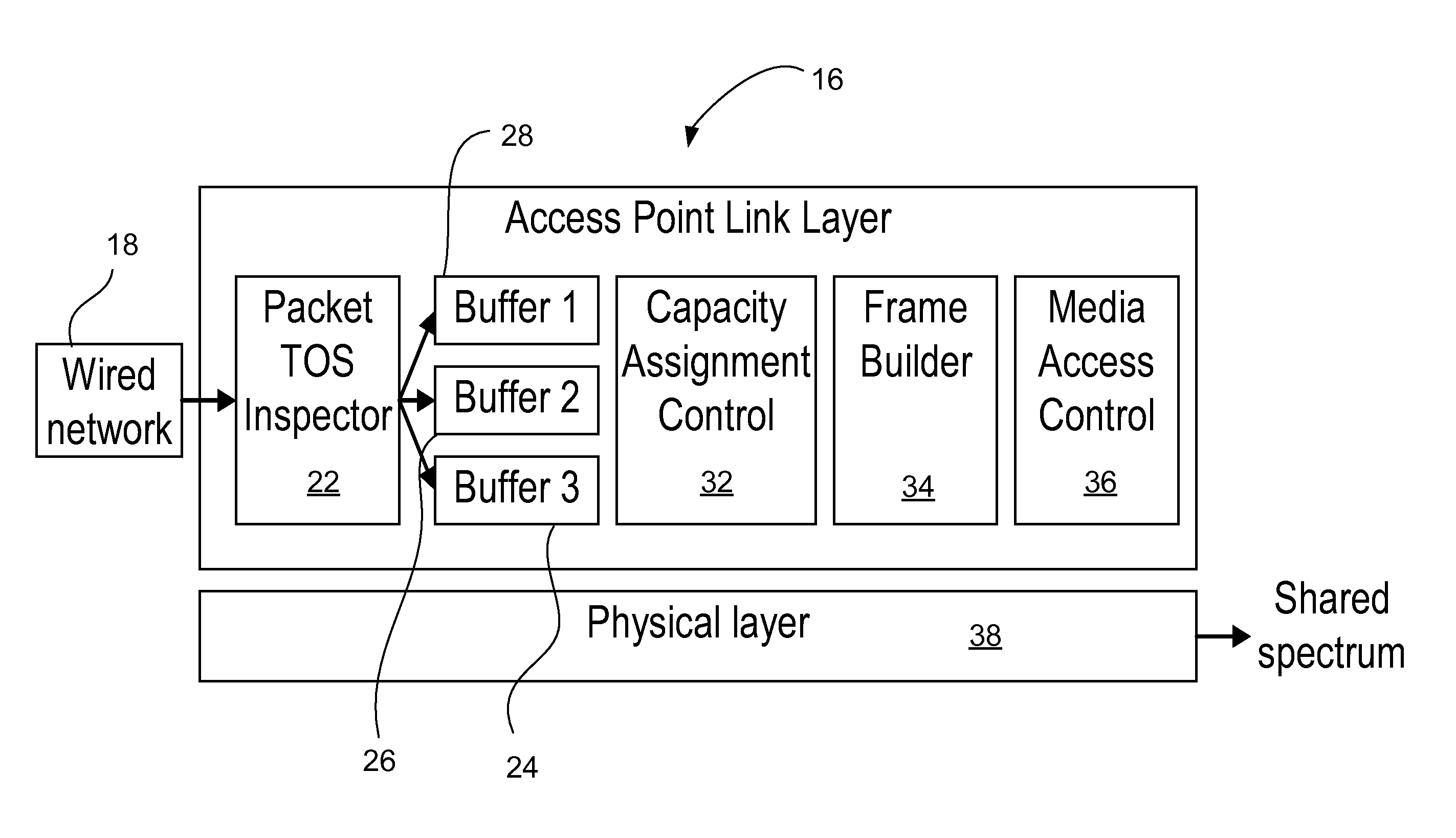
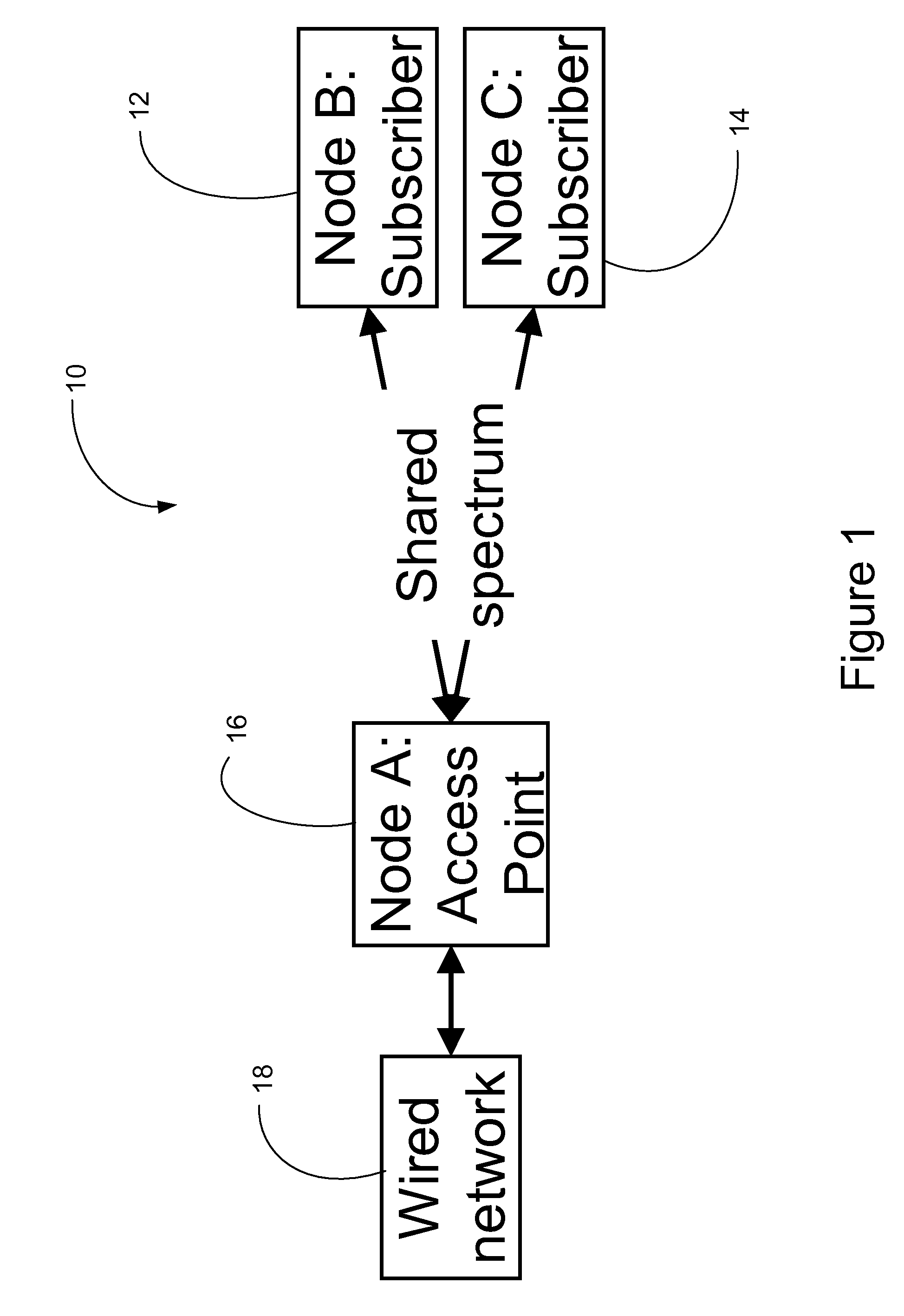
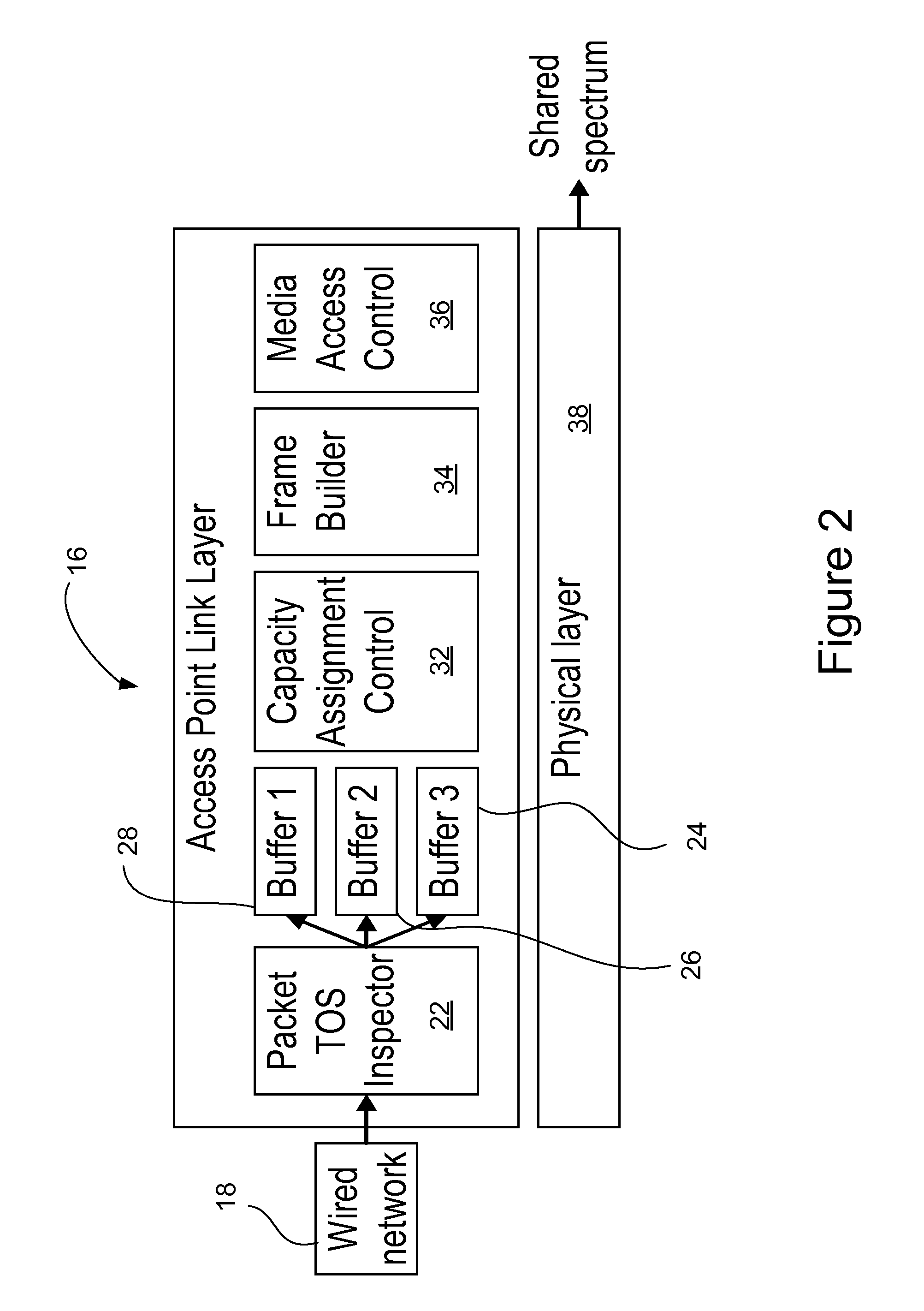
[0044]A simple example of a wireless network 10 is shown in FIG. 1, where nodes B and C, reference numerals 12 and 1...

the structure of the environmentally friendly knitted fabric provided by the present invention; figure 2 Flow chart of the yarn wrapping machine for environmentally friendly knitted fabrics and storage devices; image 3 Is the parameter map of the yarn covering machine
Login to View More

PUM

No PUM Login to View More

Abstract

Link capacity in a wireless medium is assigned by receiving at least one capacity request; and controlling the wireless link capacity based on at least the received capacity request. Link capacity is altered by reading priority information; creating a capacity request from the priority information read; transmitting the capacity request; receiving link configuration data; and configuring a wireless link to conform to the received allocation of link capacity. Link capacity is controlled by extracting the origin and priority of one or more packets received over the shared wireless medium; selecting the link capacity for one or more wireless links based at least in part on the extracted origin and priority of the one or more packets received, higher capacities are selected for origins from which higher priority packets are received; and transmitting the selected link capacity to the one or more wireless links.

Description

CROSS REFERENCE TO RELATED APPLICATIONS[0001]This patent application claims the benefit of U.S. Provisional Application No. 60 / 862,295, filed Oct. 20, 2006, which provisional application is incorporated herein by reference.BACKGROUND OF THE DISCLOSURE[0002]1. Field of the Disclosure[0003]The disclosure relates to the efficient use of the limited capacity of wireless links in a network and, more particularly, wireless systems, equipment, and methods that favor the transport of high-priority data first, regardless of which network node it comes from.[0004]2. Description of the Related Art[0005]In the past few years, both wired and wireless data networks have become common place and relatively inexpensive. These networks take many forms, use many different protocols, and carry a variety of data. For example, the data may represent voice, music, video, web pages, documents, files, bank / financial transactions, etc.[0006]In a packet network that carries a variety of data, the delivery of ...

Claims

the structure of the environmentally friendly knitted fabric provided by the present invention; figure 2 Flow chart of the yarn wrapping machine for environmentally friendly knitted fabrics and storage devices; image 3 Is the parameter map of the yarn covering machine
Login to View More

Application Information

Patent Timeline
no application Login to View More
Patent Type & Authority Patents(United States)
IPC IPC(8): H04J1/16H04L12/56H04W72/10
CPCH04W72/10H04W72/0413H04W72/21H04W72/56H04W72/569H04W28/0278
Inventor TILLOTSON, BRIAN J.
Owner THE BOEING CO
Features
  • R&D
  • Intellectual Property
  • Life Sciences
  • Materials
  • Tech Scout
Why Patsnap Eureka
  • Unparalleled Data Quality
  • Higher Quality Content
  • 60% Fewer Hallucinations
Social media
Patsnap Eureka Blog
Learn More