Signal analysis method
- Summary
- Abstract
- Description
- Claims
- Application Information
AI Technical Summary
Benefits of technology
Problems solved by technology
Method used
Image



Examples
first embodiment
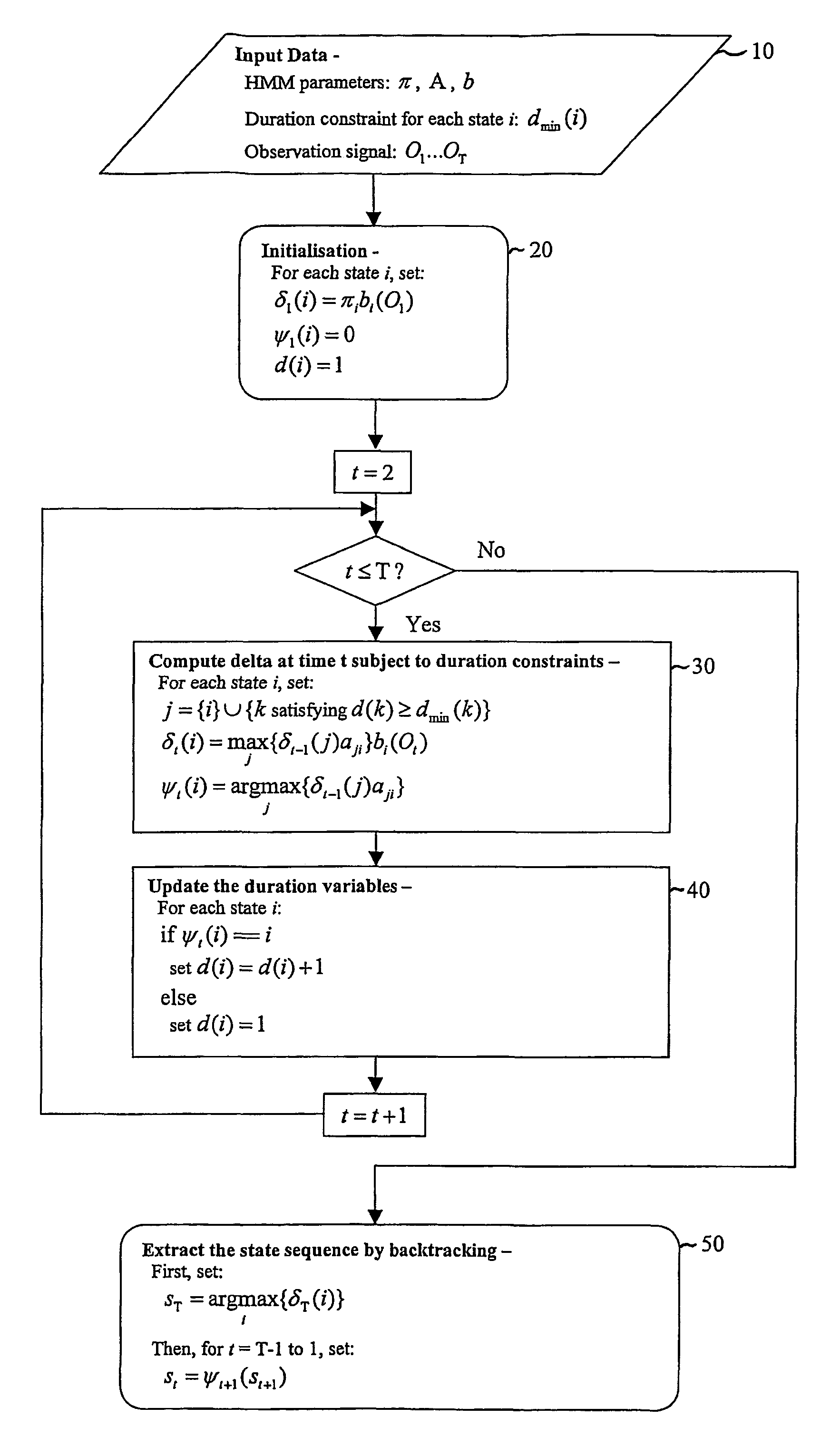
[0076]The duration constrained Viterbi algorithm according to this first embodiment of the invention proceeds as follows. At each time step t of the recursion we keep track of the duration d(i) of the current “run” of state i which ends at time t−1. More precisely, the duration variable for each state is used to keep track of the length of the consecutive sequence of predecessor states that are comprised only of that particular state and end in that state at the previous time step. If this duration is greater than or equal to the minimum permitted duration dmin(i), we consider transitions from this state to any other state j when computing δt(j) (as with the standard Viterbi recurrence). However if the current state occupancy is less than the minimum permitted, transitions from this state to different states are not allowed and the state can only self-transition (until its minimum duration constraint is satisfied). Once δt(i) has been computed for all values of t, the standard backt...
second embodiment
[0083]According to the invention, an alternative way of improving the segmentation performance of the HMM is to incorporate the duration constraints directly into the model architecture. Once the constraints have been incorporated in this way, the standard Viterbi algorithm can then be used to infer the optimal duration constrained segmentation of a given ECG waveform.
[0084]Incorporating the duration constraints into the HMM architecture involves replacing each state in the model with a set of dmin new states. These states are connected in a simple left-right fashion and share a common observation density.
[0085]More precisely, for each state k with a minimum duration of dmin(k) (where dmin(k)>1), we augment the model with dmin(k)−1 additional states directly preceding the original state k. Each additional state has a self-transition probability of zero, a transition probability of one of transitioning to the state immediately to its right, and a transition probability of zero of tra...
third embodiment
[0091]According to the invention, in addition to the accurate segmentation of an ECG waveform, it is also possible to generate a “confidence measure” (or score) from the trained model. This confidence measure quantifies how confident the model is in the resulting segmentation, and can be used to assess the quality of the ECG waveform that has been segmented. Using this measure therefore, it is possible to automatically detect ECG waveforms that are either too noisy or too “unusual” (in terms of the waveform morphology) to provide reliable segmentations and hence reliable estimates of the QT interval. The confidence measure can be used with any segmentation algorithm which operates in a probabilistic fashion.
[0092]The confidence measure can be defined as either the log likelihood of the signal given the model, i.e. log p(O1O2 . . . OT|λ), or the joint log likelihood of the signal and the most probable state sequence s1s2 . . . sT (given the model), i.e. log p(O1O2 . . . OT, s1s2 . . ...
PUM
 Login to View More
 Abstract
Description
Claims
Application Information
 Login to View More
 - R&D
- Intellectual Property
- Life Sciences
- Materials
- Tech Scout
- Unparalleled Data Quality
- Higher Quality Content
- 60% Fewer Hallucinations
Browse by: Latest US Patents, China's latest patents, Technical Efficacy Thesaurus, Application Domain, Technology Topic, Popular Technical Reports.
© 2025 PatSnap. All rights reserved.Legal|Privacy policy|Modern Slavery Act Transparency Statement|Sitemap|About US| Contact US: help@patsnap.com