

Chemically amplified positive resist composition
a technology of positive resist and composition, applied in the direction of photosensitive materials, instruments, photomechanical equipment, etc., to achieve the effect of excellent various resist abilities, good pattern profile, and higher contact angl
- Summary
- Abstract
- Description
- Claims
- Application Information
AI Technical Summary
Benefits of technology
Problems solved by technology
Method used
Image

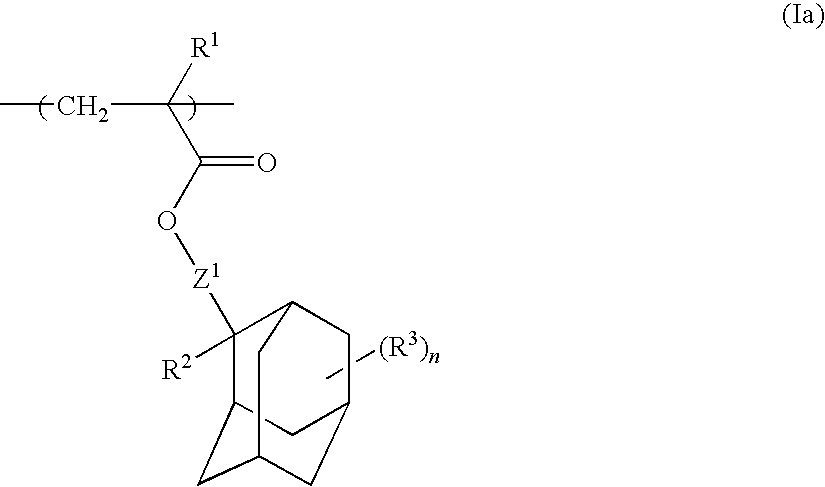
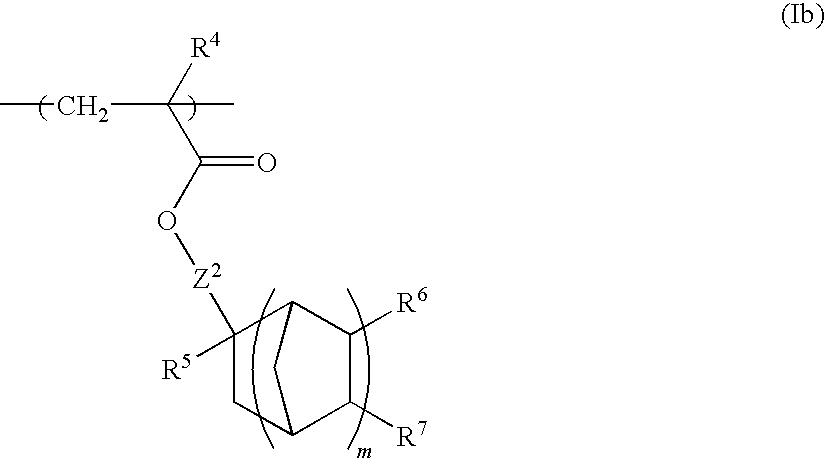
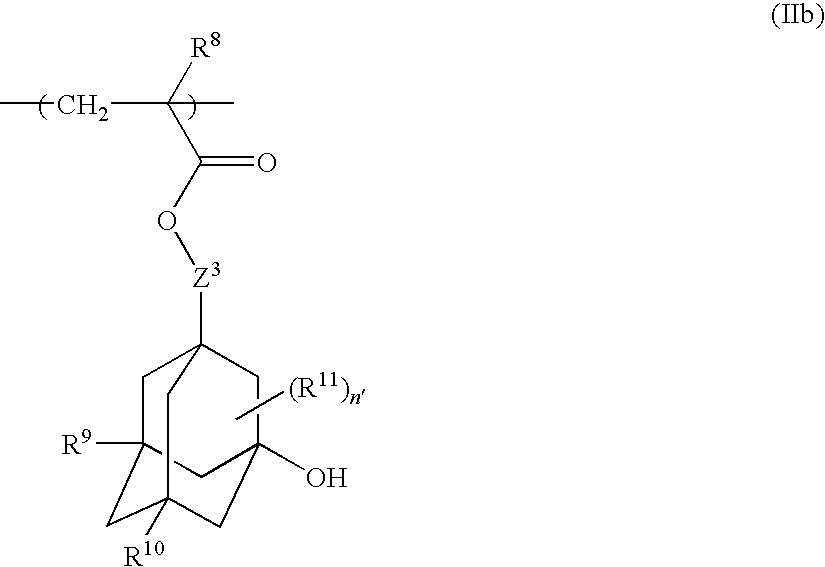
Examples
synthesis example 1
Resin Synthesis Example 1
Synthesis of Resin A1
[0213]Into a four-necked flask equipped with a thermometer and a reflux condenser, 70.91 parts of methyl isobutyl ketone was charged and a nitrogen gas was blown into it for 30 minutes. Under a nitrogen gas atmosphere, a mixture obtained by mixing 30 parts of monomer E, 14.27 parts of monomer F, 10.28 parts of monomer G, 0.79 part of 2,2′-azobisisobutyronitrile and 70.19 parts of methyl isobutyl ketone (monomer ratio; monomer E: monomer F: monomer G=50:25:25) was added dropwise thereto over 1 hour at 86° C. The resultant mixture was heated at 86° C. for about 5 hours. The reaction mixture was cooled and poured into 815 parts of n-heptane with stirring. The precipitated resin was isolated by filtration and washed three times with 407 parts of n-heptane. The resin obtained was dried under reduced pressure to obtain 25.4 parts of the resin having a weight-average molecular weight (Mw) of 9,400 in a yield of 55%. The ratio of weight-average ...
synthesis example 2
Resin Synthesis Example 2
Synthesis of Resin B1
[0216]Into a four-necked flask equipped with a thermometer and a reflux condenser, 23 parts of 1,4-dioxane was charged and a nitrogen gas was blown into it for 30 minutes. Under a nitrogen gas atmosphere, a mixture obtained by mixing 6.2 part of monomer A, 12.97 parts of monomer B, 19.17 parts of monomer C, 0.21 part of 2,2′-azobisisobutyronitrile, 0.97 part of 2,2′-azobis(2,4-dimethylvaleronitrile) and 34.51 parts of 1,4-dioxane (monomer ratio; monomer A: monomer B: monomer C=25:25:50) was added dropwise thereto over 1 hour at 75° C. The resultant mixture was heated at 75° C. for about 5 hours. The reaction mixture was cooled and diluted with 42.18 parts of 1,4-dioxane. The obtained solution was poured into a mixture of 349 parts of methanol and 224 parts of ion-exchange water with stirring. The precipitated resin was isolated by filtration and washed three times with a mixture of 224 parts of methanol and 25 parts of ion-exchange water...
examples 1 to 7
, Comparative Examples 1 and Reference Example 1
[0221]The following components were mixed to give a solution, and the solution was further filtrated through a fluorine resin filter having a pore diameter of 0.2 μm, to prepare resist liquid.
[0222]Resins (kind and amount are described in Table 1)
[0223]Acid generator (kind and amount are described in Table 1)
[0224]Quencher (kind and amount are described in Table 1)
[0225]Solvent (kind are described in Table 1)
[0226]The resist liquids prepared in Examples 1 to 7 are respectively called as resists R1 to R7, the resist liquids prepared in Comparative Examples 1 is called as resist C1, and the resist liquids prepared in Reference Examples 1 is called as resists R10.
[0227]
TABLE 1Resin AAcid(kind / Resin BgeneratorQuencheramount(kind / amount(kind / amount(kind / amountEx. No.(part))(part))(part))(part))SolventEx. 1A1 / 10B1 / 0.1P1 / 0.4Q1 / 0.015S1Ex. 2A1 / 10B1 / 0.07P1 / 0.4Q1 / 0.015S1Ex. 3A1 / 10B1 / 0.05P1 / 0.4Q1 / 0.015S1Ex. 4A1 / 10B1 / 0.03P1 / 0.4Q1 / 0.015S1Ex. 5A1 / 10B...
PUM
| Property | Measurement | Unit |
|---|---|---|
| Temperature | aaaaa | aaaaa |
| weight | aaaaa | aaaaa |
| organic | aaaaa | aaaaa |
Abstract
Description
Claims
Application Information
 Login to View More