

Protective coating compositions and devices
a technology of protective coating and composition, applied in the direction of coatings, solid-state devices, organic dyes, etc., can solve the problems of reducing the blocking ability of ultraviolet light, material exposure to photodegradation, erosion and yellowing of the polymer surface,
- Summary
- Abstract
- Description
- Claims
- Application Information
AI Technical Summary
Benefits of technology
Problems solved by technology
Method used
Image

Examples
examples
[0043]The following examples illustrate methods and embodiments in accordance with the invention, and as such, should not be construed as imposing limitations upon the claims.
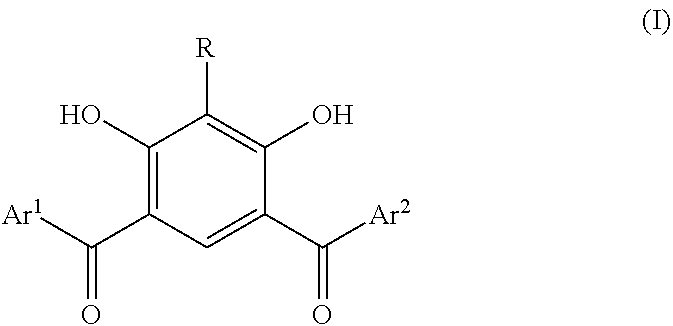
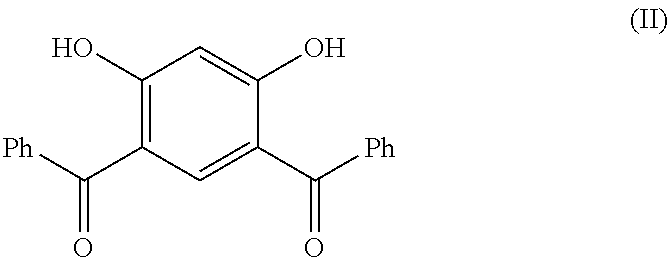
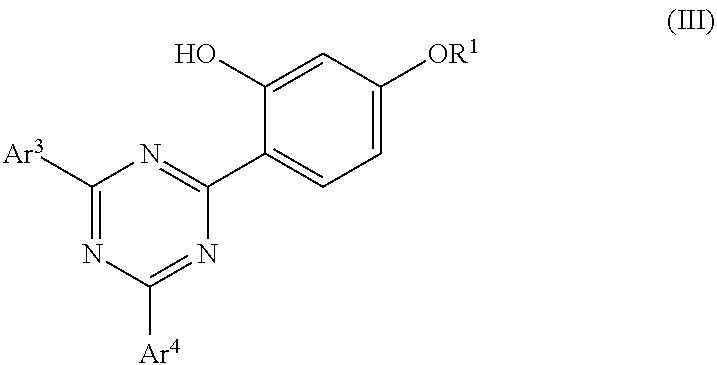
[0044]Unless specified otherwise, all ingredients may be commercially available from such common chemical suppliers as Alpha Aesar, Inc. (Ward Hill, Mass.), Sigma Aldrich (St. Louis, Mo.), Spectrum Chemical Mfg. Corp. (Gardena, Calif.), and the like. Tinuvin® 1577 was obtained from Ciba Specialty Chemicals. ADK STAB LA-46 was obtained from Adeka Corporation. 4,6-dibenzoylresorcinol and 4,6-di(4′-t-butylbenzoyl)resorcinol were prepared as described in U.S. Pat. No. 5,869,185.
Preparation of Coated Films
[0045]Poly(methyl methacrylate) (PMMA, Elvacite® 2041 from Lucite International), was dissolved in 1-methoxy-2-propanol, and the resulting composition was heated, to prepare a 7% by weight solution. UV absorber amounts as shown in Table 1 were added to vials and dissolved in 2.65 g of solvent by heating to a temper...
PUM
| Property | Measurement | Unit |
|---|---|---|
| Percent by mass | aaaaa | aaaaa |
| Percent by mass | aaaaa | aaaaa |
| Fraction | aaaaa | aaaaa |
Abstract
Description
Claims
Application Information
 Login to View More