
Component for the sliding support of another component, and process for producing it
a technology of sliding support and component, applied in the direction of mechanical equipment, rotary machine parts, coatings, etc., can solve the problems of increasing the brittleness of the microstructure of oxidized and filled light metal materials, accompanied by the strength of the boundary layer,
- Summary
- Abstract
- Description
- Claims
- Application Information
AI Technical Summary
Benefits of technology
Problems solved by technology
Method used
Image

Examples
Embodiment Construction
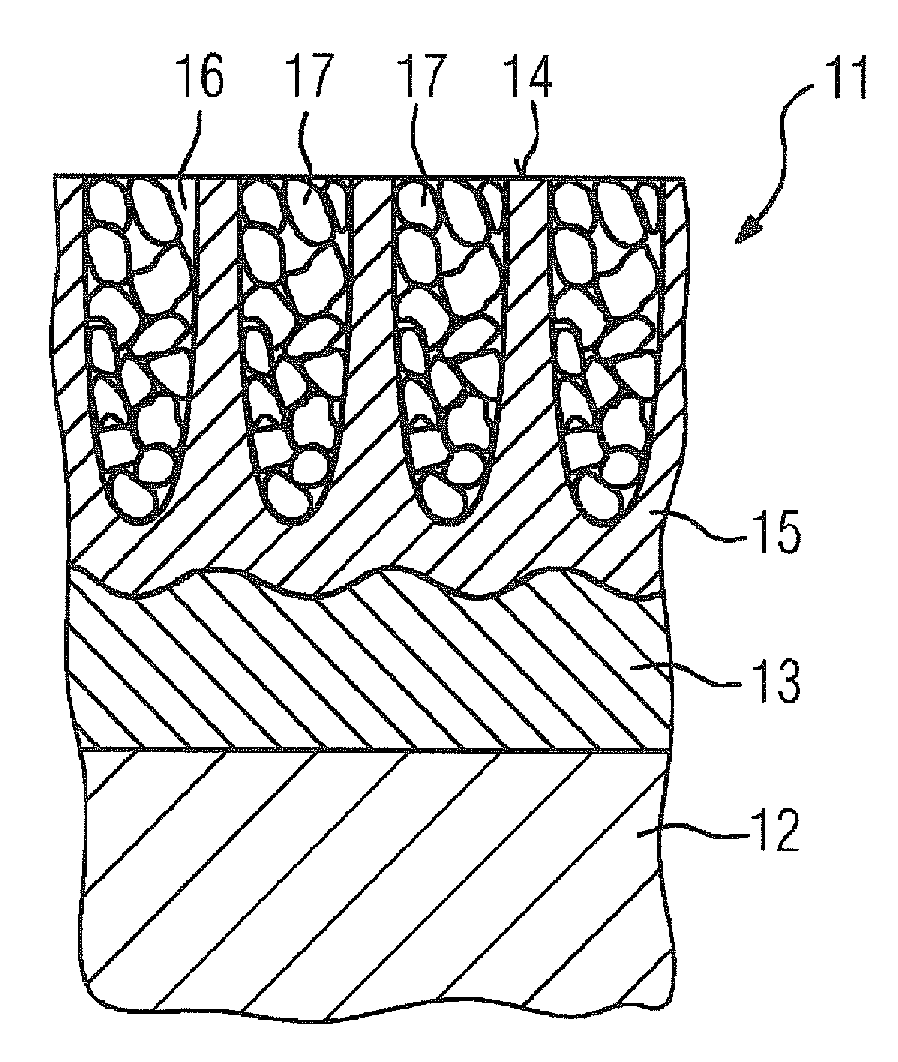
[0030]A component 11 as shown in FIG. 1 for support a component to be mounted comprises a base body 12, for example made of steel, and a layer made of a light metal material 13, for example an aluminum alloy. Proceeding from an exposed boundary surface 14, this aluminum alloy has been oxidized by an electrochemical eloxation treatment. In this process, an oxide layer 15, for example made of aluminum oxide, is produced adjacent to the boundary surface 14, and pores 16 which are open toward the boundary surface 14 are formed in said oxide layer.
[0031]In the next process step, which is also shown in FIG. 1, the pores 16 can be filled with nanoparticles 17. As an alternative to nanoparticles, it is also possible to use micro hollow balls. The nanoparticles are made of a hard material, e.g. boron nitride, and can also be dispersed in a dispersant, e.g. an alcohol. The dispersion produced in this way can simply be introduced into the pores 16.
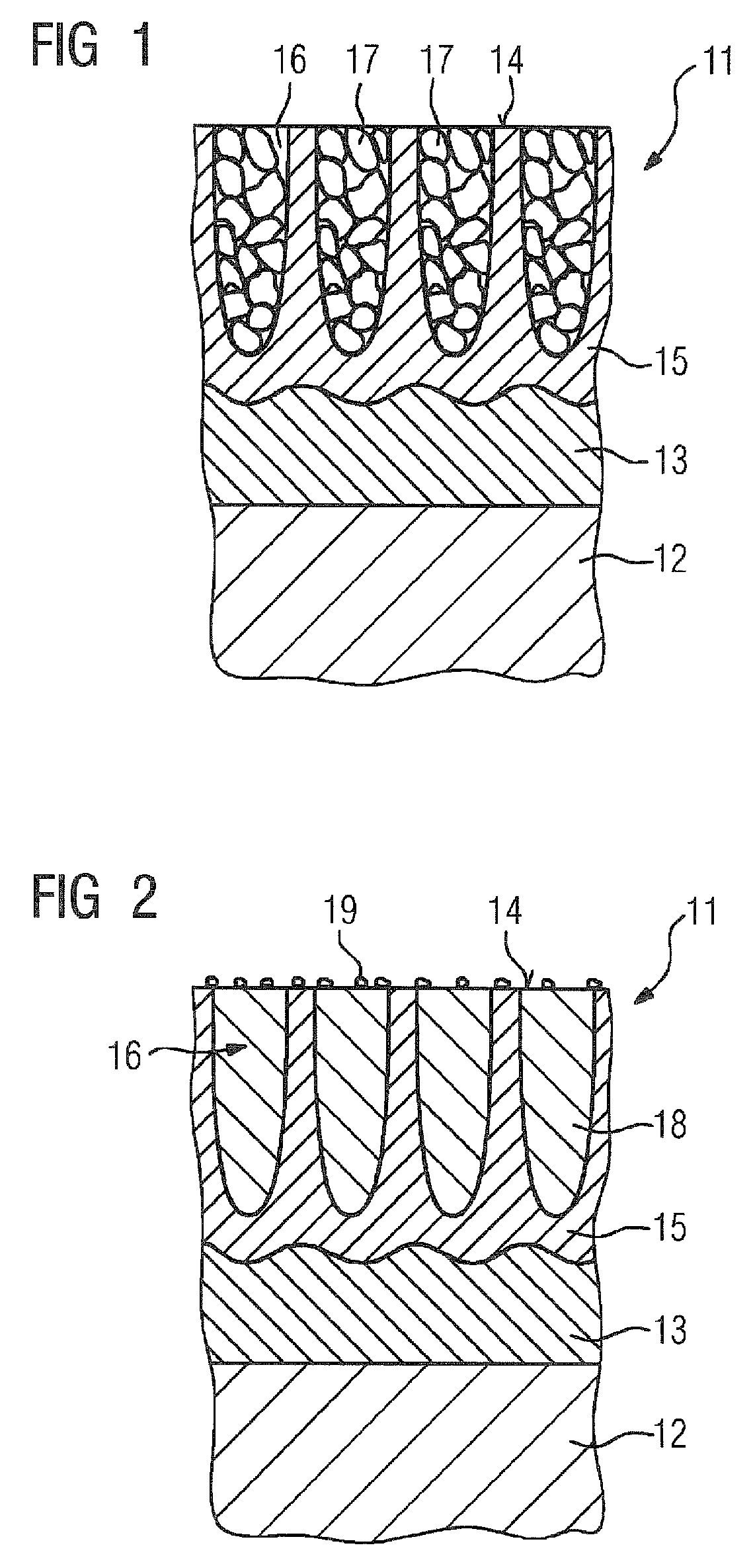
[0032]FIG. 2 shows the component 11 after a si...
PUM
| Property | Measurement | Unit |
|---|---|---|
| thickness | aaaaa | aaaaa |
| microstructure | aaaaa | aaaaa |
| metallic | aaaaa | aaaaa |
Abstract
Description
Claims
Application Information
 Login to View More