
Antenna device and communication terminal apparatus
a technology of communication terminal and antenna device, which is applied in the direction of solid-state devices, elongated active elements, resonance antennas, etc., can solve the problems of difficult to obtain a high gain in a state in which the casing is closed, and achieve the effect of increasing the effective antenna area of the frame-shaped radiating element, reducing or preventing capacitive coupling, and increasing gain
- Summary
- Abstract
- Description
- Claims
- Application Information
AI Technical Summary
Benefits of technology
Problems solved by technology
Method used
Image

Examples
first preferred embodiment
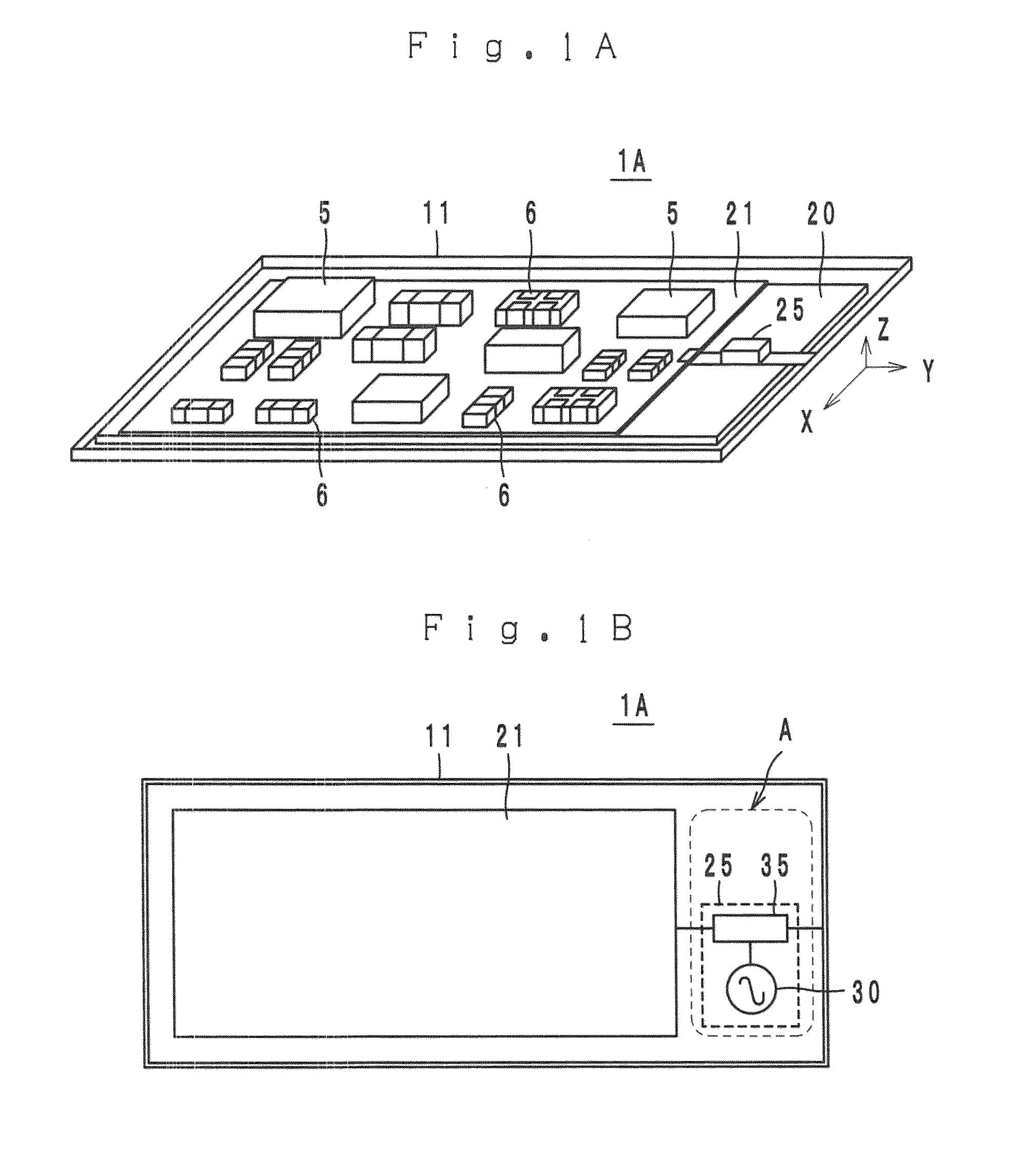
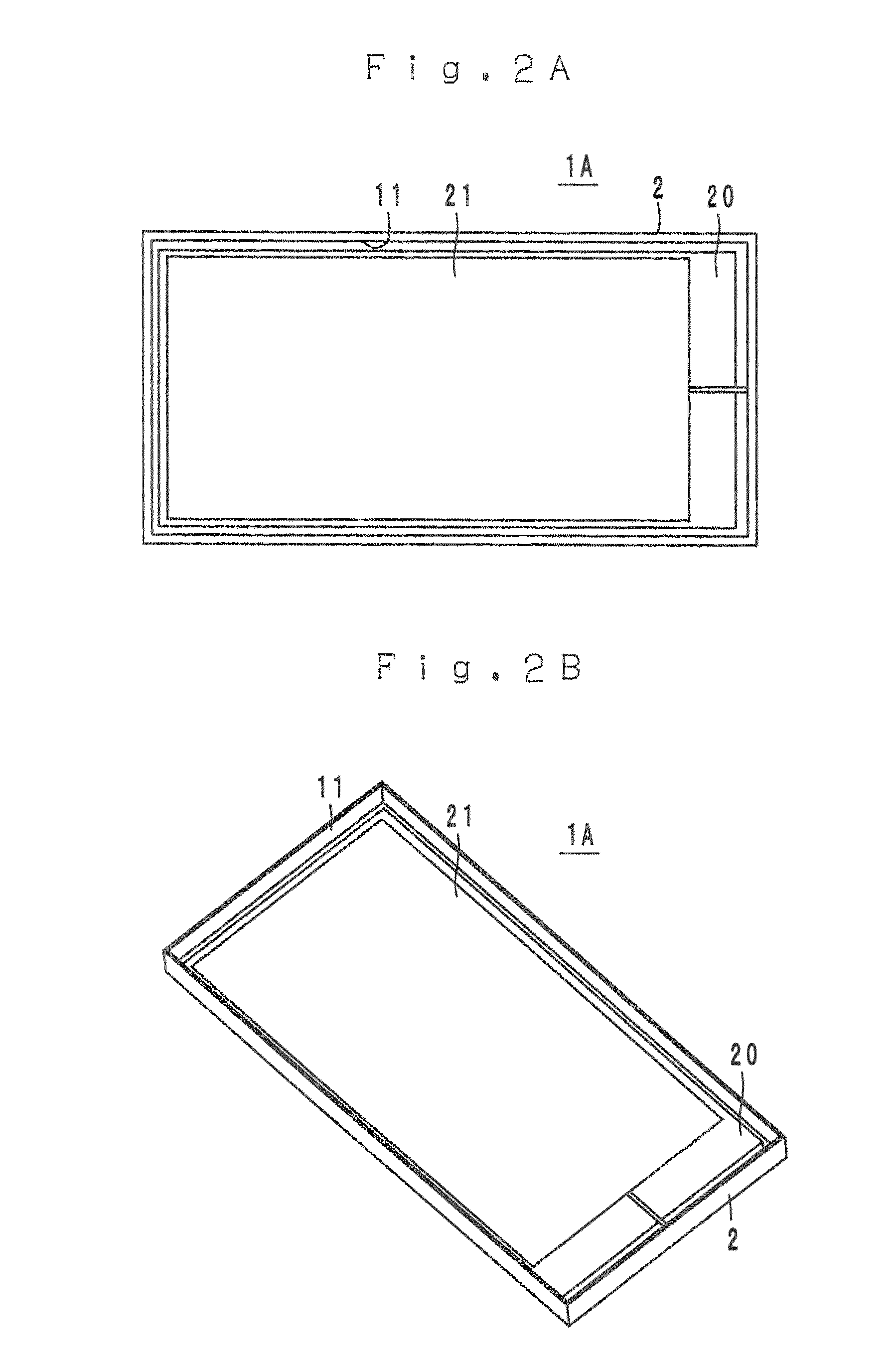
[0038]A mobile communication terminal apparatus 1A, which preferably is a terminal for 1 Seg (Japanese terrestrial digital TV broadcasting for mobile apparatuses) reception (470 MHz to 770 MHz), for example, includes an antenna device including a plate-shaped radiating element 21 which is arranged on a printed wiring board 20 provided inside a first casing 2 and which functions as a ground electrode, a frame-shaped radiating element 11 arranged along the inner surface of the first casing 2 to surround the plate-shaped radiating element 21, and a feeding unit 25 connected between the plate-shaped radiating element 21 and the frame-shaped radiating element 11, as illustrated in FIGS. 1A and 1B and FIGS. 2A and 2B. The feeding unit 25 includes a feeding circuit 30 that processes a wireless signal and a frequency stabilizing circuit 35 described in detail later. The plate-shaped radiating element 21 and the frame-shaped radiating element 11 are connected to the feeding circuit 30 throug...
second preferred embodiment
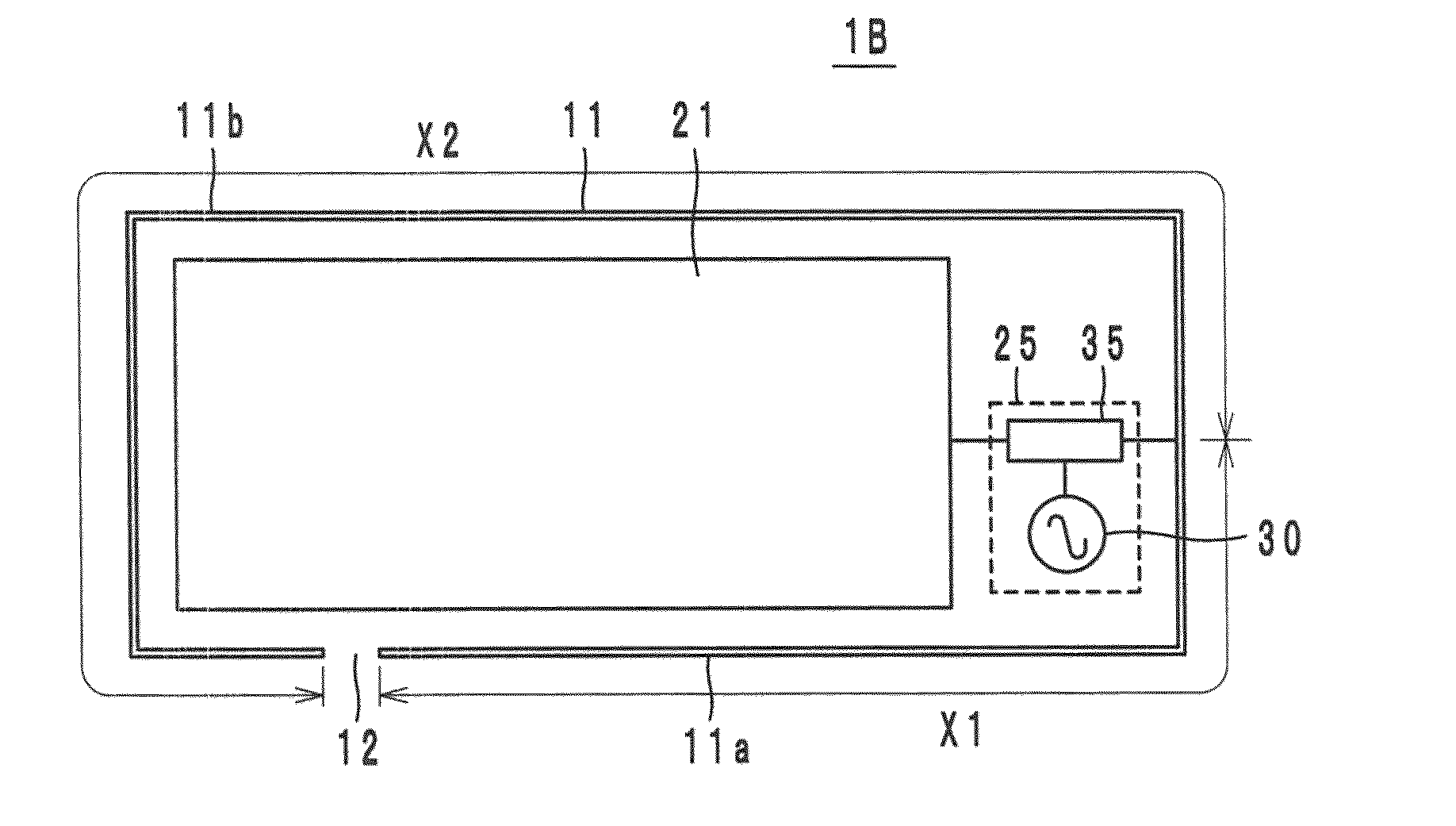
[0043]Referring to FIG. 4B, a mobile communication terminal apparatus 1B has a configuration in which a portion of a frame-shaped radiating element 11 is cut out as a gap 12. The rest of the configuration is similar to that of the first preferred embodiment described above. A potential difference is generated between the opposing end portions across the gap 12, such that the strength of an electric field at the opposing end portions is increased. Hence, the directivity of the antenna can be controlled by adjusting the position of the gap 12. Further, by dividing the frame-shaped radiating element 11 into a radiating portion 11a having a relatively short line length of X1 and a radiating portion 11b having a relatively long line length of X2, the radiating portion 11a can be made to correspond to a high-band side frequency band and the radiating portions 11a and 11b (line length of X1+X2) can be made to correspond to a low-band side frequency band in accordance with the frequency ban...
third preferred embodiment
[0044]Referring to FIG. 5, a mobile communication terminal apparatus 1C has a configuration in which a frame-shaped radiating element 11 is arranged to surround the top edge portion of the external surface of a first casing 2 as indicated by shading. The rest of the configuration and also the operations and effects of the third preferred embodiment are similar to those of the first preferred embodiment.
PUM
 Login to View More
 Abstract
Description
Claims
Application Information
 Login to View More