Method for commutating a current in an electronic power converter phase from a reverse-conducting IGBT in a diode mode to a reverse-conducting IGBT in an IGBT mode
- Summary
- Abstract
- Description
- Claims
- Application Information
AI Technical Summary
Benefits of technology
Problems solved by technology
Method used
Image



Examples
Embodiment Construction
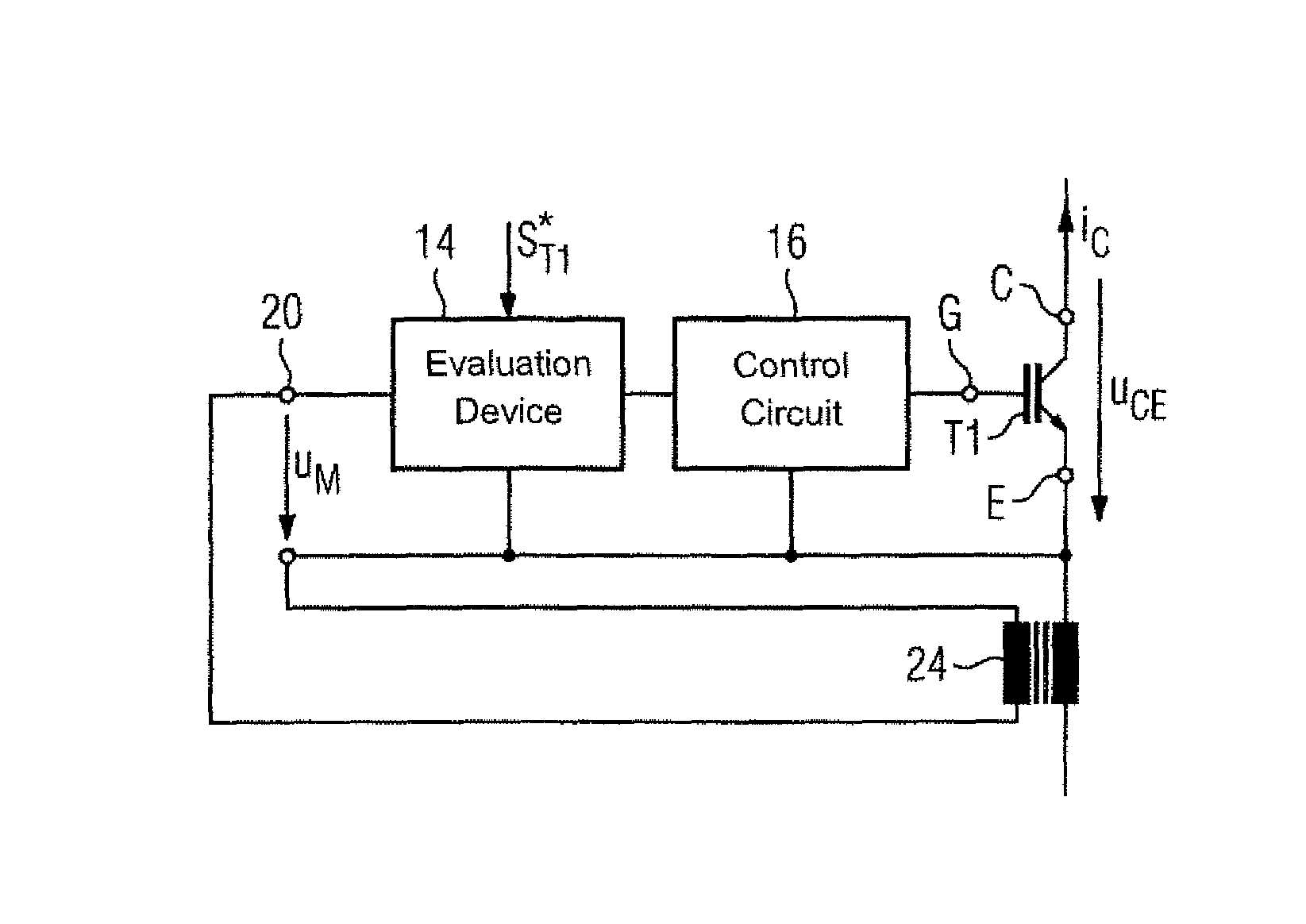
[0025]In FIG. 1, reference sign 2 designates a bridge branch, 4 a direct-current voltage source, 6 a positive current conductor bar, and 8 a negative current conductor bar. The bridge branch 2 and the direct-current voltage source 4 are electrically connected in parallel by means of said two current conductor bars 6 and 8. The bridge branch has two reverse-conducting IGBTs T1 and T2 which are electrically connected in series. A connection point of said two RC-IGBTs T1 and T2 is formed by an output A on the alternating-current voltage side, to which output a load can be connected. The direct-current voltage source 4 has two capacitors 10 and 12 which are likewise electrically connected in series. A connection point of said two capacitors 10 and 12 is formed by a midpoint terminal M. Alternatively, instead of the two capacitors 10 and 12, it is also possible to use just one capacitor which is arranged between the current conductor bars 6 and 8. The midpoint M is not accessible in that...
PUM
 Login to View More
 Abstract
Description
Claims
Application Information
 Login to View More