Antibodies directed against IL-17
a technology of antibodies and il-17, which is applied in the field of antibodies directed against il-17, can solve the problem that the therapeutic utility of currently available il-17 antibodies is limited by their natur
- Summary
- Abstract
- Description
- Claims
- Application Information
AI Technical Summary
Benefits of technology
Problems solved by technology
Method used
Image

Examples
example 1
[0079]This example demonstrates that an IL-17-binding agent in accordance with the invention can block the activity of human IL-17 in vivo.
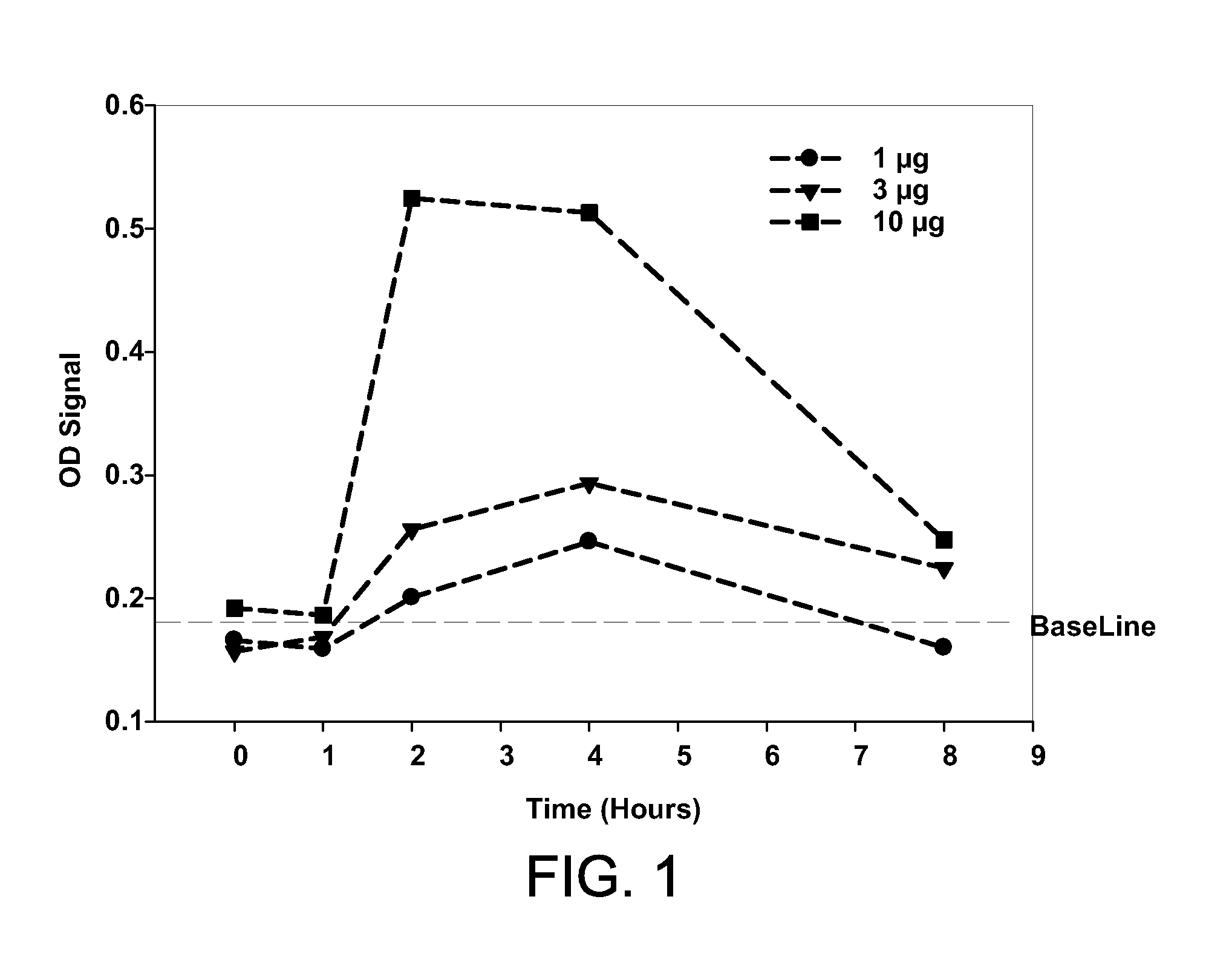
[0080]Human IL-17 (hIL-17) is able to bind and stimulate the mouse IL-17 receptor leading to the subsequent release of KC(CXCL1) chemokine Time and dose ranging experiments were performed to identify the optimal dose of hIL-17 that resulted in the maximum induction of mouse KC in vivo. Human IL-17 was administered subcutaneously to mice at 1, 3, and 10 μg / mouse. At various time-points after hIL-17 administration (FIG. 1), mice were sacrificed and KC levels were determined by ELISA using a commercially available kit according to the manufacturer's instructions (KC Quantikine, R&D Systems, Minneapolis, Minn.). These experiments indicated that a subcutaneous dose of 10 μg / mouse of human IL-17 resulted in the maximum levels of KC in mouse serum two hours post administration of the human cytokine (FIG. 1).
[0081]A full length IgG1 antibody comprising a...
example 2
[0083]This example demonstrates that immunoglobulin heavy chain (HC) and light chain (LC) polypeptides described herein can form antibodies that bind IL-17 in vitro.
[0084]DNA samples encoding various immunoglobulin heavy chain (HC) and light chain (LC) polypeptides as described herein were prepared by combining the following: 20′11 maxi-prepped DNA (comprised of 0.2 μg HC and 0.2 μg LC plasmid), 9.8 μg OPTIMEM™ (Invitrogen, Carlsbad, Calif.), 1.2 μl GENEJUICE™ Transfection Reagent (Novagen, Gibbstown, N.J.), and 13.8 μl OPTIMEM™ (pre-warmed). Following thorough mixing and incubation (at room temperature) of the DNA preparations, 35 μl of reagent / DNA mix was added to 5×10⁴ HEK293-c18 cells. 18 hours prior to transfection, the cells were plated in 150 ill of Freestyle media per well of a 96-well microtiter dish and incubated at 37° C. in 8% CO2 humidified atmosphere. Following transfection, cells were returned to 37° C. in 8% CO2. The combinations of heavy chain and light chain sequen...
example 3
[0088]This example demonstrates that immunoglobulin heavy chain (HC) and light chain (LC) polypeptides described herein can form antibodies that bind to human IL-17 in vitro.
[0089]The rank order of binding affinity for the following anti-IL17a antibodies was determined by a homogeneous time resolved fluorescence (HTRF) assay: (a) an antibody comprising a heavy chain polypeptide comprising SEQ ID NO: 55 and a light chain polypeptide comprising SEQ ID NO: 24 (“APE508”), (b) an antibody comprising a heavy chain polypeptide comprising SEQ ID NO: 78 and a light chain polypeptide comprising SEQ ID NO: 24 (“APE755”), (c) a first reference anti-IL17a antibody (described in International Patent Application Publication No. WO 2006 / 013107), and (d) a second reference anti-IL17a antibody (described in U.S. Pat. No. 7,838,738). In the assay, an IL-17 antigen (APE349-SEQ ID NO: 82) linked to wasabi fluorescent protein (WFP) (see, e.g., Ai et al., BMC Biol., 6:13 (2008)) was labeled with N-hydroxy...
PUM
| Property | Measurement | Unit |
|---|---|---|
| half life | aaaaa | aaaaa |
| half life | aaaaa | aaaaa |
| half life | aaaaa | aaaaa |
Abstract
Description
Claims
Application Information
 Login to View More