
Promoters, expression cassettes, vectors, kits, and methods for the treatment of achromatopsia and other diseases
a technology for achromatopsia and other diseases, applied in the field of promoters, expression cassettes, vectors, kits, etc., can solve the problems of low yield, raav packaging efficiency, and inability to correct the cone function of achromatopsia
- Summary
- Abstract
- Description
- Claims
- Application Information
AI Technical Summary
Benefits of technology
Problems solved by technology
Method used
Image

Examples
example 1
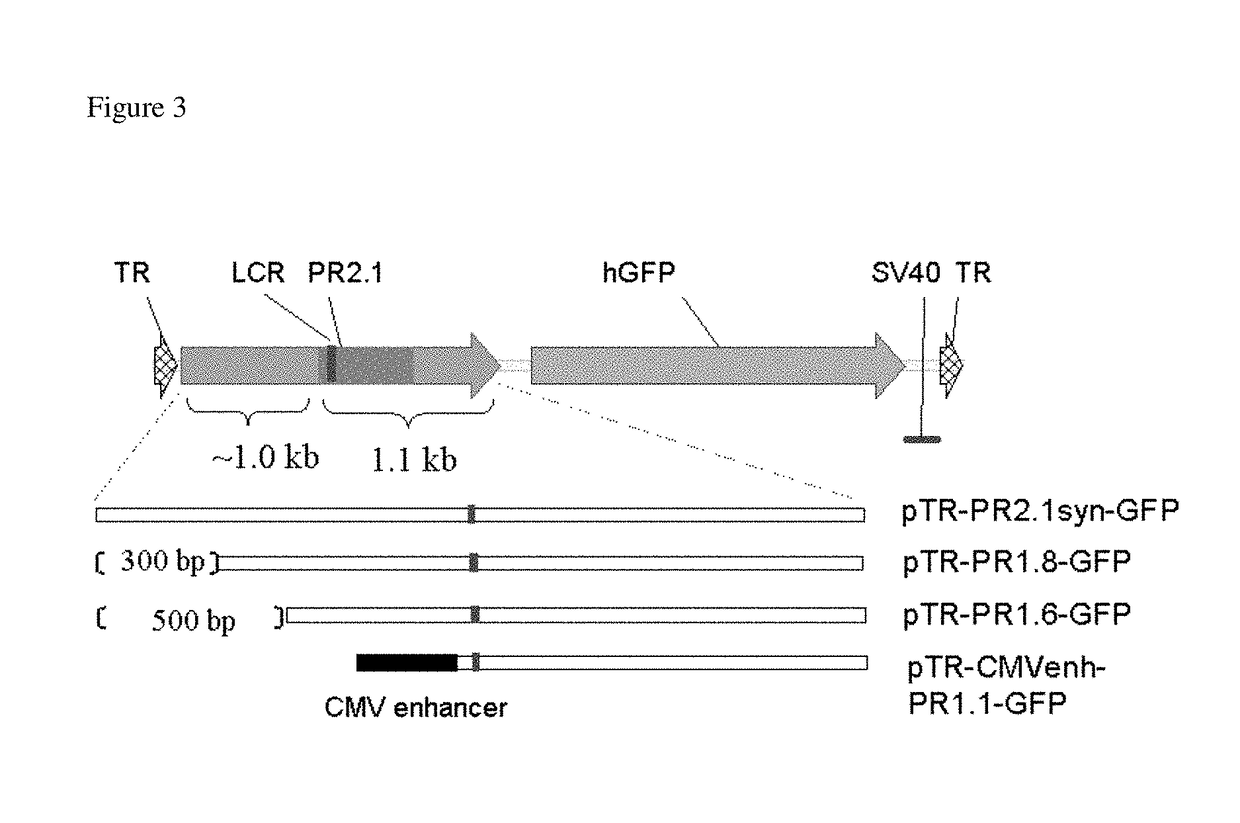
Creation and Testing of Shorter Versions of the PR2.1 Promoter
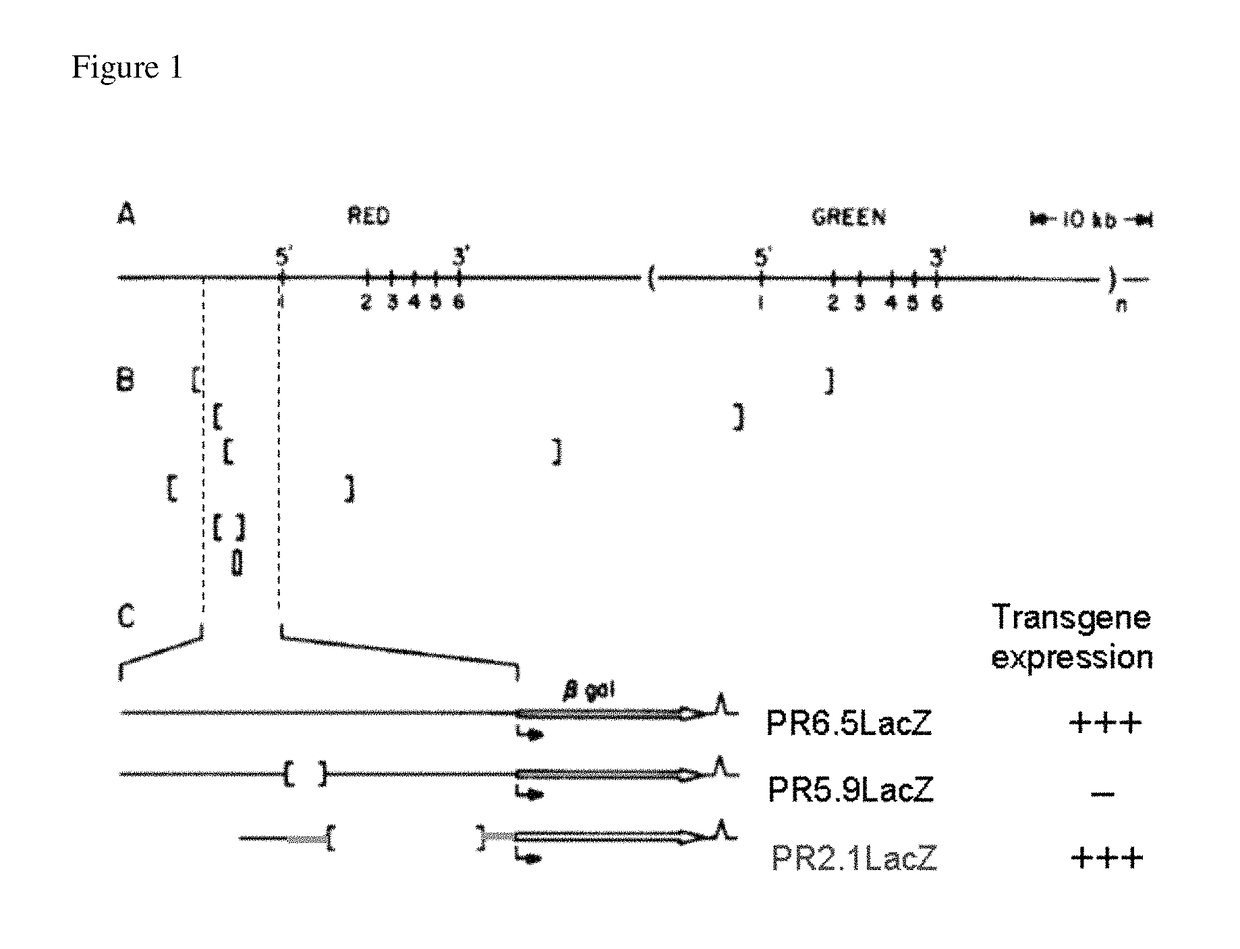
[0105]Prior investigators created a truncated human red / green cone opsin promoter based on the locations of six different deletions found in blue cone monochromats (0.6 to 55 kb). Wang, Y., et al. A locus control region adjacent to the human red and green pigment genes. Neuron 9: 429-440 (1992); Nathans, J., et al. Molecular genetics of human blue cone monochromacy. Science 245: 831-838 (1989); Shaaban, S. et al. Functional analysis of the promoters of the human red and green visual pigment genes; Integrative Opthalmology &Visual Science: 39(6): 885-896 (1998). This truncated red / green opsin promoter is shown in FIG. 1.
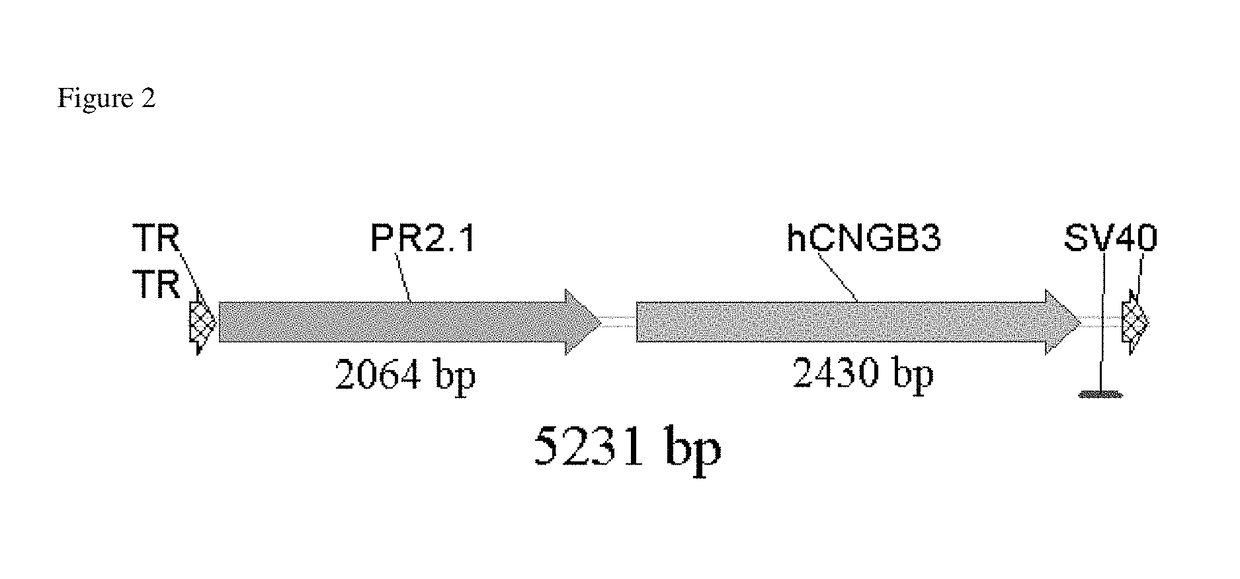
[0106]In Komaromy et al. a recombinant adeno associated viral (rAAV) vector was utilized, as shown in FIG. 2. This vector was derived from a human adeno-associated virus of serotype 5 and thus contained the capsid sequences of AAV5. It packaged an expression cassette that contained the PR2.1 cone red opsin ...
example 2
Creation of Native and Hybrid hCNGB3 Promoters
[0128]In these experiments, new native and hybrid hCNGB3 promoters were created with the goal of enabling hCNGB3 expression in all three types of cone photoreceptors. A pair of oligonucleotide primers was designed for PCR amplification of a 1913 bp DNA fragment immediately 5′ of the start codon (ATG) of the hCNGB3 open reading frame (ORF) based on the reference hCNGB3 gene sequence (GenBank acc #NG_016980). The 5′ nontranslated region (NTR) of the CNGB3 gene contains the native CNGB3 promoter. The primer sequences used are: pCNGB3-NTR F: 5′-CAGACTAGCCAGAATCACAGATC-3′ (SEQ ID NO: 9)and pCNGB3-NTR R: 5′-TCTCCTATAGGCTTCACCTTGTTG-3′ (SEQ ID NO: 10). Using 0.25 μg or 0.5 μg of human genomic DNA (Promega, cat #G1471, lot #305017) as DNA template, PCR amplification was performed using 2×Pfu Ultra HS Mix (Agilent Technologies, cat #600850). The amplification parameters were 5 min at 95° C., followed by 35 cycles of 94° C. for 1 min, 55° C. for 4...
example 3
In Vivo Efficacy of Cone Specific Promoters from the Native CNGB3 Non-Translated Region in Driving GFP Expression in Retinal Cells
[0133]The following experiments demonstrated the in vivo efficacy of cone specific promoters from the native CNGB3 non-translated region in driving GFP expression in retinal cells of mice.
[0134]Four AAV5 vectors containing a unique promoter driving GFP were constructed and manufactured by the conventional transfection methods. These four vectors include: 1) AAV5-NTR1.8-hGFP which contains an isolated promoter comprising approximately 1.8 kb of the 5′-NTR of the CNGB3 gene as described herein; 2) AAV5-NTR1.6-hGFP which contains an isolated promoter comprising approximately 1.6 kb of the 5′-NTR of the CNGB3 gene as described herein; 3) AAV5-CMVenh-NTR1.4-hGFP which contains an isolated promoter comprising approximately 400 bp of the cytomegalovirus (CMV) enhancer as described herein. and approximately 1.4 kb of the 5′-NTR of the CNGB3 gene as described here...
PUM
| Property | Measurement | Unit |
|---|---|---|
| wavelength | aaaaa | aaaaa |
| wavelength | aaaaa | aaaaa |
| wavelengths | aaaaa | aaaaa |
Abstract
Description
Claims
Application Information
 Login to View More