An indoor distributed system for supporting real time network optimization and its implementation method
A distributed system and network technology, which is applied to the indoor distributed system and its implementation field that supports real-time network optimization, can solve the problems of community load fluctuations, large space attenuation loss, indoor coverage system cost pressure, etc., to increase system capacity , the effect of saving network resources
- Summary
- Abstract
- Description
- Claims
- Application Information
AI Technical Summary
Problems solved by technology
Method used
Image

Examples
Embodiment 1
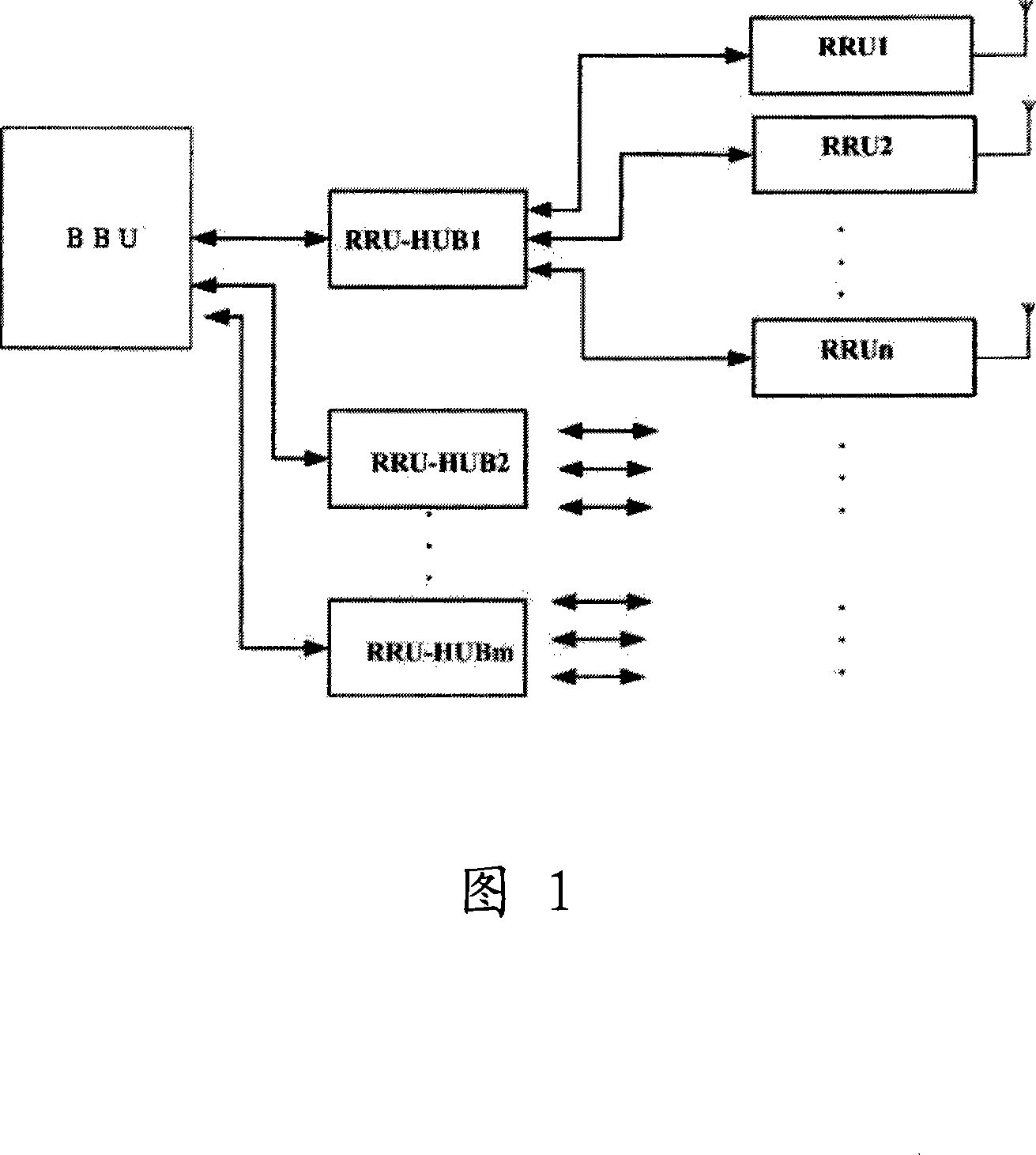
[0030] Embodiment 1 provides an indoor distributed system that supports real-time network optimization. As shown in Figure 1, the system includes a BBU, multiple RRU-HUBs, and multiple Pico-RRUs, where the BBU is connected to multiple HUB, each RRU-HUB is connected to multiple Pico-RRUs. The downlink direction of the system is that the RRU-HUB receives the downlink data of the BBU and distributes it to each Pico-RRU at the same time; the uplink direction is that after the RRU-HUB receives the data of all Pico-RRUs, it sends the data to the BBU after data combining.
[0031] Among them, the BBU mainly completes functions such as uplink and downlink baseband processing, clock processing, and interface with the base station controller.
[0032] RRU-HUB is mainly used to realize the collection and exchange of baseband data.
[0033] The Pico-RRU mainly completes the conversion of downlink baseband signals to RF signals and the transmission of RF signals, the reception of uplink R...
Embodiment 2
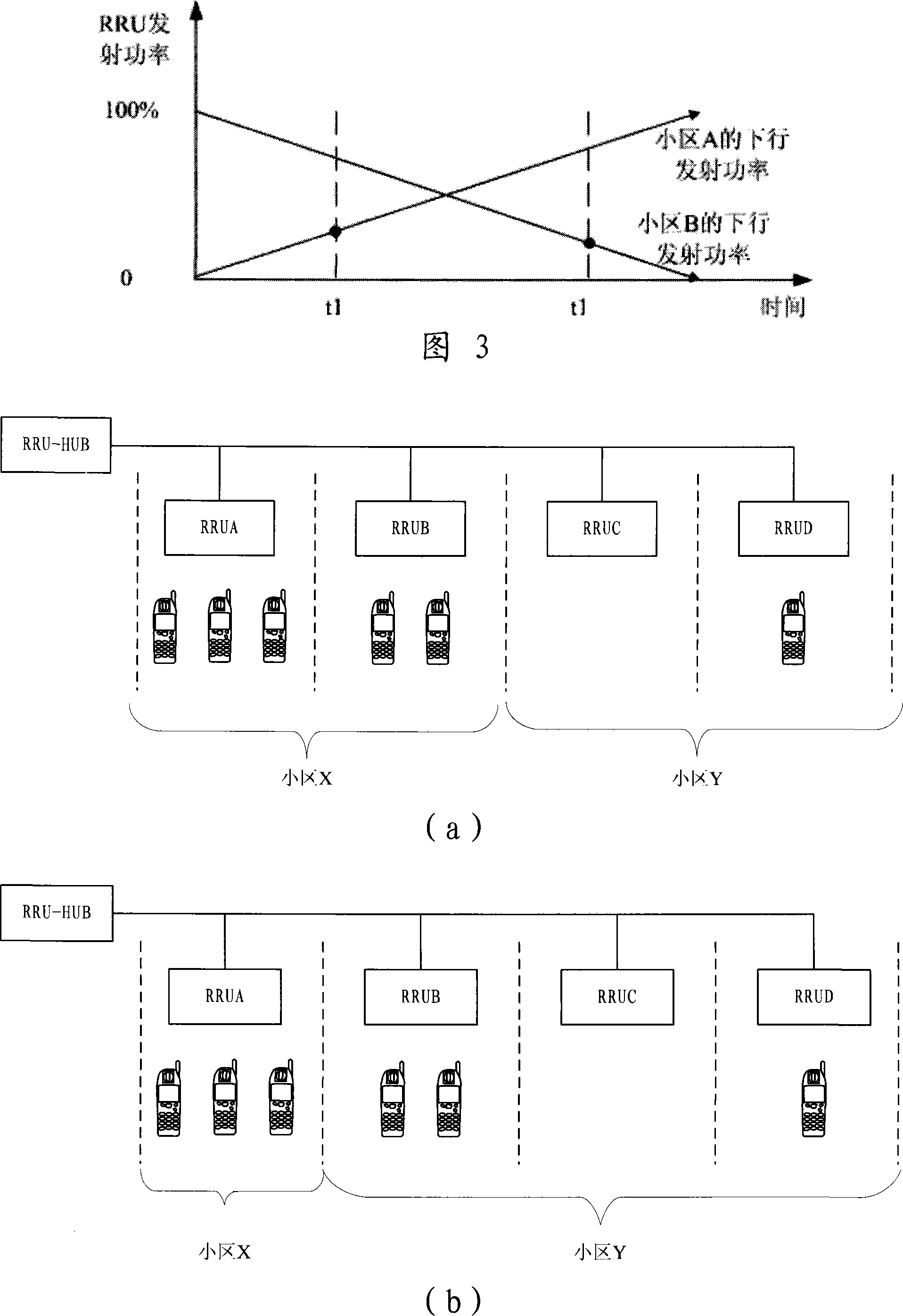
[0057] Embodiment 2 provides an indoor distributed system that realizes real-time network optimization through cell splitting and merging. Figure 4(a) is a schematic diagram of the structure of the cell coverage system without optimization in Embodiment 2. In this system, four Pico-RRUs are connected behind the RRU-HUB, which are RRUA, RRUB, RRUC, and RRUD, and RRUA and RRUB support both Cell X, RRUC and RRUD support cell Y. At this time, the number of users accessed in cell X is relatively large, while the number of users accessed in cell Y is small.
[0058] In the system shown in Figure 4(a), the RRUB downlink transmission content is switched from the downlink signal of cell X to the downlink signal of cell Y, so that the mobile station in the coverage area of RRUB is brought to cell Y, and the figure 4 ( b) shows a schematic diagram of the optimized system structure, where RRUA alone supports a cell X, and RRUB, RRUC, and RRUD together support a cell Y, and the user vol...
PUM
 Login to View More
 Abstract
Description
Claims
Application Information
 Login to View More
 - R&D
- Intellectual Property
- Life Sciences
- Materials
- Tech Scout
- Unparalleled Data Quality
- Higher Quality Content
- 60% Fewer Hallucinations
Browse by: Latest US Patents, China's latest patents, Technical Efficacy Thesaurus, Application Domain, Technology Topic, Popular Technical Reports.
© 2025 PatSnap. All rights reserved.Legal|Privacy policy|Modern Slavery Act Transparency Statement|Sitemap|About US| Contact US: help@patsnap.com