[0004] 1. The angle of light projection is limited, so it is not suitable for traditional lamps, and it must be used with a reflective or direct structure cover to emit light;
[0005] 2. The brightness of a single light-emitting
diode cannot meet the needs of lamps. Multiple light-emitting diodes with fixed projection angles must be used to emit light to provide sufficient brightness, resulting in uneven light, glare and limited light-emitting range of direct-lit lamps with fixed projection angles. and other issues, causing discomfort to the viewers;
[0006] 3. The light projection angle of the
light emitting diode light source is fixed, so it is difficult to adjust different
light emission angles and light patterns for different light or needs for refracting or reflective lamps with fixed light projection angles, which is less flexible in use;
[0007] 4. In traditional LED lamps, since the LEDs are fixed on the circuit board, if you need to replace or repair a single LED light source, or change the type of LED configuration, you must disassemble and replace it together with the circuit board. The maintenance method is quite Difficult, it is difficult for ordinary consumers to replace or repair by themselves
[0013] Due to the shortcomings of the limited light projection angle of LED lighting, it cannot be effectively improved at present. In order to control the light emitting angle, light emitting range and light uniformity of LED lighting fixtures, direct-lit LED lamps can only be changed by changing the arrangement of LEDs, or in the LED lighting. The light source is improved by adding a lens, and the refractive or reflective LED lamps are usually designed to control the light angle, light range and light uniformity of the lamp through the design of the
refraction or reflector or the replacement of the reflector.
[0014] First of all, as far as direct-type lamps are concerned, although good light output efficiency can be obtained, the light-emitting angle of LEDs cannot be adjusted, resulting in users being unable to adjust the most appropriate light-emitting angle, light-emitting pattern, and uniformity of light in the light-emitting area according to environmental needs. degree, the accompanying light environment comfort is also reduced
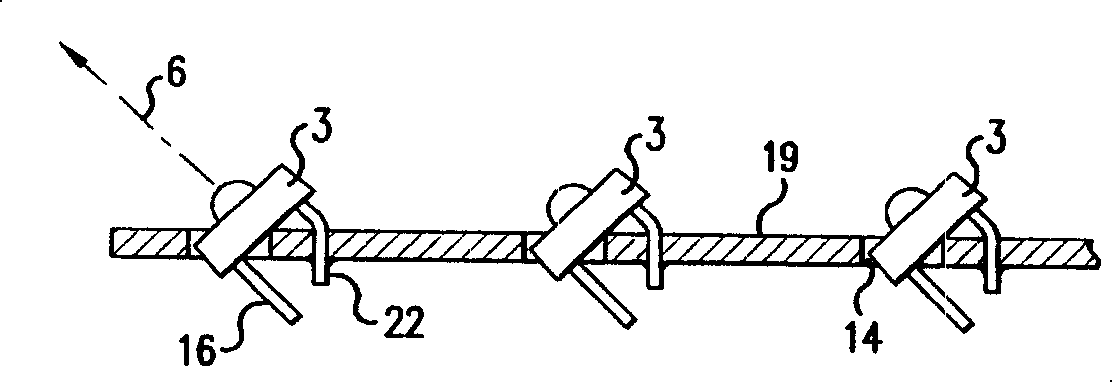
[0015] Cooperating with the two previous patents, a brief description of the light-emitting method of the direct-type LED lamps is given, please refer to Figure 4 , U.S. Patent No. 5136483 Illuminating device, the invention is a lamp applied to vehicles, which includes a plurality of light-emitting diodes 14 placed flat on the inner annular side wall of the lamp, a lamp reflector 16 and cooling fins 19, placed flat on the side wall The light emitted by the light-emitting diode 14 is reflected by the curved reflector (the reflective structure surface with an arc-shaped bottom), which can generate parallel light rays; in this patent, since the light-emitting diode 14 is placed flat inside the lamp Above the side wall, only a part of the light emitting angle range of the
light emitting diode 14 can be reflected by the reflector 16 to generate parallel light rays, and the light rays in other light emitting angle ranges are emitted at undesired light angles, or are trapped It cannot be projected inside the lamp, so it cannot efficiently project the light required by the user
[0016] see again Figure 5 , Japanese Invention Patent Laid-Open No. 2004327670, which discloses a tiltable and rotatable light-emitting diode lamp. The
angle of rotation between the foot
assembly 11 and the lamp body 10 changes the angle between the light-emitting diode 1 and the substrate 2 to obtain light in different directions; in this patent, since the light is directly irradiated without any
refraction or reflection device, it is easy to generate glare , and the adjustable angle is limited between 0° and 90°. If there is light in other directions, another set of devices needs to be used together; inconvenient


 Login to View More
  Login to View More