
Design method of bridge arm balance compensating resistance of pressure sensor signal conditioning integrate circuit
A pressure sensor and signal conditioning technology, which is applied in the direction of fluid pressure measurement by changing the ohmic resistance, to achieve the effect of avoiding errors and small adjustment steps
- Summary
- Abstract
- Description
- Claims
- Application Information
AI Technical Summary
Problems solved by technology
Method used
Image

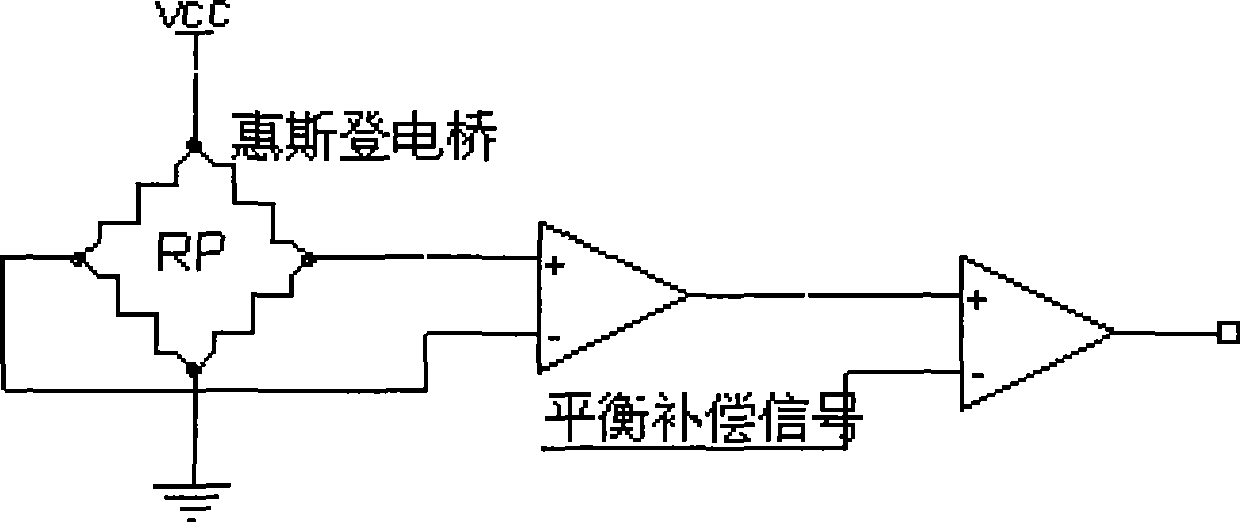
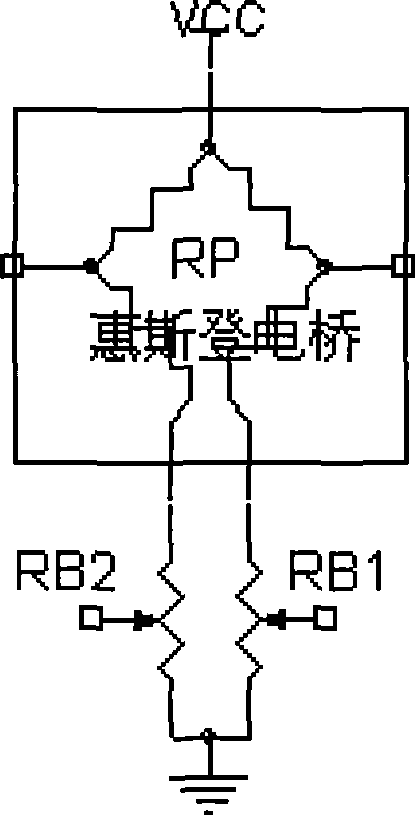
Examples
Embodiment Construction
[0022] The temperature characteristic of the resistance can be expressed by the quadratic term equation
[0023] R(T)=R0*{1+(1st.Coeff)*(T-T0)+(2nd.Coeff)*(T-T0) 2}
[0024] The temperature characteristic of the resistance of the bridge arm of the silicon pressure sensor used is
[0025] RP(T)=R0*{1+(1.829E-3)*(T-T0)+(0.5546E-5)*(T-T0) 2}
[0026] In the CZ6H process, the temperature characteristics of the resistance of Poly-silicon and N-well are
[0027] Rpolys(T)=R0*{1+(-0.3E-3)*(T-T0)}
[0028] Rnwell(T)=R0*{1+(3.52E-3)*(T-T0)+(1.07E-5)*(T-T0) 2}
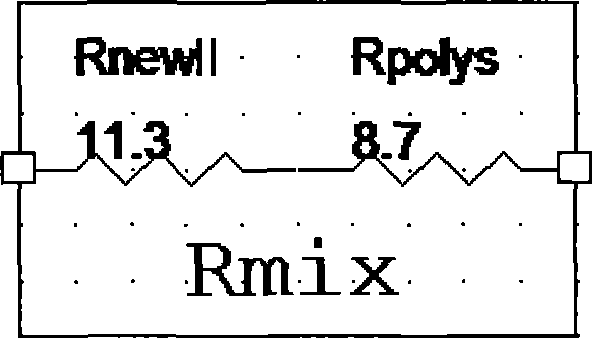
[0029] The resistance composed of n parts of Rpolys and (1-n) parts of Rnwell in series is
[0030] Rmix(T)=n*Rpolys+(1-n)*Rnwell
[0031] =R0*{n*(1+(-0.3E-3)*(T-T0))+(1-n)*1+(3.52E-3)*(T-T0)+(1.07E-5 )*(T-T0) 2}
[0032] Therefore, n=0.415 is obtained by solving Rmix(T)≈RP(T).
[0033] That is, mix 0.415 parts of Rpolys with 0.565 parts of Rnwell resistors
[0034] Rmix(T)=0.415*Rpolys+0.565*Rnwell
[0035] The re...
PUM
 Login to View More
 Abstract
Description
Claims
Application Information
 Login to View More