Unlock instant, AI-driven research and patent intelligence for your innovation.

Method for converting design feature model into manufacturing feature model based on intermediate model

An intermediate model and processing feature technology, applied in the field of CAD and CAM integration technology, can solve problems such as lack of user interaction means, unsatisfactory conversion results, and difficulty in obtaining conversion results, and achieve the effect of improving efficiency

Inactive Publication Date: 2010-12-22
HOHAI UNIV CHANGZHOU
View PDF2 Cites 3 Cited by
  • Summary
  • Abstract
  • Description
  • Claims
  • Application Information

AI Technical Summary

Problems solved by technology

In the past 20 years, a variety of feature conversion methods from the design feature model to the processing feature model have emerged, but these methods have problems such as unsatisfactory conversion results or insufficient robustness of the conversion algorithm.
In addition, due to the complexity and diversity of parts and the high complexity of CAPP (Computer Aided Process Planning), there has not yet been a universally applicable standard in the field of CAPP. Although some methods consider multiple processing interpretation issues, they lack user interaction means , the fully automatic feature model conversion process makes it difficult to obtain ideal conversion results

Method used

the structure of the environmentally friendly knitted fabric provided by the present invention; figure 2 Flow chart of the yarn wrapping machine for environmentally friendly knitted fabrics and storage devices; image 3 Is the parameter map of the yarn covering machine
View more

Image

Smart Image Click on the blue labels to locate them in the text.
Viewing Examples
Smart Image
  • Method for converting design feature model into manufacturing feature model based on intermediate model
  • Method for converting design feature model into manufacturing feature model based on intermediate model
  • Method for converting design feature model into manufacturing feature model based on intermediate model

Examples

Experimental program
Comparison scheme
Effect test

Embodiment 1

[0114] Figure 6 The design feature model DFM in is composed of 14 design features. According to the order of adding the design features, the 1st to 2nd design features are positive features, the 3rd to 8th design features are negative features, and the 9th to 14th design features are Concave fillet feature. exist Figure 6 The 1st to 8th design features are marked in , and the 9th to 14th features are located on the 6 concave edges of F7 and F8.

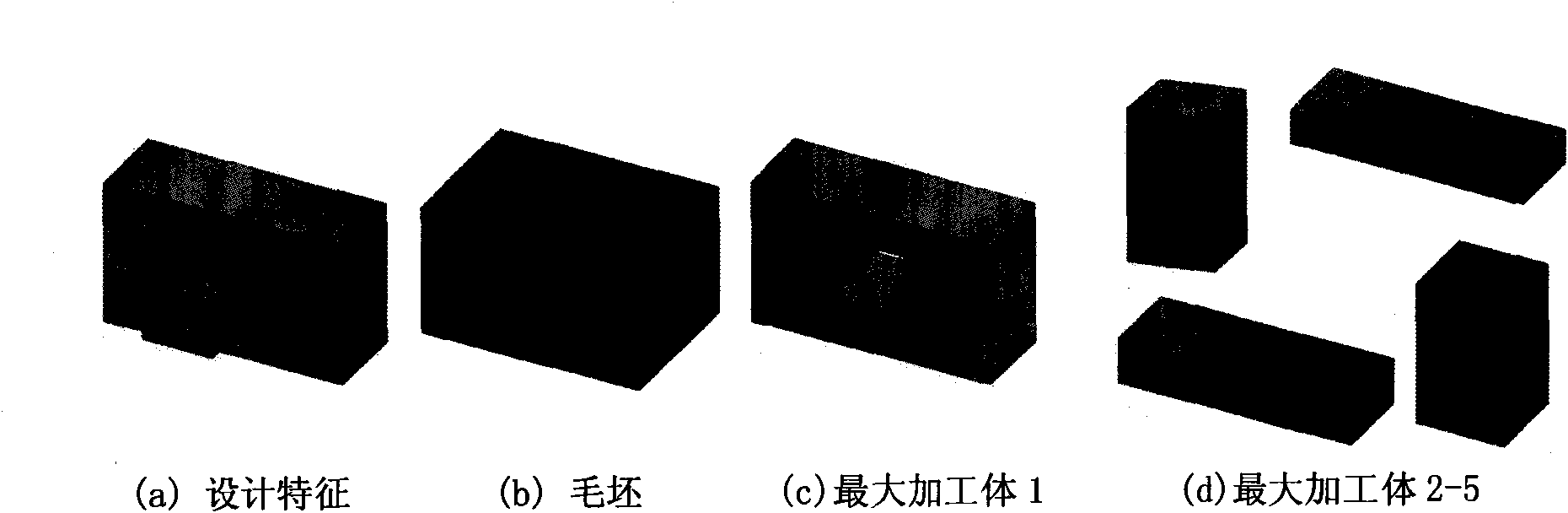
[0115] At the beginning of the algorithm, the design feature model DFM is empty, and the blank body is taken as the initial basic maximum processing body (assuming the initial basic maximum processing body B1), and its six processing directions are respectively represented by v1~v6, as shown in Figure 7 (a) shown. Figure 6 The first feature F1 is a boss feature (positive feature). After adding this feature and performing a Boolean subtraction operation on the feature bodies of B1 and F1, only one solid surface of the remaining ...

Embodiment 2

[0121] The design feature model of parts such as Figure 11 Shown (the front and back sides of the model are symmetrical). The model consists of 24 design features, including 5 extruded boss features, 15 extruded cut features and 4 fillet features.

[0122] Blank shape such as Figure 12 shown. After converting the design feature model DFM to the intermediate model IM according to the order of adding design features, there are 21 basic maximum processing bodies and newly generated maximum processing bodies after merging, numbered B1~B21, respectively, as Figure 13 shown. Table 1 lists all design features or sequences of design features that lead to the generation or change of each basic maximum processing body and the newly generated maximum processing body after merging.

[0123] Table 1 Correspondence between the largest processed body and design features

[0124]

[0125] When converting the intermediate model IM to the machining feature model MFM, there are multip...

the structure of the environmentally friendly knitted fabric provided by the present invention; figure 2 Flow chart of the yarn wrapping machine for environmentally friendly knitted fabrics and storage devices; image 3 Is the parameter map of the yarn covering machine
Login to View More

PUM

No PUM Login to View More

Abstract

The invention discloses a method for converting a design feature model into a manufacturing feature model based on an intermediate model, which comprises the following steps of: firstly, converting the design feature model (DFM) into the intermediate model (IM); and then, converting the intermediate model (IM) into the manufacturing feature model (MFM). The invention is applied to CAD / CAM (Computer Aided Design / Computer Aided Manufacturing) integration, can realize user interaction through computers, greatly improve the design efficiency and the manufacturing efficiency of products and effectively shorten the product development period and the production cost.

Description

technical field [0001] The invention relates to a CAD (Computer Aided Design) and CAM (Computer Aided Manufacturing) integrated technology. Background technique [0002] CAD / CAM and its related technologies emerged independently and developed in parallel from the beginning, and independent systems were used for product modeling in the product design and manufacturing stages, forming an "island of automation" for design and manufacturing. In fact, CAD, CAM and their related technologies are closely related in terms of technology and application, and the effective integration of CAD and CAM has always been an important direction of people's efforts. The emergence of feature technology provides an effective way to realize CAD / CAM integration. In the past 20 years, a variety of feature conversion methods from the design feature model to the processing feature model have emerged, but these methods have problems such as unsatisfactory conversion results or insufficient robustness...

Claims

the structure of the environmentally friendly knitted fabric provided by the present invention; figure 2 Flow chart of the yarn wrapping machine for environmentally friendly knitted fabrics and storage devices; image 3 Is the parameter map of the yarn covering machine
Login to View More

Application Information

Patent Timeline
no application Login to View More
IPC IPC(8): G06F17/50
Inventor 刘景陈正鸣温坤李晶朱英
Owner HOHAI UNIV CHANGZHOU