
Distributed stimulated Brillouin temperature strain sensing system based on double-sideband modulation
A technology of stimulated Brillouin and temperature strain, applied in the field of optical fiber, can solve problems such as power gap, power reduction, frequency difference stability, etc.
- Summary
- Abstract
- Description
- Claims
- Application Information
AI Technical Summary
Problems solved by technology
Method used
Image

Examples
Embodiment Construction
[0027] The invention provides a distributed Brillouin temperature strain sensing system based on double sideband modulation. The present invention will be described in detail below in conjunction with the accompanying drawings.
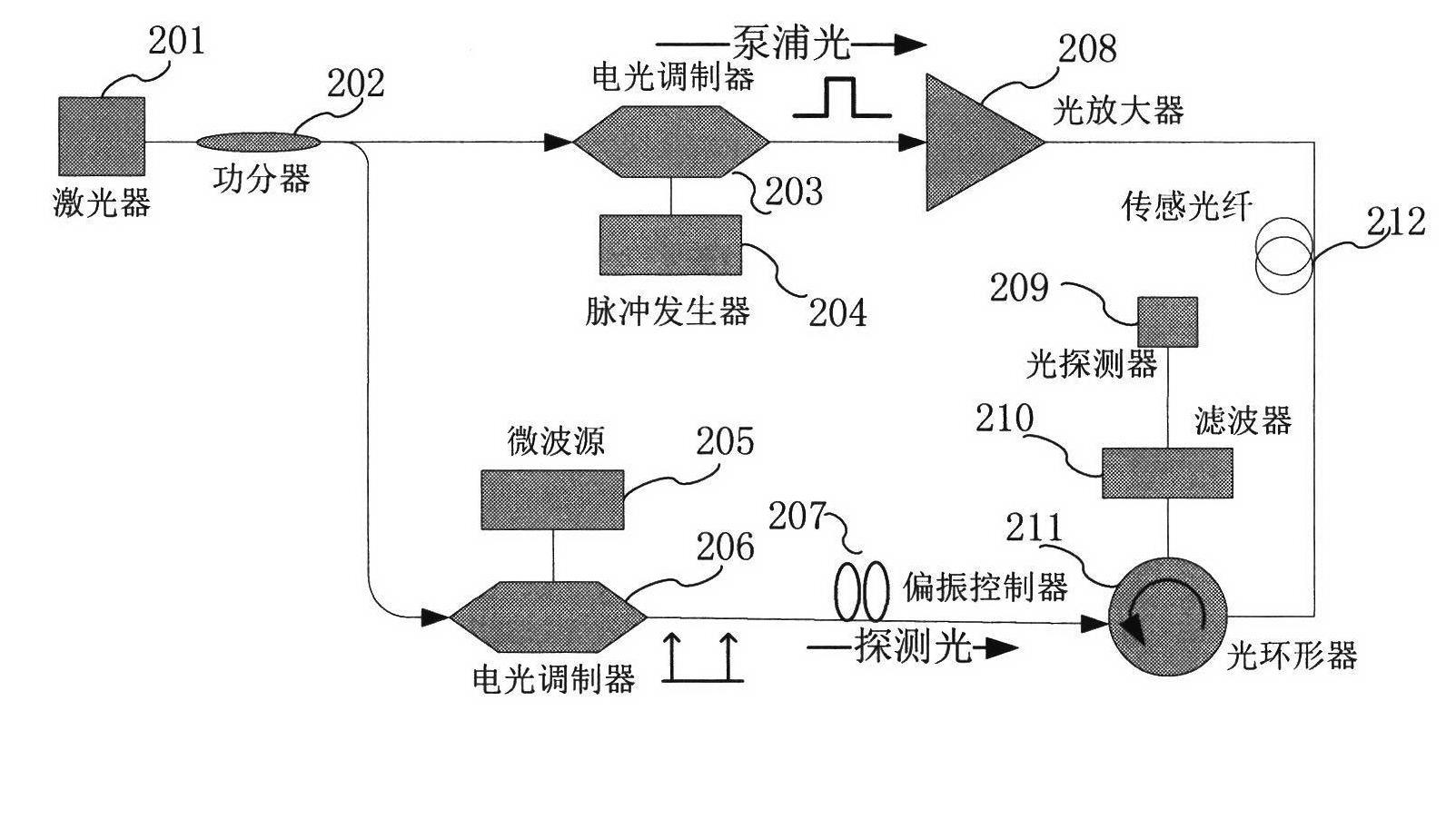
[0028] The present invention provides a distributed Brillouin temperature strain sensing system based on double sideband modulation, such as figure 2 As shown, the system includes a narrow-linewidth light source 201, a microwave source 205, a pulse signal generator 204, an optical amplifier 208, an electro-optic intensity modulator 203, an optical detector 209, and a sensing fiber 212; Continuous light with a frequency of ν0 is divided into two beams through a 50:50 coupler, one of which is modulated by a pulse signal generator and an intensity modulator into a pump light pulse, amplified by an optical amplifier, and injected into the sensing fiber; the microwave source generates a frequency for f m microwave signal, another beam of light is modula...
PUM
 Login to View More
 Abstract
Description
Claims
Application Information
 Login to View More