Anti-hepatitis B drug entecavir intermediate and synthesis thereof
What is AI technical title?
AI technical title is built by Patsnap AI team. It summarizes the technical point description of the patent document.
A technology for entecavir and anti-hepatitis B, which is applied to the intermediate of entecavir and its synthesis field, and can solve the problems of long synthesis steps, difficulty in product purification, low economic benefits and the like
Inactive Publication Date: 2013-03-06
NANJING UNIV OF TECH
View PDF5 Cites 17 Cited by
Summary
Abstract
Description
Claims
Application Information
AI Technical Summary
This helps you quickly interpret patents by identifying the three key elements:
Problems solved by technology
Method used
Benefits of technology
Problems solved by technology
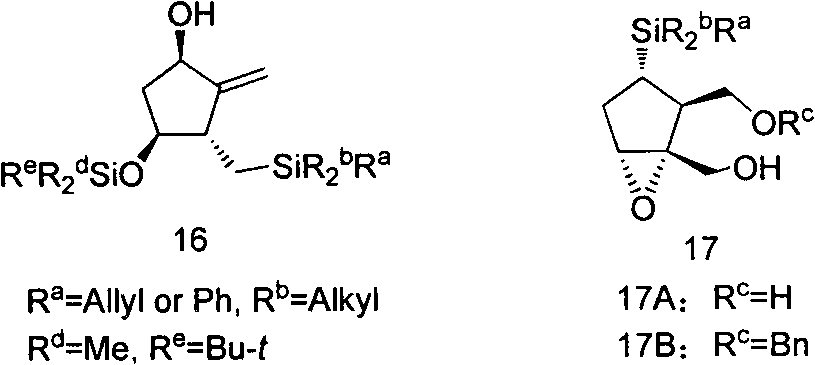
[0016] At present, the defect that still exists in the synthesis of this type of intermediate (17) is that a large amount of tar is generated in the reaction, which makes product purification difficult and also affects the yield
In order to solve this difficult problem, in 2005, Maotang X.Zhou carried out further group modification to 17, designed the method (US20050272932) with intermediate 30 and 31 as key intermediate synthetic entecavir, the use of these two intermediates has reduced The production of tar in the late reaction, and the yield is high, but the synthesis steps are too long, and the overall economic benefit is not high
Method used
the structure of the environmentally friendly knitted fabric provided by the present invention; figure 2 Flow chart of the yarn wrapping machine for environmentally friendly knitted fabrics and storage devices; image 3 Is the parameter map of the yarn covering machine
View more
Image
Smart Image Click on the blue labels to locate them in the text.
Viewing Examples
Smart Image
Click on the blue label to locate the original text in one second.
Reading with bidirectional positioning of images and text.
Smart Image
Examples
Experimental program
Comparison scheme
Effect test
Embodiment 11
[0030] Embodiment 1.1, the synthesis of 1-diphenylcyclotrisilane (3a)
[0031] Under nitrogen protection, magnesium chips (53g, 2.21mol) and anhydroustetrahydrofuran (1400mL) were added to a 2L dry four-neck flask, heated to reflux, and 1,3-dibromopropane (202g, 1.01mol) was slowly added dropwise, After dropping within 2h, continue to reflux for 2h, remove the oil bath, cool to 0°C, add diphenyldichlorosilane (2) (240g, 0.92mol) dropwise, drop within 2h, reflux for 24h, cool down To 0°C, quench the reaction with saturated ammoniumchloride solution, extract with petroleumether, wash the organic phase with saturated brine, dry over anhydroussodiumsulfate, concentrate, and distill under reduced pressure to obtain 1,1-diphenylcyclotrisilane (3a) (148.38g, yield: 70%, bp.=110°C-114°C / 2mmHg).
Embodiment 21
[0032] Embodiment 2.1, the synthesis of 1-diphenylcyclotetrasilane (3b)
[0033] Diphenyldichlorosilane (2) and Grignard reagent BrMg(CH 2 ) 4 MgBr was reacted according to the operation steps of Example 1 to obtain 1,1-diphenylcyclotetrasilane (3b), yield: 79%, bp.=124°C-127°C / 3mmHg, 1 H-NMR (300MHz, CDCl 3 )δ: 7.55-7.52 (m, 4H), 7.36-7.23 (m, 6H), 1.82-1.77 (m, 4H), 1.14-1.09 (m, 4H).
Embodiment 31
[0034] Embodiment 3.1, the synthesis of 1-diphenylcyclopentasilane (3c)
[0035] Diphenyldichlorosilane (2) and Grignard reagent BrMg(CH 2 ) 5 MgBr was reacted according to the operation steps of Example 1 to obtain 1,1-diphenylcyclopentasilane (3c), yield: 81%, bp.=133°C-136°C / 3mmHg.
the structure of the environmentally friendly knitted fabric provided by the present invention; figure 2 Flow chart of the yarn wrapping machine for environmentally friendly knitted fabrics and storage devices; image 3 Is the parameter map of the yarn covering machine
Login to View More
PUM
Login to View More
Abstract
The invention belongs to the field of drug intermediates and provides a five-membered ring chiral intermediate (1R, 2S, 3S, 5R)-3-(1-phenylcyclo silicon)-6-oxa-bicyclo [3.1.0] hexane-1, 2-dimethyl carbinol for synthesis of entecavir and a synthesis of the five-membered ring chiral intermediate. A chiral five-membered carboatomic ring is obtained by reacting 1-phenyl-1-chlorocyclosilane with alkali metal salt of cyclopentadiene and introducing cyclosilane into a molecule to serve as a construction protecting group and by the aid of a chemical resolution method. Introduction of the cyclosilane enhances molecule rigidity to enable a solid product to be crystallized and purified more easily, and the synthesis method is simpler in reaction operation, cheap in raw materials, available to raw materials and suitable for industrial production.
Description
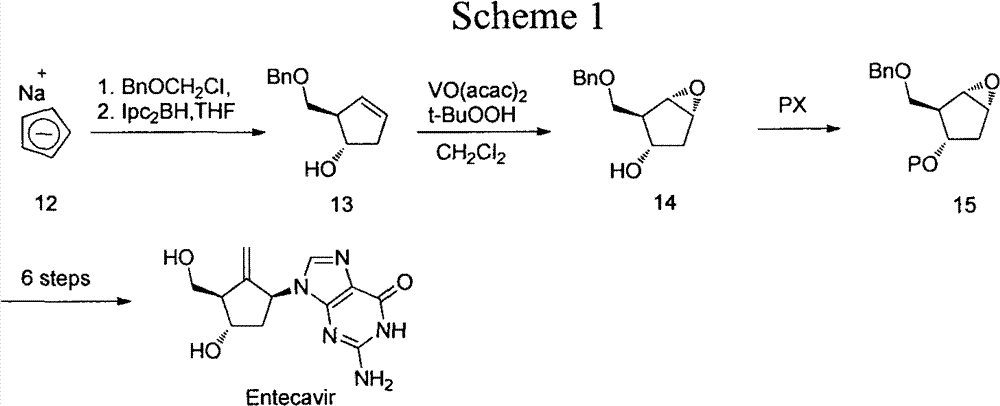
technical field [0001] The invention belongs to the field of pharmaceutical intermediates, and in particular relates to an entecavir intermediate and a synthesis method thereof. Background technique [0002] Entecavir (Entecavir) is a kind of deoxyguanosine compound that can effectively inhibit the replication of hepatitis B virus. It was developed by the U.S. Bristol-Myers Squibb company and was listed in the U.S. in April 2005. Hepatitis B drugs. In terms of synthesis, the construction of chiral five-membered ring intermediates determines the industrial prospects of the entire synthesis process. Therefore, people have launched research on the synthesis of intermediates. [0003] In 1993, Robert Zahler reported for the first time in the patent US5206244 the method for synthesizing entecavir with compounds of this type 15 as key intermediates. In this method, a chiral five-membered carbocyclic structure (15) is first obtained through asymmetric synthesis, and then combined...
Claims
the structure of the environmentally friendly knitted fabric provided by the present invention; figure 2 Flow chart of the yarn wrapping machine for environmentally friendly knitted fabrics and storage devices; image 3 Is the parameter map of the yarn covering machine
Login to View More
Application Information
Patent Timeline
Application Date:The date an application was filed.
Publication Date:The date a patent or application was officially published.
First Publication Date:The earliest publication date of a patent with the same application number.
Issue Date:Publication date of the patent grant document.
PCT Entry Date:The Entry date of PCT National Phase.
Estimated Expiry Date:The statutory expiry date of a patent right according to the Patent Law, and it is the longest term of protection that the patent right can achieve without the termination of the patent right due to other reasons(Term extension factor has been taken into account ).
Invalid Date:Actual expiry date is based on effective date or publication date of legal transaction data of invalid patent.


 Login to View More
  Login to View More