
Novel nano-fluid and its preparation method and application thereof
A nanofluid, a new type of technology, applied in chemical instruments and methods, fibrous fillers, dyed low-molecular organic compound treatment, etc., can solve problems such as weak physical affinity, not the best effect, and difficult application of direct modification. The preparation method is simple and easy, and the processing performance is improved
- Summary
- Abstract
- Description
- Claims
- Application Information
AI Technical Summary
Problems solved by technology
Method used
Image

Examples
Embodiment 1
[0048] Embodiment 1: Preparation of novel nanofluid
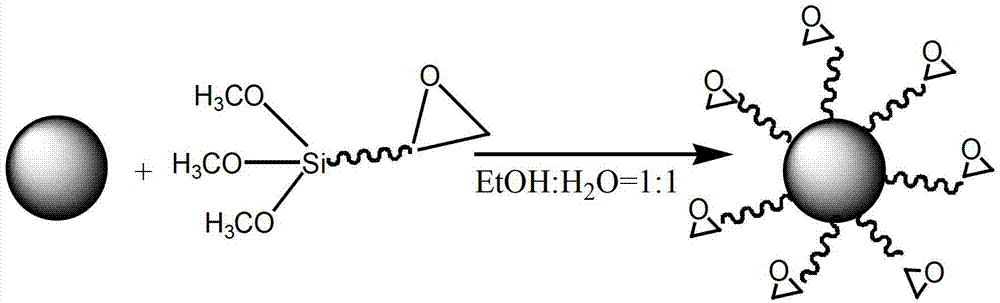
[0049] (1) Weigh 1.67g of 30wt% silica aqueous solution (purchased from Sigma-Aldrich) with an average particle size of 7nm and dilute it in 75ml of water (use sodium hydroxide to adjust the pH of the solution to 12), sonicate for 1h; Dissolve 0.59g of γ-glycidyl ether propoxytrimethoxysilane coupling agent (purchased from Aladdin Reagent Company) in 40ml of ethanol, then pour it into the above-mentioned sonicated silica solution, and stir at 70°C for reaction , after 6h, the reaction is complete, and the reaction solution of nano-silica / epoxy coupling agent is obtained. For the reaction mechanism, see figure 1 .
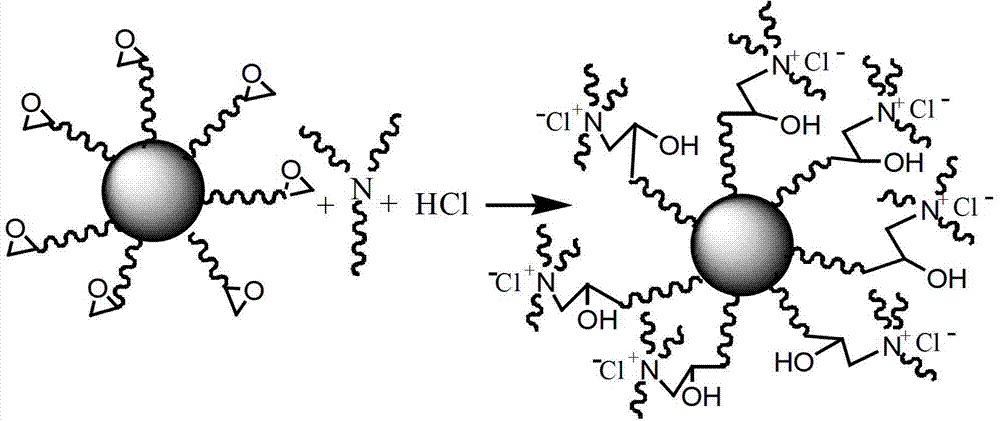
[0050] (2) Weigh and add 0.51g of tri-n-butylamine and 0.27g of concentrated hydrochloric acid with a concentration of 36.5wt% to the nano-silica / epoxy coupling agent reaction solution in step (1), stir and react at a constant temperature of 70°C , after 24 hours of reaction, the reaction solution of nano-silic...
Embodiment 2
[0053] Embodiment 2: Preparation of novel nanofluid
[0054] (1) Weigh 1.67g of 30wt% silica aqueous solution (purchased from Sigma-Aldrich) with an average particle size of 7nm and dilute it in 75ml of water (use sodium hydroxide to adjust the pH of the solution to 12), sonicate for 1h; Dissolve 0.59g of γ-glycidyl ether propoxytrimethoxysilane coupling agent (purchased from Aladdin Reagent Company) in 40ml of ethanol, then pour it into the above-mentioned sonicated silica solution, and stir at 70°C for reaction , after 6h, the reaction is complete, and the reaction solution of nano-silica / epoxy coupling agent is obtained. For the reaction mechanism, see figure 1 .
[0055] (2) Weigh and add 0.51g of tri-n-butylamine and 0.27g of concentrated hydrochloric acid with a concentration of 36.5wt% to the nano-silica / epoxy coupling agent reaction solution in step (1), stir and react at a constant temperature of 70°C , after 24 hours of reaction, the reaction solution of nano-silic...
Embodiment 3
[0057] Embodiment 3: Preparation of novel nanofluid
[0058] (1) Weigh 1.67g of a 30% silica solution with an average particle size of 7nm and dilute it in 5ml of water, ultrasonicate for 1h, and add 5.0g of γ-glycidyl ether propoxymethoxydiethoxysilane coupling agent Dissolve it in 40ml of ethanol, then pour it into the sonicated silicon dioxide aqueous solution, stir and react at a constant temperature at 80°C, and the reaction is complete after 4 hours to obtain a nanometer silicon dioxide / epoxy coupling agent reaction solution.
[0059] (2) Weigh and add 2.55g of tri-n-butylamine and 1.35g of concentrated hydrochloric acid with a mass concentration of 36.5% to the nano-silica / epoxy coupling agent reaction solution in step (1), stir and react at a constant temperature of 80°C , after reacting for 1 hour, the reaction liquid of nano-silica / ammonium salt organic ions was obtained.
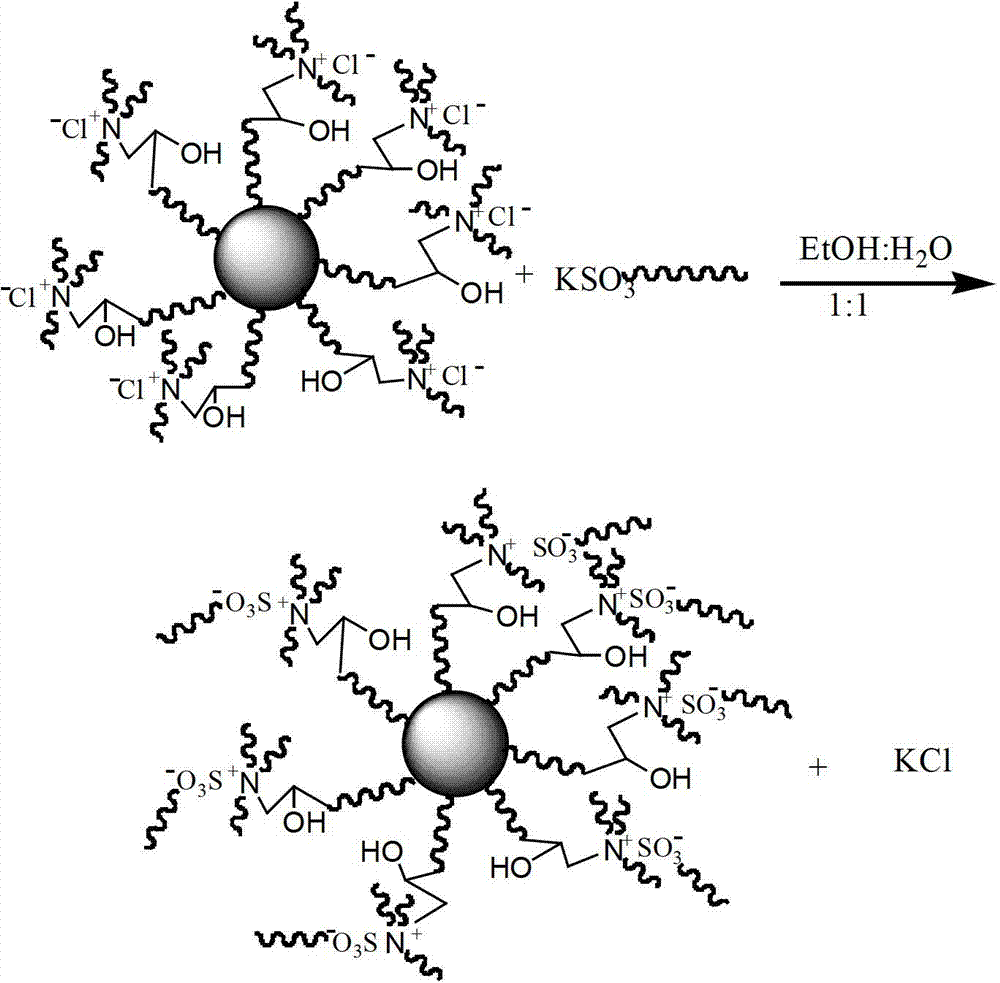
[0060] (3) Add 2.04g of C 9 h 19 -(C 6 h 4 )-(OCH 2 CH 2 ) 10 -O(CH 2 ) 3 SO 3 – K...
PUM
| Property | Measurement | Unit |
|---|---|---|
| particle diameter | aaaaa | aaaaa |
Abstract
Description
Claims
Application Information
 Login to View More