
Optoisolator with bandwidth of 1 mu m
An optical isolator and bandwidth technology, applied in optics, instruments, nonlinear optics, etc., can solve the problems of unstable characteristics and damage to the LD light source unit, and achieve polarization independence, miniaturization, and improvement of magnetic flux density. Effect
- Summary
- Abstract
- Description
- Claims
- Application Information
AI Technical Summary
Problems solved by technology
Method used
Image

Examples
Embodiment 1
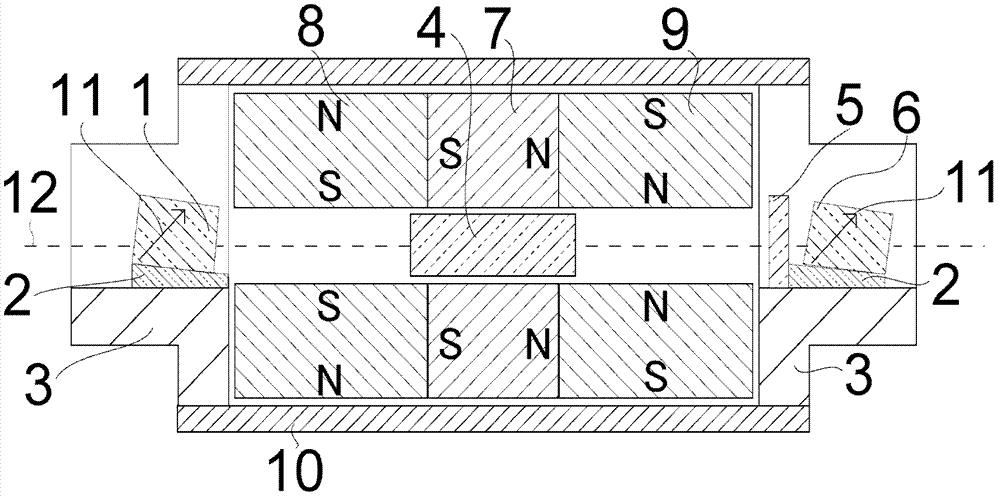
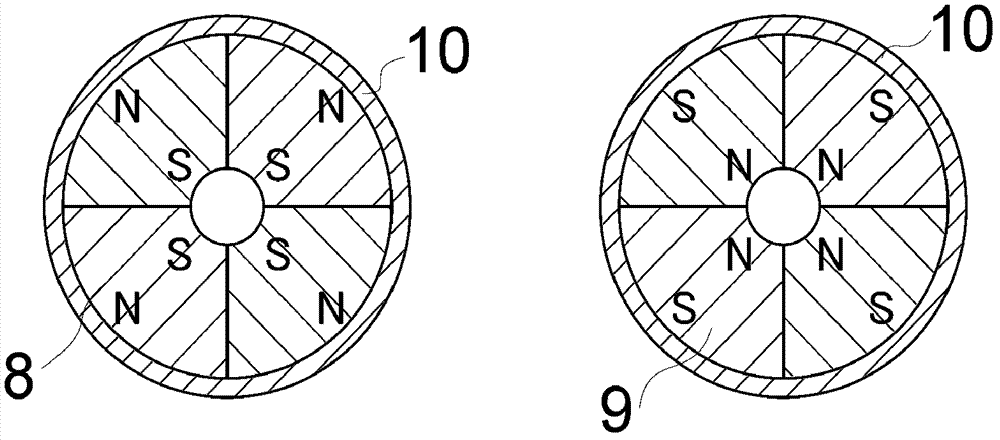
[0197] produced as figure 1 A 1μm bandwidth optical isolator constructed as shown.
[0198] The incident polarizer 1 and the outgoing polarizer 6 use rutile single crystal, and the light transmission surface thereof is processed into a parallel plate with a thickness of 1.0 cm, and the optical axis 11 is inclined 47.8 degrees relative to the optical axis 12 . figure 1 The direction of inclination depicted in is toward the inside of the paper. In addition, an anti-reflection film with a center wavelength of 1.06 μm was applied to the light transmission surface of the flat-plate polarizer. At the same time, in order to prevent the reflected light from the light transmission surface from returning to the incident light path, the bottom surface of the polarizer was adhered. It is fixed on the wedge glass 2 with an inclination angle of only 5 degrees, and loaded on the polarizer bracket 3.
[0199] And, let the Faraday rotator 4 be located at the central position of the hollow po...
Embodiment 2 and 3
[0205]In the above formula (I), the correspondence relationship between the Tb content x (0.5 to 1.0) and the Verdet constant was examined. As Example 2, (Tb 0.5 Y 0.5 ) 2 o 3 The same procedure as in Example 1 was carried out except for the single crystal of the oxide.
[0206] Furthermore, as Example 3, Tb containing the same weight % and x=1.0 was used 2 o 3 Except for the single crystal of the oxide, it was carried out in exactly the same manner as in Example 1.
[0207] The Verdet constant of a single crystal having the above composition was measured. It can be seen from the results that its Verdet constant is: when x=0.5, 0.27min / (Oe*cm); when x=1.0, 0.43min / (Oe*cm). In addition, in Examples 2 and 3, the extinction ratios were both 35 dB.
[0208] When changing the sample length (optical path length) of the single crystals used in Examples 1 to 3 at intervals of 0.1 cm within the range of 0.7 to 1.1 cm, the magnetic flux density T when the Faraday rotation angle ...
PUM
| Property | Measurement | Unit |
|---|---|---|
| Field constant | aaaaa | aaaaa |
| Thickness | aaaaa | aaaaa |
| Insertion loss | aaaaa | aaaaa |
Abstract
Description
Claims
Application Information
 Login to View More