
Experiment table for double-motor coaxial redundant drive control research
A test bench and dual-motor technology, applied in the direction of engine testing, machine/structural component testing, measuring devices, etc., can solve safety problems, high experimental costs, high risks, etc., to achieve simple structure, reduce costs and risks Effect
- Summary
- Abstract
- Description
- Claims
- Application Information
AI Technical Summary
Problems solved by technology
Method used
Image

Examples
Embodiment 1
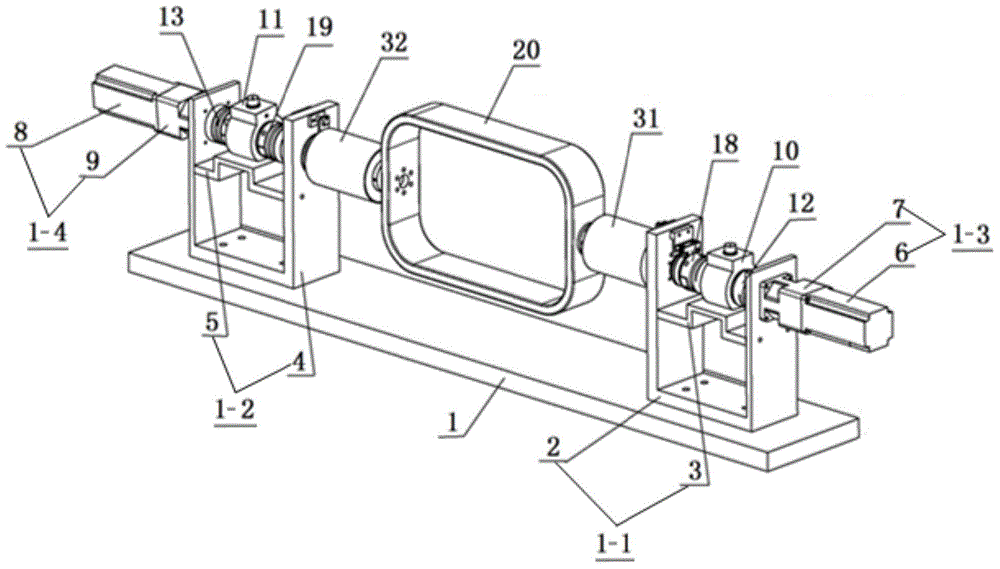
[0027] Embodiment 1. Experimental research on synchronous control with the minimum output torque difference of the drive unit as the optimization index.
[0028] The first torque sensor 10 and the second torque sensor 11 are added on the test bench provided by the present invention, and are used to collect the torque signals output by the first drive unit and the second drive unit respectively, and the first drive unit and the second drive unit are calculated according to the torque signals. The torque difference output by the two drive units can minimize the output torque difference between the first drive unit and the second drive unit as the optimization index, and the synchronous control algorithm of the dual-motor coaxial redundant drive system is studied.
Embodiment 2
[0029] Embodiment 2. Experimental research on synchronous control with the minimum difference of output state quantities (angular displacement, angular velocity or angular acceleration) of the drive unit as the optimization index.
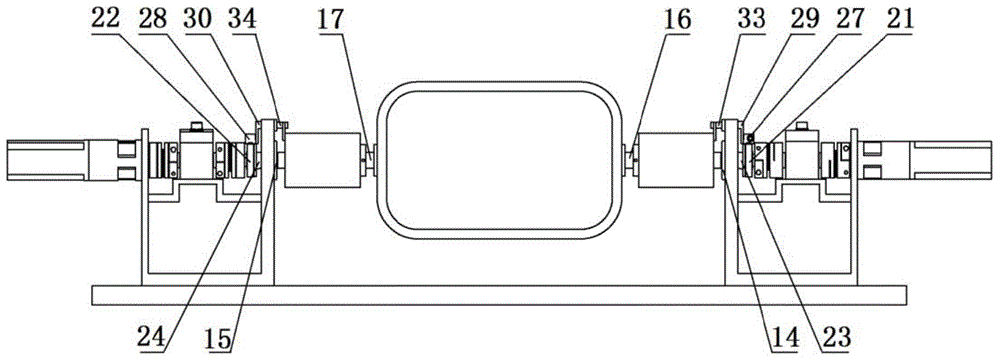
[0030] The first and second grating measuring devices are added on the experimental platform provided by the present invention, which are respectively used to collect state quantity signals such as angular displacement, angular velocity and angular acceleration output by the first drive unit and the second drive unit, according to these state quantity signals Calculate the difference between the output state quantities of the first drive unit and the second drive unit, then the difference between the output state quantities of the first drive unit and the second drive unit can be minimized as an optimization index, and the dual-motor coaxial redundant drive Synchronous control algorithm of the system.
Embodiment 3
[0031] Embodiment 3. Experimental research on synchronous control with the minimum deformation of the frame as the optimization index.
[0032] Paste the strain gauges at different positions of the frame 20, and increase the first slip ring 31 and the second slip ring 32 on the test bench provided by the present invention, and the strain on the frame 20 will be reduced by the first slip ring 31 and the second slip ring 32 The stress / strain signal collected by the chip is output to the outside of the entire mechanical system to be used to detect the stress / strain of different parts of the frame 20, and to obtain the deformation of the frame 20, then the minimum deformation of the frame 20 can be used as an optimization index. A Synchronous Control Algorithm for a Coaxial Redundant Drive System.
PUM
 Login to View More
 Abstract
Description
Claims
Application Information
 Login to View More