
Zizania aquatica preservation method
A fresh-keeping method and technology of water jasmine are applied in the directions of fruit and vegetable fresh-keeping, food preservation, and heating preservation of fruits/vegetables, etc., which can solve the problems of restricting sales and market circulation, intolerant of storage shelf life of water jasmine, and complicated formulation of film coating agents, etc. Achieve the effect of prolonging shelf life, reducing activity and reducing chilling damage
- Summary
- Abstract
- Description
- Claims
- Application Information
AI Technical Summary
Problems solved by technology
Method used
Image

Examples
Embodiment 1
[0023] Example 1 Heat shock treatment experiment
[0024] Harvesting: Harvest fresh wild rice stems, choose wild wild rice stems with normal shape, freshness, no mechanical damage, uniform color, uniform length, and uniform thickness, peel off the outer sheath, soak some of them in 50ppm sodium hypochlorite for 1-2 minutes to sterilize, and some of them are treated with water As a control group (CK0).
[0025] Take 50ppm sodium hypochlorite soaking 1-2min to sterilize and sterilize part of Zizania zizania, and set up four temperature heat shock treatments at 35°C, 40°C, 45°C, and 50°C in the experiment. Time period (respectively recorded as samples 35°C 30s, 35°C 1min, 35°C 2min, 40°C 30s, 40°C 1min, 40°C 2min, 45°C 30s, 45°C 1min, 45°C 2min, 50°C 30s, 50°C 1min , 50°C for 2min), each treatment was repeated 3 times, a total of 36 samples, each sample had 5-10 wild rice stems, and normal temperature water treatment was used as the control (CK1). After heat shock treatment, pr...
Embodiment 2
[0029] Embodiment 2 acid treatment experiment
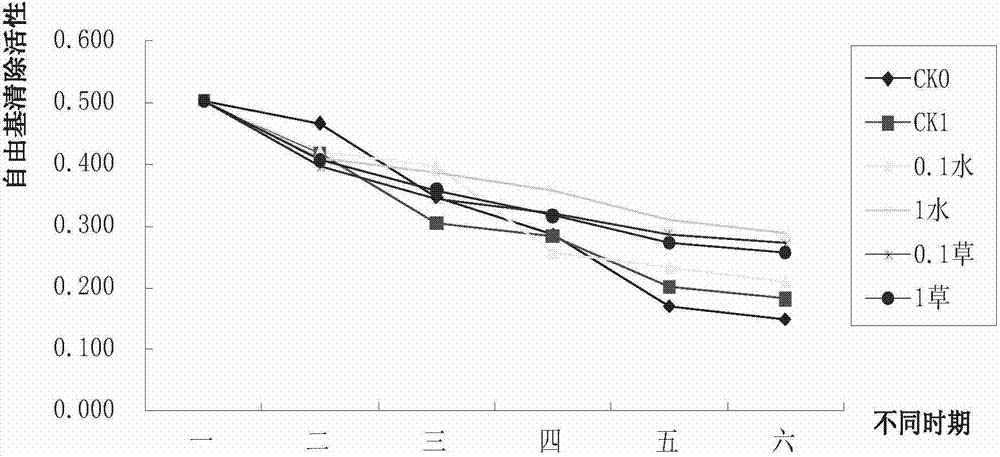
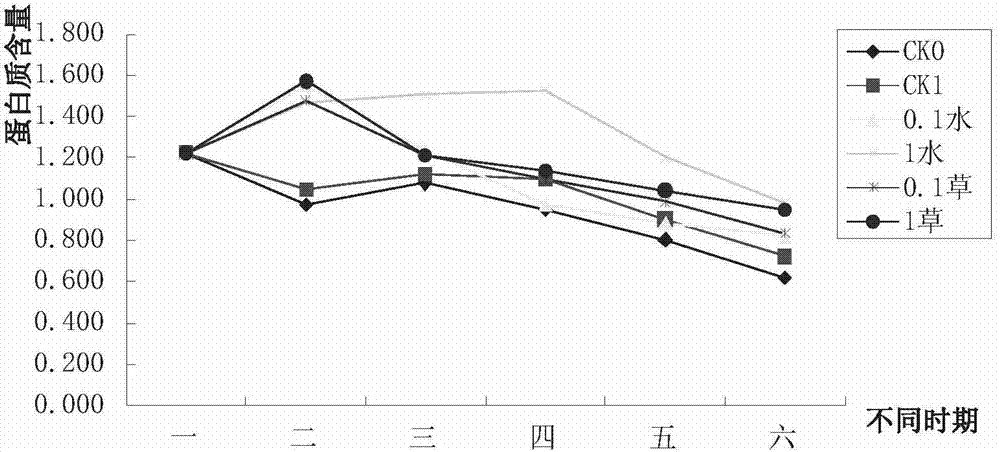
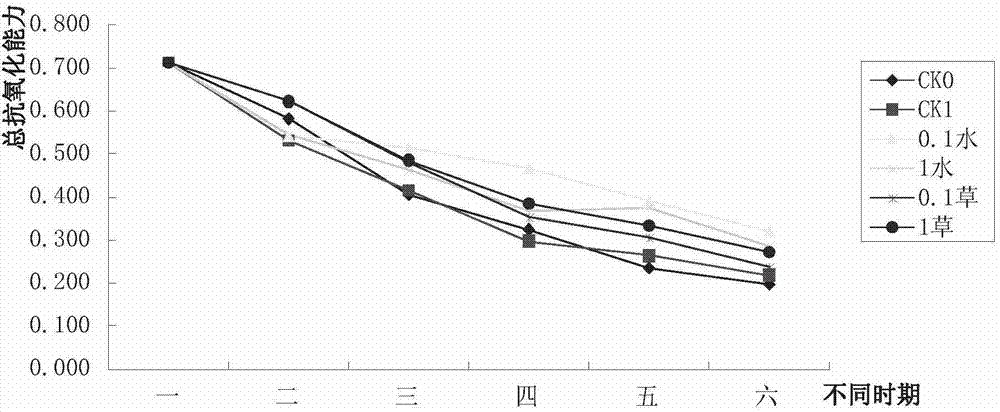
[0030] From the heat shock treatment experiment, it is analyzed that the heat shock treatment method is better for the storage of fresh-cut Zizania. According to the results of the heat shock treatment experiment, it can be known that the weight loss rate of Zizania zizania is low under the condition of 45°C for 1 min, so the acid treatment laboratory test uses The most important thing is the heat shock treatment under this condition. Zizania zizania is processed, then treated with salicylic acid and oxalic acid respectively, pre-cooled at 0-4°C for 2-5 minutes after treatment, and refrigerated at 4-8°C. Random samples were taken every 4 days to measure its color, weight loss, and hardness, and sensory evaluation was made. Combined with spraying with different concentrations of food-grade salicylic acid and oxalic acid, the free radical scavenging activity, protein content of Zizania zizania and total antioxidant Changes in oxid...
PUM
 Login to View More
 Abstract
Description
Claims
Application Information
 Login to View More