Polycarbonate compositions, articles formed therefrom, and methods of manufacture thereof
A technology of polycarbonate and composition, applied in the field of polycarbonate composition, can solve problems such as not being suitable for application
- Summary
- Abstract
- Description
- Claims
- Application Information
AI Technical Summary
Problems solved by technology
Method used
Image



Examples
Embodiment 1 to 13
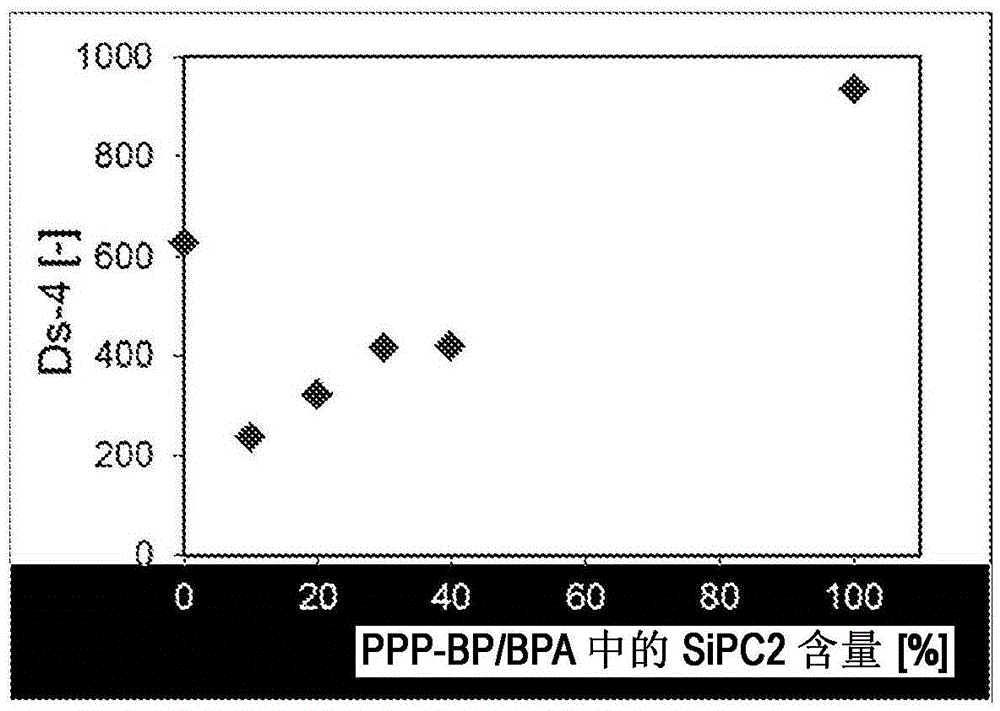
[0322] Examples 1 to 13 demonstrate the effect of adding various polycarbonate-siloxane copolymers and polydimethylsiloxane (PDMS) oils to PPP-BP / BPA copolymers on smoke density, clarity and haze properties. Influence. The recipes and results are shown in Table 3. figure 1 and figure 2 The results are also shown graphically in .
[0323] Comparative Examples 1 and 6 show that PPP-BP / BPA copolymers and polydimethylsiloxane / bisphenol A polycarbonate copolymers with 6 wt.% siloxane units (SiPC2) have 2 Relatively high smoke density (DS-4), measured according to ISO5659-2, far exceeds the hazard class 2 requirements for EN45545 R1 or R6 applications (DS-4<300) or R3 applications (DS-4<480). Surprisingly, when a relatively low amount of SiPC2 was added to the PPP-BP / BPA copolymer, compared with a composition containing SiPC2 but no PPP-BP / BPA (Comparative Example 6) and a composition containing PPP-BP / BPA However, the DS-4 of the compositions containing both SiPC2 and PPP-BP / B...
Embodiment 14 to 29
[0329] These examples demonstrate the effect of adding various polydimethylsiloxane / bisphenol A polycarbonate copolymers and polysiloxanes to branched polycarbonates on smoke density, transmittance, and haze properties.
Embodiment 14 to 21
[0331] Examples 14 to 21 demonstrate the addition of polydimethylsiloxane / bisphenol A with 6 wt.% siloxane units to a branched bisphenol A polycarbonate resin (PC3) terminated with cyanophenyl groups Effect of polycarbonate copolymer (SiPC2) on smoke density and other properties. The recipes and results are shown in Table 4. image 3 The results are also shown graphically in .
[0332] Table 4.
[0333]
[0334] Comparative examples 14 and 21 show that at 50kW / m 2 Branched bisphenol A polycarbonate resin (PC3) terminated with cyanophenyl groups and polydimethylsiloxane / bisphenol A polycarbonate with 6 wt.% siloxane units, measured according to ISO5659-2 Both ester copolymers (SiPC2) have relatively high DS-4 values (1165 and 935 respectively), far exceeding those for EN45545 R1 or R6 applications (DS-4<300) or R3 applications (DS-4<480) HL2 requirements.
[0335] When a relatively small amount of SiPC2 was added to PC3, the DS-4 values of the compositions containin...
PUM
 Login to View More
 Abstract
Description
Claims
Application Information
 Login to View More
PatSnap Eureka turns technology decisions into work you can execute. Powered by our Innovation Knowledge Graph, it runs expert workflows across engineering, life sciences, materials and intellectual property. Get your review-ready output in minutes.


