Process for the manufacture of polyisocyanate polypolyols and products
A polyisocyanate and isocyanate-based technology, which is applied in the field of manufacturing dispersions of polyisocyanate polyaddition particles in polyols, can solve problems such as inapplicability and achieve the effect of high functionality
- Summary
- Abstract
- Description
- Claims
- Application Information
AI Technical Summary
Problems solved by technology
Method used
Image

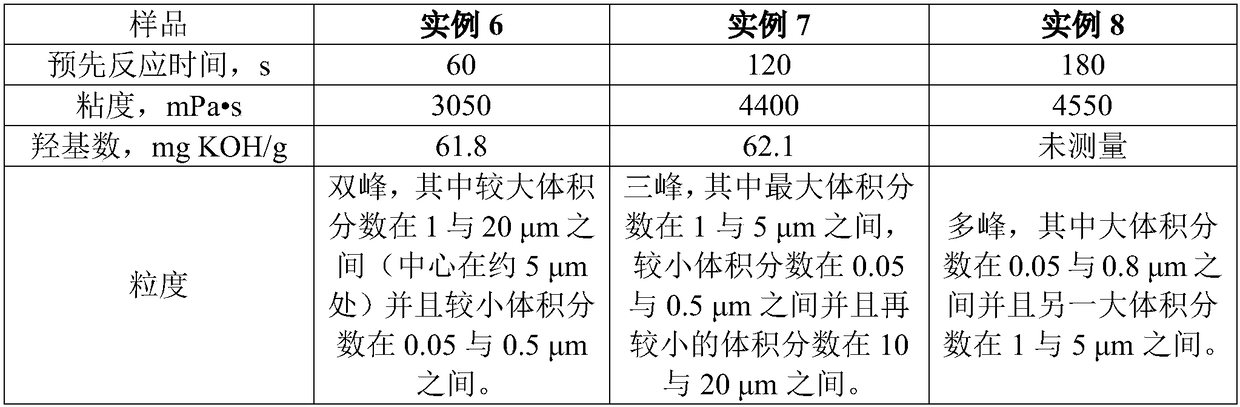

Examples
example 1
[0125] Example 1 and Comparative Samples A, B and C
[0126] Polyol A is a 3500 molecular weight nominal trifunctional copolymer with 92% propylene oxide and 8% ethylene oxide. It is manufactured using a potassium hydroxide catalyst from which residues have been removed. It contains about 0.1% by weight of water. Less than 2% of its hydroxyl groups are primary and the remainder are secondary.
[0127] The seed PIPA polyol is a 10% solids PIPA polyol manufactured in a conventional manner using a base polyol with predominantly primary hydroxyl groups and TEOA (see WO 2012 / 154831 ).
[0128] Charge 88 parts polyol A and 2 parts seed PIPA polyol into a high speed laboratory mixer. With rapid stirring, 5.32 parts of room temperature toluene diisocyanate (80% 2,4-isomer, "80 / 20 TDI") were added. After the toluene diisocyanate addition was complete, the mixture was stirred for 60 seconds followed by the addition of 0.4 parts of tin octoate catalyst. After an additional 60 second...
example 2 and 3
[0132] Polyol B is a nominally trifunctional copolymer of propylene oxide and ethylene oxide with a hydroxyl number of approximately 48. It is manufactured using a zinc hexacyanocobaltate catalyst complex. It contains about 0.1% by weight of water. Not more than 15% of its hydroxyl groups are primary and the remainder are secondary.
[0133] To make Example 2, 87.68 parts of room temperature polyol B were mixed with 0.2 parts of zinc formate catalyst, 2 parts of seed PIPA polyol, 0.1 parts of triethylenediamine catalyst solution, and 5.52 parts of 80 / 20 TDI on a laboratory speed mixer for two minutes, during which time 4.5 parts of triethanolamine were added with continued mixing. Mixing was continued for an additional 5 minutes without application of heat, during which time a stable PIPA dispersion was obtained.
[0134] Particle size was measured using a Beckman Coulter LS particle size analyzer. Essentially all particles are between 0.1 and 1 μm in size. The viscosity ...
example 3
[0137] Example 3 has a narrower particle size distribution than Example 2. This can be attributed to the preheating of the base polyol in Example 3. This reduces the viscosity of the TEOA, which may allow better dispersion of the triethanolamine in the base polyol mixture. In any event, such a narrow distribution of fine PIPA particles in the final PIPA polyol is unexpectedly obtained using the method of reacting the TEOA at the end.
PUM
| Property | Measurement | Unit |
|---|---|---|
| particle size | aaaaa | aaaaa |
| viscosity | aaaaa | aaaaa |
| particle size | aaaaa | aaaaa |
Abstract
Description
Claims
Application Information
 Login to View More
 - R&D
- Intellectual Property
- Life Sciences
- Materials
- Tech Scout
- Unparalleled Data Quality
- Higher Quality Content
- 60% Fewer Hallucinations
Browse by: Latest US Patents, China's latest patents, Technical Efficacy Thesaurus, Application Domain, Technology Topic, Popular Technical Reports.
© 2025 PatSnap. All rights reserved.Legal|Privacy policy|Modern Slavery Act Transparency Statement|Sitemap|About US| Contact US: help@patsnap.com