
Method for preparing RNA probe by template of miR-196a precursor
A technology of RNA probe and RNA polymerase, which is applied in the field of preparation of RNA probes, can solve the problem of low surgical resection rate of pancreatic cancer, achieve low background signal interference, strong specificity and stability, and enhance probe specificity Effect
Patent Information
- Authority / Receiving Office
- CN · China
- Patent Type
- Applications(China)
- Current Assignee / Owner
- Publication Date
- 2016-06-01
- Estimated Expiration
- Not applicable · inactive patent
Smart Images
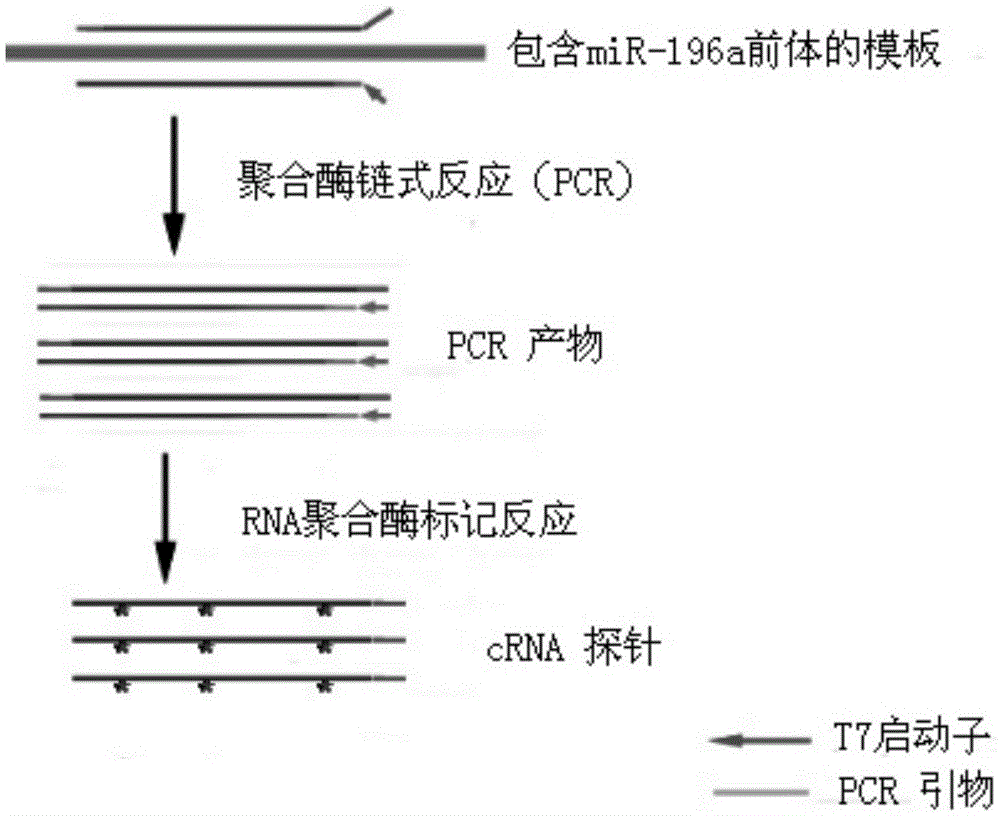
Figure 1 
Figure 2 
Figure 3
Abstract
Description
technical field
[0001] The invention belongs to the field of nucleic acid diagnosis, and in particular relates to a method for preparing an RNA probe using a miR-196a precursor as a template and an application thereof. Background technique
[0002] Fluorescence in situ hybridization (FISH) is an important non-radioactive in situ hybridization technology. Fluorescent dye-labeled specific nucleic acid probes hybridize with corresponding target DNA or RNA molecules in cells. If the detected chromosomal target DNA and The nucleic acid probes used are homologous and complementary, and the two undergo denaturation-annealing-annealing. Since the DNA molecules on the chromosome are arranged linearly along the longitudinal axis of the chromosome, the probes can directly hybridize with the chromosome so that the specific Genes are located on chromosomes. By observing the fluorescent signal under a fluorescent microscope to determine the location of the DNA region or RNA molecule in t...
Examples
Embodiment 1
[0041] Example 1: Preparation of RNA probes using miR-196a precursor as a template
[0042] The process of preparing RNA probes using miR-196a precursor as a template can be found in figure 1 .
[0043] 1. Design of PCR primers:
[0044] (1) Find the name and sequence of its corresponding pre-miRNA in the miRBase database (http: / / www.mirbase.org / ), that is, the miR-196a precursor (AccessionMI0000279): HomosapiensmiR-196a-2stem-loop.
[0045] (2) Query the sequence of the corresponding pre-miRNA, and the result shows that the length of the pre-miRNA is about 100nt.
[0046] (3) Design a pair of primers.
[0047] Primer design:
[0048] Primer number
Primer name
Primer sequence
1 forward
miR-196a1F
TGCTCGCTCAGCTGATCTGT
1 reverse
miR-196a-1R
taatacgactcactatagGCCCTCGACGAAAACCGACT
[0049] The primers mentioned in the above table are only examples, and those skilled in the art can design more suitable primers according to ...