[0004] However, there are still many defects in the existing interspinous process dynamic internal fixator.
[0005] For example, the Coflex
system designed and provided by Samani in 1994 has a "U" shape when viewed from the side, and there are two "clip-shaped"
fixed wing structures (one front and one rear) at the upper and lower ends of the U-shaped main structure. The upper and lower spinous processes are clamped and fixed; however, the fixed part of the
system and the spinous process is a square structure, which does not match the anatomical structure of the spinous process, resulting in the need to use
forceps to stretch and deform the flanks in a
large range during installation After installation, it needs to be clamped and deformed in a
large range, which makes the operation complicated during installation, and even fatigue and fracture of the flanks occur, and only sagittal extension and flexion can be provided.
Chinese invention patent (patent number: ZL201020247832.0) discloses a "spinal non-fusion fixation device", which has basically the same structure as the Coflex
system, specifically, in the scheme of the invention patent, the U-shaped part 1 Corresponding to the U-shaped main structure of Coflex, the front and rear fixing plates 2 of the fixing part correspond to the two "clip-shaped" fixing wing structures of Coflex, and the front and rear fixing plates 2 are respectively fixed to two adjacent spines by screws. To achieve the fixation of the U-shaped main structure, but, as mentioned above, this structure can only achieve the extension and flexion of the sagittal position, that is, the size of the U-shaped opening is changed through the deformation of the U-shaped structure, so that the Cooperating with the change of the distance between spinous processes (inter-spinous) in the direction of opening and closing, the vertical support force of this large U-shaped structure is poor, and the ability to
resist elastic attenuation is weak
[0006] The applicant of this application has also applied for an "interspinous stabilizer", patent number: 201520426702.6. However, due to the large structure volume of this technology during clinical use, the
prosthesis cannot be placed into the hard disk during the operation. Therefore, the center of rotation of the
prosthesis is far away from the center of rotation of the human
lumbar spine when the human
lumbar spine is twisted, that is, rotated in the coronal position. The operation is complicated when
screw fixation is used, and the screw has the risk of loosening. Excessively large, adding new lumbar
instability factors
[0007] The ideal interspinous process or interspinous plate dynamic
internal fixation system should be able to generate continuous and sufficient
distraction force at the bottom of the spinous process after implantation, so as to restore the height of the
intervertebral space, increase the height of the
intervertebral foramen, and make the infolded yellow The ligaments are opened in reverse to reduce their invasion into the
spinal canal, increase the volume of the
spinal canal, and at the same time maintain good dynamic activities such as extension and flexion of the spine, but the existing dynamic internal fixation systems between spinous processes or spinous plates often cannot At the same time, it has good and continuous vertical stretching force and universal mobility
[0008] The activities of the
human spine include extension and flexion in the sagittal position,
lateral bending in the left and right directions, rotation in the coronal position, and a circle formed by comprehensive motion in multiple directions, but the existing dynamic internal fixator between spinous processes or spinous plates It is difficult to match the physiological activity patterns of the
human spine, some of which can only move in one direction, some stress is easy to concentrate in a certain place and cause the prosthesis to break, some prosthesis and spinous processes cause
wear and tear reactions, and some are long When used for a long time, its elastic structure has weak anti-elastic attenuation ability, some have poor vertical support, and some cannot realize that the rotation center of the prosthesis is close to the rotation center of the human
lumbar spine on the coronal position and the rotation center on the sagittal position at the same time. Therefore, there are problems such as poor matching with the physiological activity pattern of the human
lumbar spine, and it is difficult to guarantee low complications and good long-term effects


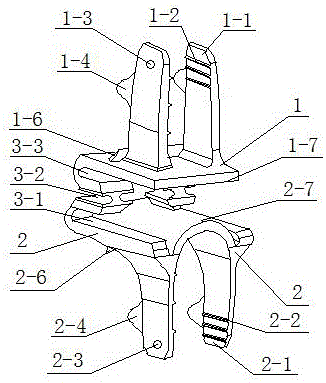
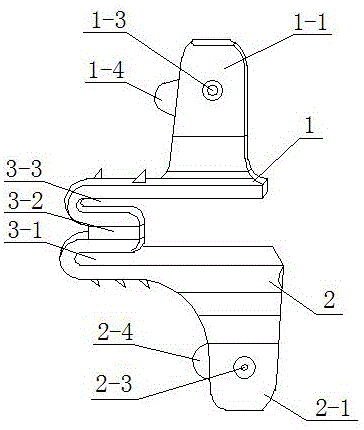
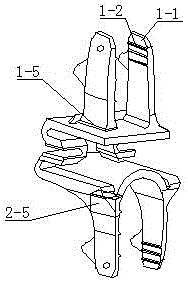
 Login to View More
  Login to View More