
Carbon quantum dot/aurum cluster ratiometric fluorescent probe for detection of cadmium ion and ascorbic acid
A ratiometric fluorescent probe, ascorbic acid technology, applied in the field of fluorescent sensing, can solve the problems of high cost and weak luminescence stability, and achieve high selectivity, sensitivity, and high detection accuracy
- Summary
- Abstract
- Description
- Claims
- Application Information
AI Technical Summary
Problems solved by technology
Method used
Image

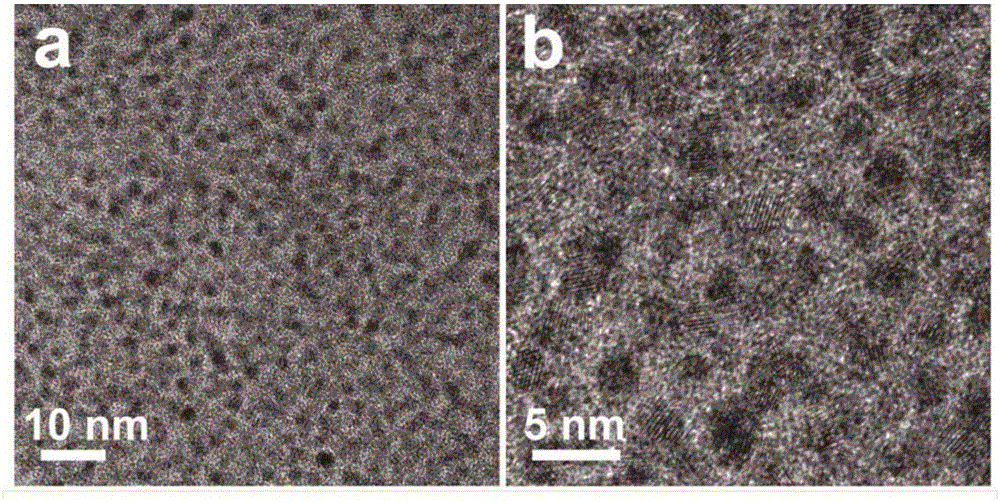
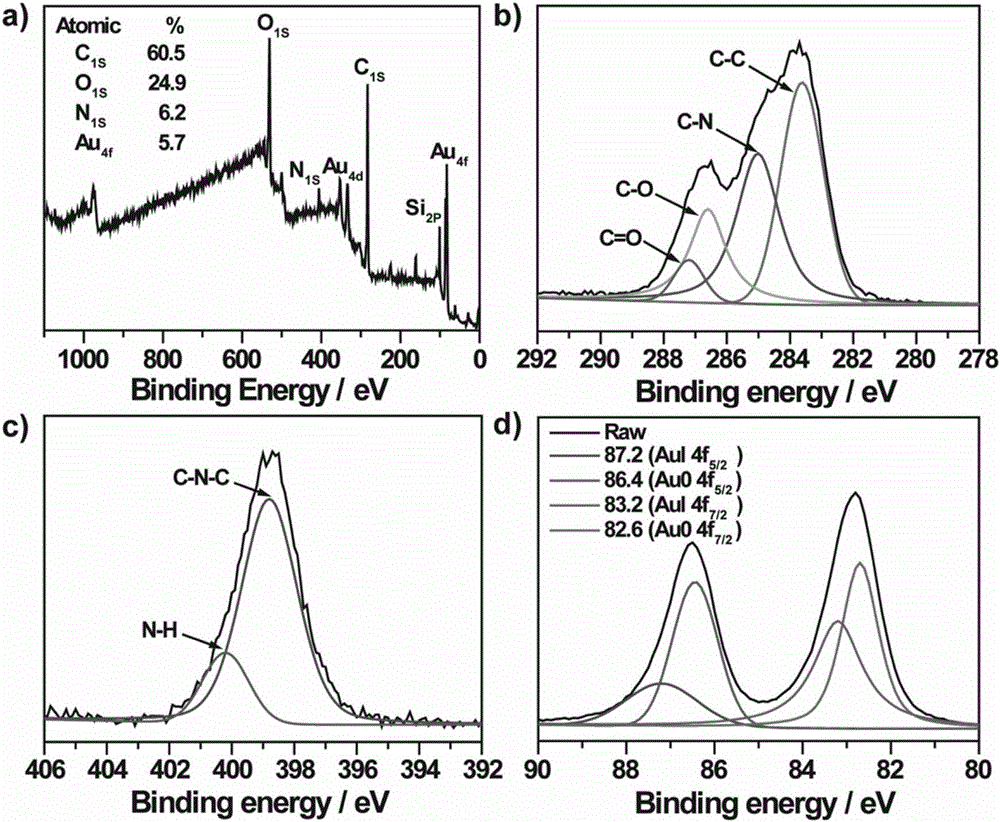
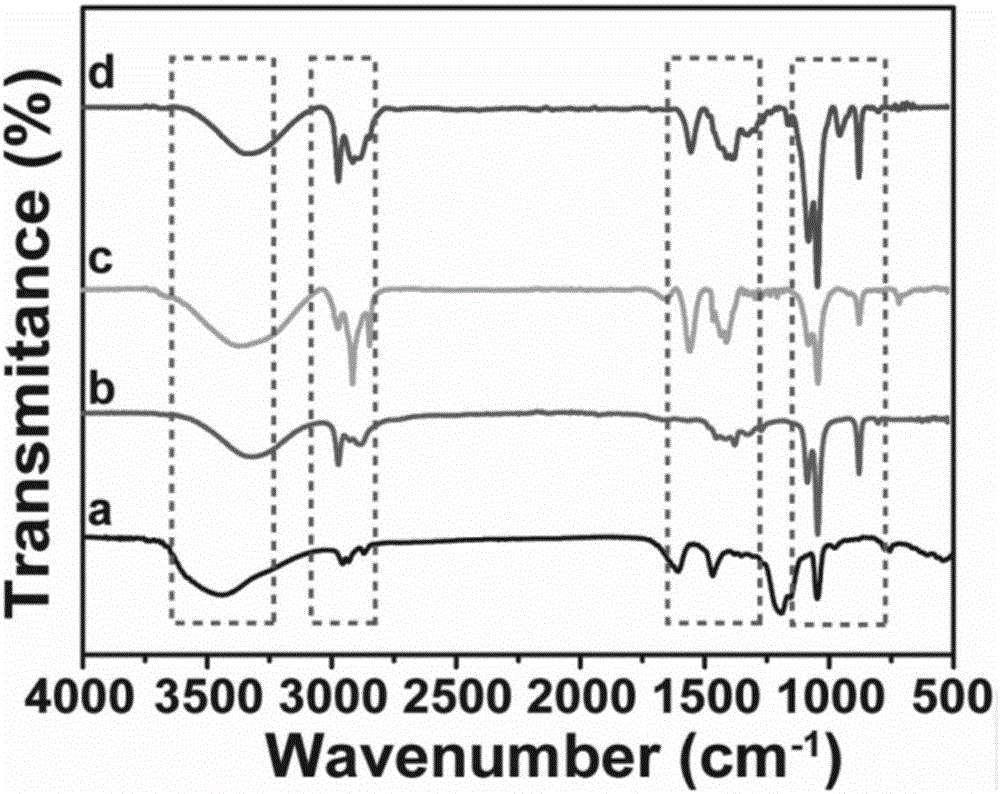
Examples
Embodiment 1
[0035] A method for preparing the carbon quantum dot / gold nanocluster ratio fluorescent probe of the present invention comprises the steps:
[0036] Step 1. Preparation of carbon quantum dots: ultrasonically dissolve 2.673g of alanine and 0.466g of histidine in 30.0mL of ultrapure water, and then transfer the mixed solution into a polytetrafluoroethylene autoclave (model 50.0mL) placed in a blast-type heating oven, hydrothermally reacted at 200°C for 6 hours, and cooled naturally to room temperature after the reaction to obtain a dark green transparent liquid, which was put into a dialysis bag with a molecular weight cut-off of 1000 and dialyzed in double-distilled water for 24 hours to remove untreated The precursor of the reaction was removed by rotary evaporation at 45°C to prepare CQDs;
[0037] Step 2, preparation of amidated carbon quantum dots: disperse 5 mg of CQDs obtained in step 1 and 20 μL of ammonia (28 wt %) into 1.5 mL of absolute ethanol, add 10 μL of 3-aminopr...
Embodiment 2
[0041] A method for preparing the carbon quantum dot / gold nanocluster ratio fluorescent probe of the present invention comprises the steps:
[0042] Step 1, preparation of carbon quantum dots: ultrasonically dissolve 2.138g of alanine and 0.466g of histidine in 30.0mL of ultrapure water, and other conditions are the same as step 1 of Example 1;
[0043] Step 2, preparation of amidated carbon quantum dots: same as step 2 of Example 1;
[0044] Step 3, preparation of gold nanoclusters (AuNCs): same as step 3 of Example 1;
[0045] Step 4. Preparation of carbon quantum dots / gold nanoclusters (CQDs / AuNCs): Take 800 μL of the 2.0 mg / mL MUA-modified AuNCs solution prepared in step (3) and diffuse into 1.5 mL of HEPES buffer, and sonicate evenly. Freshly prepare an aqueous solution containing 10mM 1-(3-dimethylaminopropyl)-3-ethylcarbodiimide hydrochloride (EDC) and 20mM N-hydroxysuccinimide, add 100μL EDC / NHS mixed solution The above 1.5mL AuNCs solution was magnetically stirred f...
Embodiment 3
[0047] A method for preparing the carbon quantum dot / gold nanocluster ratio fluorescent probe of the present invention comprises the steps:
[0048] Step 1, preparation of carbon quantum dots: ultrasonically dissolve 4.2763g of alanine and 0.466g of histidine in 30.0mL of ultrapure water, and other conditions are the same as step 1 of Example 1;
[0049] Step 2, preparation of amidated carbon quantum dots: same as step 2 of Example 1;
[0050] Step 3, preparation of gold nanoclusters (AuNCs): same as step 3 of Example 1;
[0051] Step 4. Preparation of carbon quantum dots / gold nanoclusters (CQDs / AuNCs): Take 200 μL of the 2.0 mg / mL MUA-modified AuNCs solution prepared in step (3) and diffuse into 1.5 mL of HEPES buffer, and sonicate evenly. Freshly prepare an aqueous solution containing 10 mM 1-(3-dimethylaminopropyl)-3-ethylcarbodiimide hydrochloride (EDC) and 40 mM N-hydroxysuccinimide, add 100 μL EDC / NHS mixed solution The above 1.5mL AuNCs solution was magnetically stirr...
PUM
 Login to View More
 Abstract
Description
Claims
Application Information
 Login to View More