
A method for human positioning and tracking with dual-frequency continuous wave radar applied indoors
A technology of positioning tracking and wave radar, which is applied in the direction of using re-radiation, radio wave measurement system, radio wave reflection/re-radiation, etc., can solve the problems of spectrum peak reduction, affecting speed measurement accuracy, and positioning accuracy reduction, etc., to achieve the elimination of spectrum The effect of extension, improving ranging accuracy, and high-precision positioning
Patent Information
- Authority / Receiving Office
- CN · China
- Patent Type
- Patents(China)
- Current Assignee / Owner
- Publication Date
- 2018-06-22
Smart Images
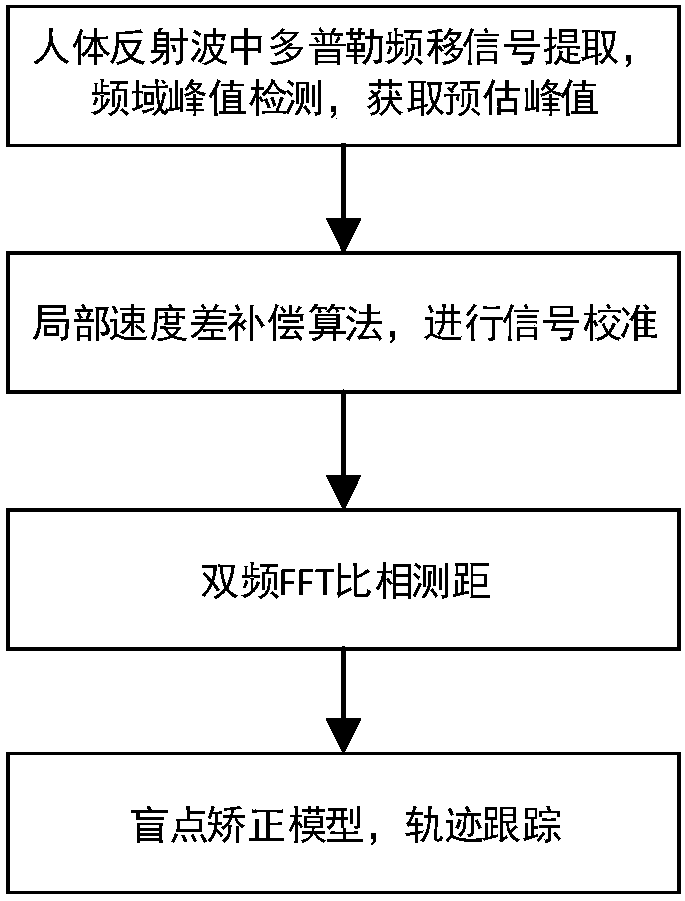
Figure 1 
Figure 2 
Figure 3
Abstract
Description
technical field
[0001] The invention belongs to the field of wireless communication, and more specifically relates to an indoor dual-frequency continuous wave radar human body positioning and tracking method. Background technique
[0002] With the development of wireless signals, location-based services (Location Based Service, referred to as LBS) have been widely used, and mobile positioning as the main technology has received extensive attention. There are endless positioning awareness technologies in the positioning process, mainly including: radio frequency identification technology, bluetooth technology, ultrasonic positioning perception, WIFI, etc. Mainly through the strength of the received signal combined with the indoor propagation model, the received signal strength (Received Signal Strength, referred to as RSS) is converted into a distance to determine the distance, so the requirements for the indoor environment are high, and the reflection of multiple objects wil...
Examples
Embodiment Construction
[0058] In order to make the object, technical solution and advantages of the present invention clearer, the present invention will be further described in detail below in conjunction with the accompanying drawings and embodiments. It should be understood that the specific embodiments described here are only used to explain the present invention, not to limit the present invention. In addition, the technical features involved in the various embodiments of the present invention described below can be combined with each other as long as they do not constitute a conflict with each other.
[0059] Such as figure 1 As shown, the present invention is applied to the method for indoor dual-frequency continuous wave radar human positioning and tracking comprising the following steps:
[0060] (1) Obtain the human body reflected wave signals emitted by the two signal sources and reflected by the human body, and perform frequency mixing and filtering on the two human body reflected wave ...