
Closed-Loop Envelop Tracking System Calibrating Method And Apparatus
An envelope tracking and closed-loop technology, applied in the field of envelope tracking, can solve problems such as long factory calibration time, and achieve the effect of maintaining linearity
- Summary
- Abstract
- Description
- Claims
- Application Information
AI Technical Summary
Problems solved by technology
Method used
Image

Examples
Embodiment Construction
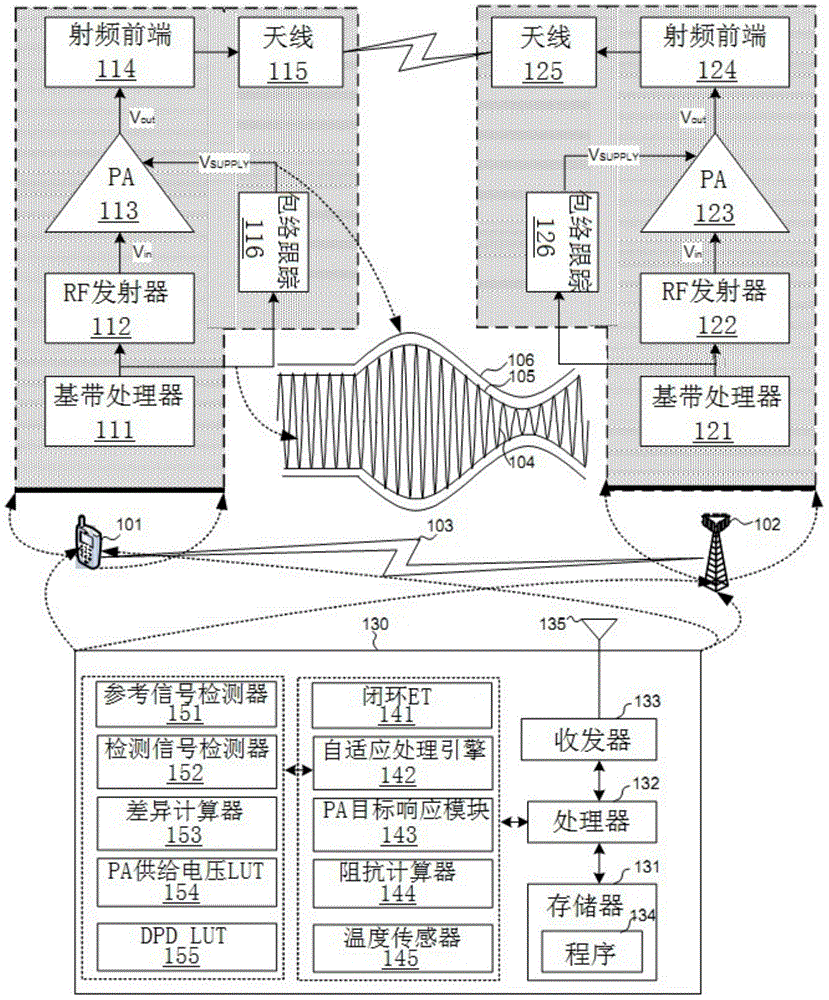
[0023] The following description is a preferred embodiment of the present invention. The following embodiments are only used to illustrate the technical features of the present invention, and are not used to limit the scope of the present invention. Certain terms are used throughout the specification and the following claims to refer to specific elements. Those skilled in the art should understand that manufacturers may use different terms to refer to the same components. This specification and claims do not use differences in names as ways to distinguish elements, but use differences in functions of elements as a basis for distinction. The terms "element", "system" and "device" used in the present invention may be entities related to a computer, where the computer may be hardware, software, or a combination of hardware and software. The terms "including" and "including" mentioned in the following description and claims are open-ended terms, so they should be interpreted as "...
PUM
 Login to View More
 Abstract
Description
Claims
Application Information
 Login to View More