
Airplane forebody vortex flow control device
A flow control and precursor technology, which is applied in the direction of power plant, aircraft control, power plant layout/installation, etc., can solve the problems of reducing aircraft thrust, deterioration of intake/engine matching performance, and lower performance of air inlet, etc. Achieve the effect of reducing the flow field distortion index value, easy installation and maintenance, and remarkable effect
- Summary
- Abstract
- Description
- Claims
- Application Information
AI Technical Summary
Problems solved by technology
Method used
Image

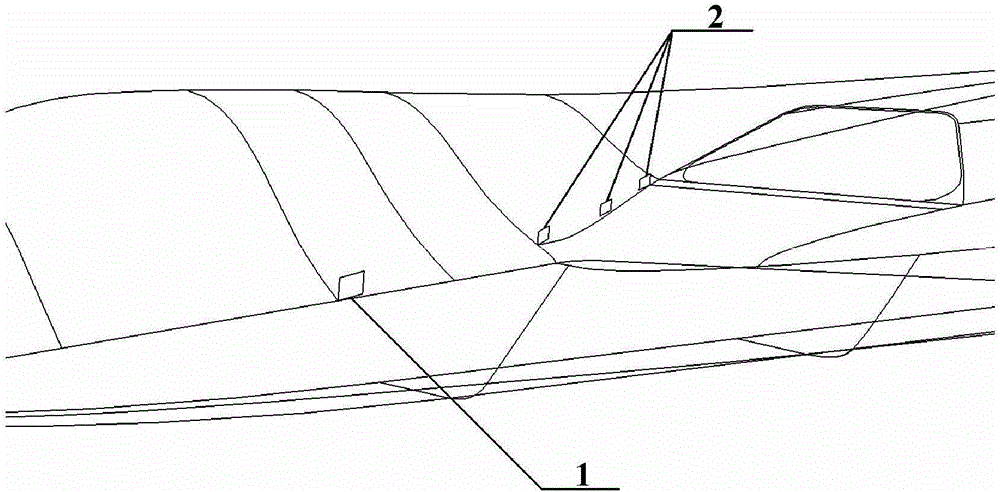
Examples
Embodiment 1
[0012] Such as figure 1 As shown, an aircraft precursor vortex flow control device includes a precursor vortex breaker 1 and three deflectors 2. The precursor vortex breaker 1 is installed above the ridge line of the aircraft precursor and in front of the inlet of the air intake along the flow direction. ; 3 deflectors 2 are sequentially installed behind the precursor vortex breaker 1, the original low-energy flow flows on the path, and guide the low-energy flow behind the precursor vortex breaker 1 so that it does not flow into the inlet of the air duct, Instead, it flows backward along the groove between the air intake cover and the fuselage. The height of the precursor vortex breaker 1 is equivalent to the height of the local vortex, and the length is 1.5 times of the height. The height of the deflector 2 is equivalent to the height of the local low-energy flow, the length is 1.8 times the height, and the angle between the installation angle and the original flow direction...
PUM
 Login to View More
 Abstract
Description
Claims
Application Information
 Login to View More