Nano-composite electrode material for chloride ion battery and preparation method of material
A nanocomposite material and nanocomposite technology, which is applied in the field of nanocomposite electrode materials for chloride ion batteries and its preparation, can solve problems such as poor conductivity, low cycle discharge capacity, and complicated preparation methods, and achieve poor conductivity and improve cycle stability. , to alleviate the effect of volume change
- Summary
- Abstract
- Description
- Claims
- Application Information
AI Technical Summary
Problems solved by technology
Method used
Image



Examples
Embodiment 1
[0020] 1), material preparation and battery assembly: FeCl 3 ·6H 2 O is the precursor for preparing FeOCl material, and CMK-3 is a porous carbon material. The two are mixed in a mortar according to the ratio of the obtained FeOCl / CMK-3 ratio of 90:10, and then the mixture is vacuum-sealed in a glass tube. , kept at 55°C for 72h. The mixture was then removed and heated at 250 °C for 1 h. The obtained FeOCl / porous carbon nanocomposite material has a pore diameter of 2-10 nm and a corresponding FeOCl size of 2-10 nm. The composite material is mixed with acetylene black and PVDF in NMP, then coated on a stainless steel sheet, and dried to obtain an electrode sheet; the negative electrode material is Li, and the electrolyte is 0.5MPP 14 Cl / PP 14 TFSI mixed ionic liquid.
[0021] 2) The results of charge and discharge experiments show that the first discharge capacity of FeOCl / porous carbon (90:10) nanocomposite electrode material is 175mAh / g. After the first activation, the d...
Embodiment 2
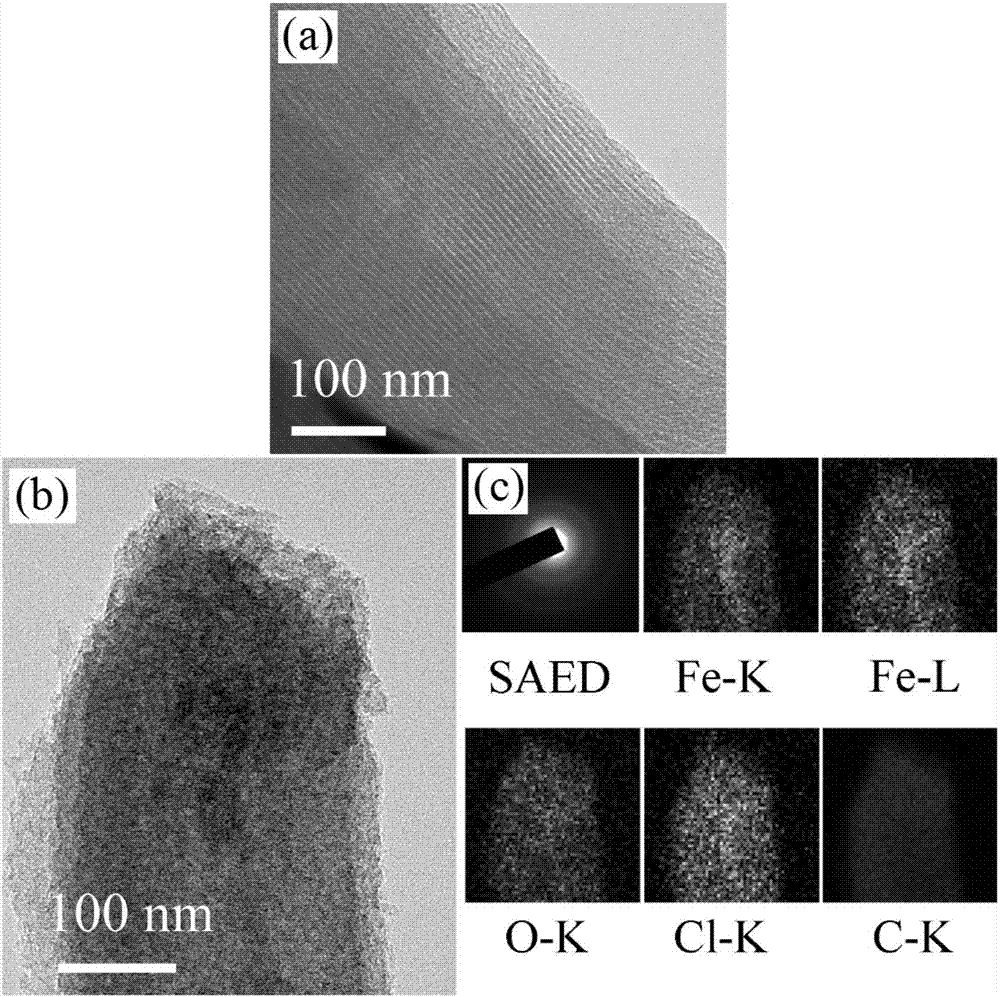
[0023] 1), material preparation and battery assembly: FeCl 3 ·6H 2 O is the precursor for preparing FeOCl material, and CMK-3 is a porous carbon material. The two are mixed in a mortar according to the obtained FeOCl / CMK-3 ratio of 65:35, and then the mixture is vacuum-sealed in a glass tube. , kept at 80°C for 48h. The mixture was then removed and heated at 180 °C for 10 h. Prepared FeOCl / porous carbon nanocomposites. Analysis of electron microscope results showed that the composite material included FeOCl@CMK-3 composite material and FeOCl nanosheets with a thickness of 10-30nm ( figure 1 ); the FeOCl material was successfully embedded in the 3-4nm pores of the CMK-3 porous carbon material, and the element distribution was uniform ( figure 2 ). The composite material is mixed with acetylene black and PVDF in NMP, then coated on a stainless steel sheet, and dried to obtain an electrode sheet; the negative electrode material is Li, and the electrolyte is 0.5M PP 14 Cl / P...
Embodiment 3
[0026] 1), material preparation and battery assembly: FeCl 3 ·6H 2 O is the precursor for preparing FeOCl material, and CMK-3 is a porous carbon material. The two are mixed in a mortar according to the ratio of the obtained FeOCl / CMK-3 ratio of 60:40, and then the mixture is vacuum-sealed in a glass tube. , kept at 85°C for 20h. The mixture was then removed and heated at 130 °C for 15 h. The FeOCl / porous carbon nanocomposite material is prepared, and the size of the FeOCl is divided into two types: ~4nm and 10-40nm. The composite material is mixed with acetylene black and PVDF in NMP, then coated on a stainless steel sheet, and dried to obtain an electrode sheet; the negative electrode material is Li, and the electrolyte is 0.5MPP 14 Cl / PP 14 TFSI mixed ionic liquid.
[0027] 2) The results of charge and discharge experiments show that the first discharge capacity of FeOCl / porous carbon (60:40) nanocomposite electrode material is 168mAh / g. After the first activation, the...
PUM
| Property | Measurement | Unit |
|---|---|---|
| Size | aaaaa | aaaaa |
| Thickness | aaaaa | aaaaa |
Abstract
Description
Claims
Application Information
 Login to View More
PatSnap Eureka turns technology decisions into work you can execute. Powered by our Innovation Knowledge Graph, it runs expert workflows across engineering, life sciences, materials and intellectual property. Get your review-ready output in minutes.


