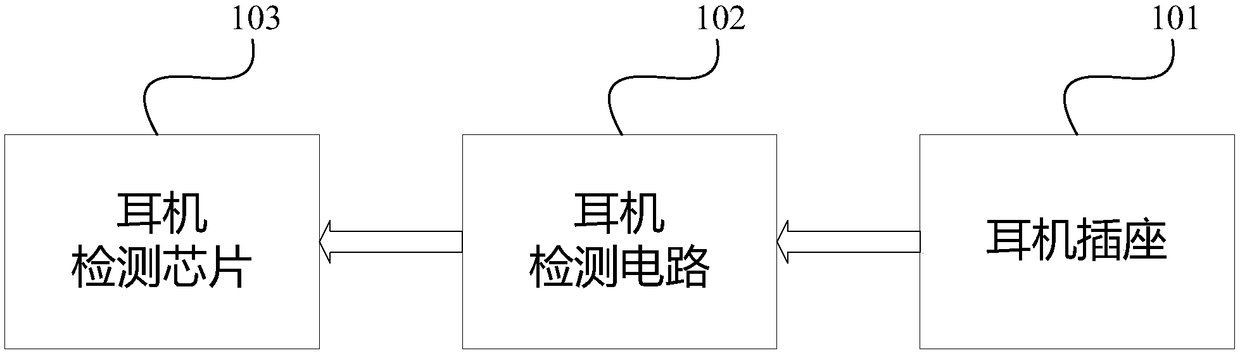
Specifically, please refer to Figure 5 As shown, the earphone detection
chip 103 generally includes a
microphone signal detection port MIC2_INP, an analog-to-
digital converter ADC for performing analog-to-
digital conversion on signals detected by the MIC2_INP detection port, a detection port HSDET for detecting earphone plug-in signals, and a The core module Mechanicalinsertion detection for judging the
signal detected by the detection port and the corresponding operation, and the
multiplexer module MUX for
multiplexing the
microphone and earphone, etc. When the HSDET detection port has a
negative voltage, the internal ESD
diode D1 will conduct forward , resulting in leakage current at the HSDET detection port, the leakage current path is as follows Figure 5 As shown by the thick
black line in ; at the same time, due to the existence of
negative voltage, the internal MUX cannot be completely closed, and when the MUX is accidentally opened, there will be
crosstalk between internal channels
[0008] 2. It cannot be applied to high-level audio output solutions, otherwise it may cause wrong judgment of earphone
insertion and extraction. Specifically, when it is used for ordinary audio output, its output
voltage is about ±1.4V, such as Figure 6A As shown, V1=-V2=1.2V~1.4V, and when outputting HIFI audio with high-impedance
headphones, the output
voltage can reach about ±2.7V, such as Figure 6B As shown, V1=-V2=2.5V~2.7V, this is mainly because the internal
operational amplifier U0 of the HIFI
amplifier circuit directly works on the ±5V power supply, such as Figure 7 As shown, so when the NO-type headphone socket is connected with high-impedance
headphones, the output level will be higher
[0009] In view of the above two shortcomings of the NO-type earphone socket, the existing technology has a circumvention plan in the actual
product design and use process. One is to select a special earphone detection
chip that supports the negative level detection port, so as to ensure the normal operation of the earphone detection chip. Work, this circumvention scheme has the following disadvantages: (1) high cost: due to the negative level requirements for the earphone detection chip, usually only a dedicated earphone detection chip can be selected, and the general cost is relatively high; (2) the design is limited : Because usually only a dedicated headphone detection chip (such as CODEC) will design a dedicated detection port that supports negative levels, and a general-purpose processor (such as a CPU) generally does not have such a special port, so the
circuit design will be limited
The other is that when high-level audio output is required, instead of using the NO type earphone jack, only the NC type earphone jack can be used. This circumvention scheme has the following disadvantages: (1): Higher cost: as mentioned above, NC NC-type headphone jacks are more expensive than NO-type headphone jacks because of their complex internal structure; (2) High R&D costs: As mentioned above, NC-type headphone jacks have far fewer models than NO-type, so it often happens during the
design stage. Structural engineers will spend a long time looking for an NC-type headphone jack with a matching structure, or conversely, they will be forced to modify the existing design in order to accommodate the existing NC-type headphone jack, so that the internal structure and appearance design of the product are different. Compromises and concessions; (3) Full customization of headphone sockets: If no headphone sockets with exactly matching structural specifications can be found and the R&D cannot compromise the design, then the design manufacturer can only customize the headphone sockets, but custom materials will cause additional problems, such as There are a series of problems such as independent development costs of suppliers,
quality control risks of customized
new materials, material inventory and
production cycle, so the full customization of earphone sockets is the most costly and risky in all aspects.



 Login to View More
  Login to View More