
Heat-insulating riser bush for casting
A technology for thermal insulation riser sleeves and casting molds, applied in the field of metallurgical casting, can solve problems such as affecting the internal quality of castings, and achieve the effects of improving temperature, pore size, grain boundary shape and distribution, and high degree of bonding
- Summary
- Abstract
- Description
- Claims
- Application Information
AI Technical Summary
Problems solved by technology
Method used
Image

Examples
Embodiment 1
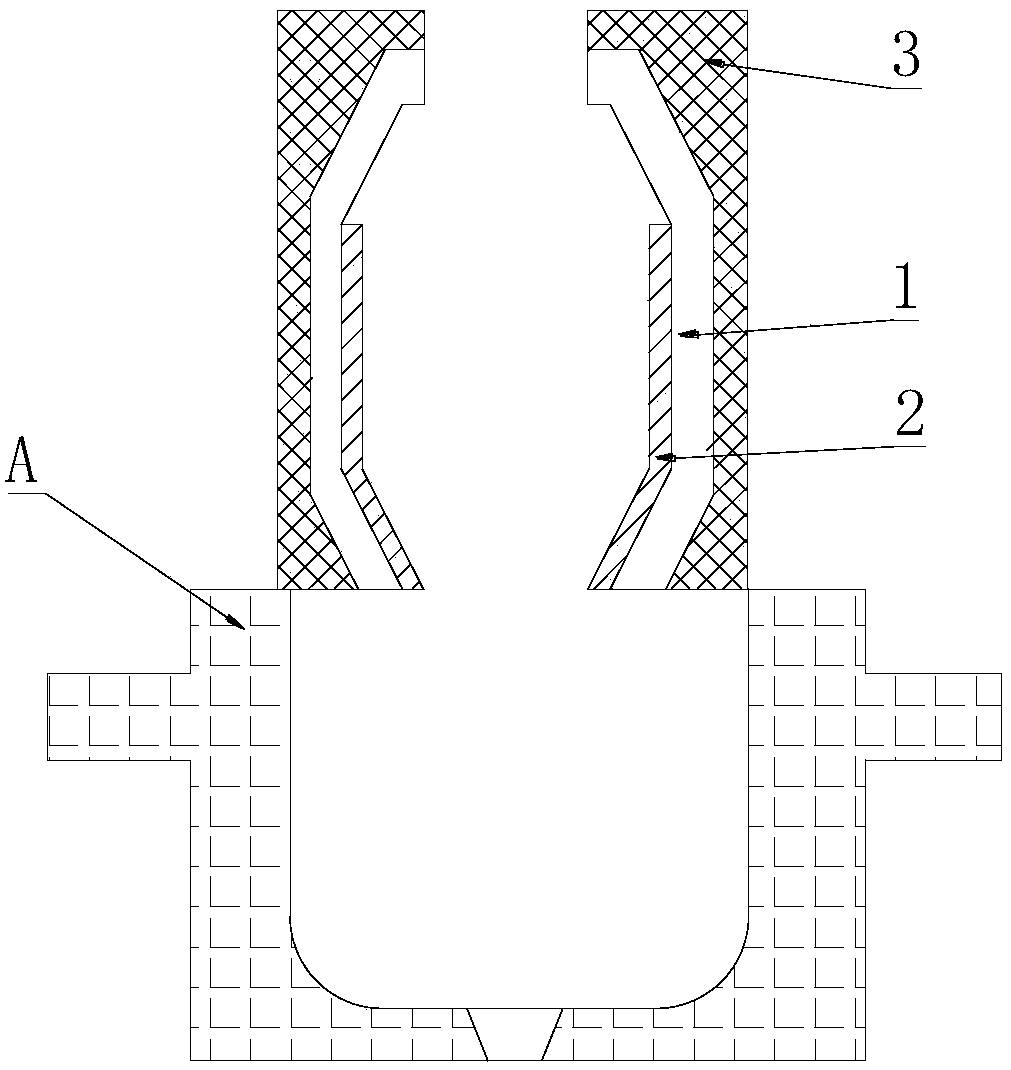
[0019] The present invention proposes a casting thermal insulation riser sleeve, which is used for feeding into the casting mold A, and includes a base body 1, a heating layer 2 and a protective layer 3, a feeding cavity is opened inside the base body 1, and a feeding cavity is opened at the bottom of the base body 1 A feeding outlet, the feeding cavity communicates with the inside of the casting mold A through the feeding outlet, and the radial cross-sectional area of the end of the feeding outlet away from the feeding cavity is smaller than that of the feeding outlet near the The radial cross-sectional area of one end of the feeding cavity; the heating layer 2 is arranged on the inner wall of the feeding cavity, and the protective layer 3 is coated on the outside of the substrate 1; one end of the heating layer 2 is flush with the bottom of the substrate 1, and the other end of the heating layer 2 One end is located in the middle of the base body 1 .
[0020] Substrate 1...
Embodiment 2
[0023] The present invention proposes a casting thermal insulation riser sleeve, which is used for feeding into the casting mold A, and includes a base body 1, a heating layer 2 and a protective layer 3, a feeding cavity is opened inside the base body 1, and a feeding cavity is opened at the bottom of the base body 1 A feeding outlet, the feeding cavity communicates with the inside of the casting mold A through the feeding outlet, and the radial cross-sectional area of the end of the feeding outlet away from the feeding cavity is smaller than that of the feeding outlet near the The radial cross-sectional area of one end of the feeding cavity; the heating layer 2 is arranged on the inner wall of the feeding cavity, and the protective layer 3 is coated on the outside of the substrate 1; one end of the heating layer 2 is flush with the bottom of the substrate 1, and the other end of the heating layer 2 One end is located in the middle of the base body 1 .
[0024] The base bo...
Embodiment 3
[0027] The present invention proposes a casting thermal insulation riser sleeve, which is used for feeding into the casting mold A, and includes a base body 1, a heating layer 2 and a protective layer 3, a feeding cavity is opened inside the base body 1, and a feeding cavity is opened at the bottom of the base body 1 A feeding outlet, the feeding cavity communicates with the inside of the casting mold A through the feeding outlet, and the radial cross-sectional area of the end of the feeding outlet away from the feeding cavity is smaller than that of the feeding outlet near the The radial cross-sectional area of one end of the feeding cavity; the heating layer 2 is arranged on the inner wall of the feeding cavity, and the protective layer 3 is coated on the outside of the substrate 1; one end of the heating layer 2 is flush with the bottom of the substrate 1, and the other end of the heating layer 2 One end is located in the middle of the base body 1 .
[0028] Substrate 1...
PUM
 Login to View More
 Abstract
Description
Claims
Application Information
 Login to View More