Low-loss membrane electrode for fuel cell and preparation method
A fuel cell and membrane electrode technology, which is applied in fuel cells, battery electrodes, circuits, etc., can solve problems affecting application and poor improvement effects, and achieve the effects of improving stability, simple and controllable preparation methods, and easy control
- Summary
- Abstract
- Description
- Claims
- Application Information
AI Technical Summary
Problems solved by technology
Method used
Image


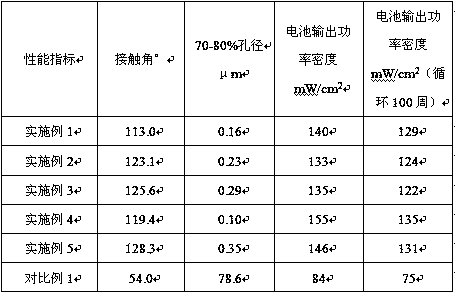
Examples
Embodiment 1
[0031] (1) Uniformly disperse polystyrene monodisperse colloidal microspheres with a diameter of 1 μm in absolute ethanol, and obtain a polystyrene monodisperse colloidal microsphere dispersion by ultrasonic oscillation;
[0032] (2) Place the multi-layer glass fiber porous membrane with a thickness of 0.3 mm in the polystyrene monodisperse colloidal microsphere dispersion, and heat it in a water bath under a low pressure of 360 Pa at a heating temperature of 72 ° C. Ultrasonic vibration, so that the polystyrene monodisperse colloidal microspheres are incorporated into the interlayer of the polymer porous membrane, so that the interlayer distance is enlarged to 3 μm, and a composite layered material is obtained;
[0033] (3) Add excess potassium chloroplatinate, polyvinylpyrrolidone, and potassium bromide in a molar ratio of 1:10:13 to the composite layered material, add water and continue ultrasonic oscillation, and heat to 100°C. The temperature is controlled at 13°C / min. Af...
Embodiment 2
[0037] (1) Uniformly disperse polystyrene monodisperse colloidal microspheres with a diameter of 2 μm in absolute ethanol, and obtain a polystyrene monodisperse colloidal microsphere dispersion by ultrasonic oscillation;
[0038] (2) Place the multi-layer glass fiber porous membrane with a thickness of 0.3 mm in the polystyrene monodisperse colloidal microsphere dispersion, and heat it in a water bath under a low pressure of 360 Pa at a heating temperature of 72 ° C. Ultrasonic vibration, so that the polystyrene monodisperse colloidal microspheres are incorporated into the interlayer of the polymer porous membrane, so that the interlayer distance is enlarged to 3 μm, and a composite layered material is obtained;
[0039] (3) Add excess potassium chloroplatinate, polyvinylpyrrolidone, and potassium bromide in a molar ratio of 1:10:18 to the composite layered material, add water and continue ultrasonic oscillation, and heat to 80°C. Controlled at 13°C / min, after 5 hours of react...
Embodiment 3
[0043] (1) Uniformly disperse polystyrene monodisperse colloidal microspheres with a diameter of 1.5 μm in absolute ethanol, and obtain a polystyrene monodisperse colloidal microsphere dispersion by ultrasonic oscillation;
[0044] (2) Place the multi-layer glass fiber porous membrane with a thickness of 0.3 mm in the polystyrene monodisperse colloidal microsphere dispersion, and heat it in a water bath under a low pressure of 360 Pa at a heating temperature of 72 ° C. Ultrasonic vibration, so that the polystyrene monodisperse colloidal microspheres are incorporated into the interlayer of the polymer porous membrane, so that the interlayer distance is enlarged to 3 μm, and a composite layered material is obtained;
[0045] (3) Add an excess of potassium chloroplatinate, polyvinylpyrrolidone and potassium bromide in a molar ratio of 1:10:12 to the composite layered material, add water and continue ultrasonic oscillation, heat to 90°C, the heating rate Controlled at 13°C / min, af...
PUM
| Property | Measurement | Unit |
|---|---|---|
| thickness | aaaaa | aaaaa |
| thickness | aaaaa | aaaaa |
| thickness | aaaaa | aaaaa |
Abstract
Description
Claims
Application Information
 Login to View More